
Story Mainnet Launch Approaching: Which Tokens Are Worth HODLing?


Original Article Title: Tell Your Stories Through Story
Original Article Author: Defi0xJeff, Founder of Steak Studio
Original Article Translation: Ashley, BlockBeats
Editor's Note: The Story Protocol is reshaping Intellectual Property (IP) management in the Web3 era, empowering creators with greater control through decentralized registration, authorization, and monetization. This article outlines the core concepts of the Story ecosystem and highlights key projects, demonstrating how it makes IP tradable and collaborative.
The following is the original content (slightly reorganized for readability):
In 1935, "Happy Birthday to You" was widely believed to have entered the public domain—until it was proven otherwise. The Hill sisters had actually registered a copyright for it, which was later acquired by Warner/Chappell Music, who then charged hefty royalties for its use in movies, TV, and even public birthday parties. In 2013, documentary filmmaker Jennifer Nelson, while filming "Happy Birthday," formally challenged this copyright.
Fast forward to 2018, Match Group (Tinder's parent company) sued Bumble, accusing it of copying Tinder's iconic swipe matching mechanism. Bumble, founded by former Tinder employees, counter-sued, claiming Match Group was trying to acquire them through intimidation tactics. The core dispute? Who owned the "swipe right" feature.
By 2021, MSCHF released 666 custom-pairs of Nike Air Max 97, named "Satan Shoes," featuring satanic symbols, human blood in the soles, and a tie-in with Lil Nas X's "Montero" music video. Nike promptly sued, even though MSCHF was independently customized, the shoe's design was still based on Nike's registered trademark, Air Max.
Regardless of how these cases concluded, imagine if all these IPs were registered on @StoryProtocol, how would the situation be different? Story can ensure fair ownership, simplify authorization processes, and create a more collaborative ecosystem.
More importantly, it can transform these IPs into tradable assets, allowing creators to seamlessly monetize their work while respecting the original intent.
What is Story?
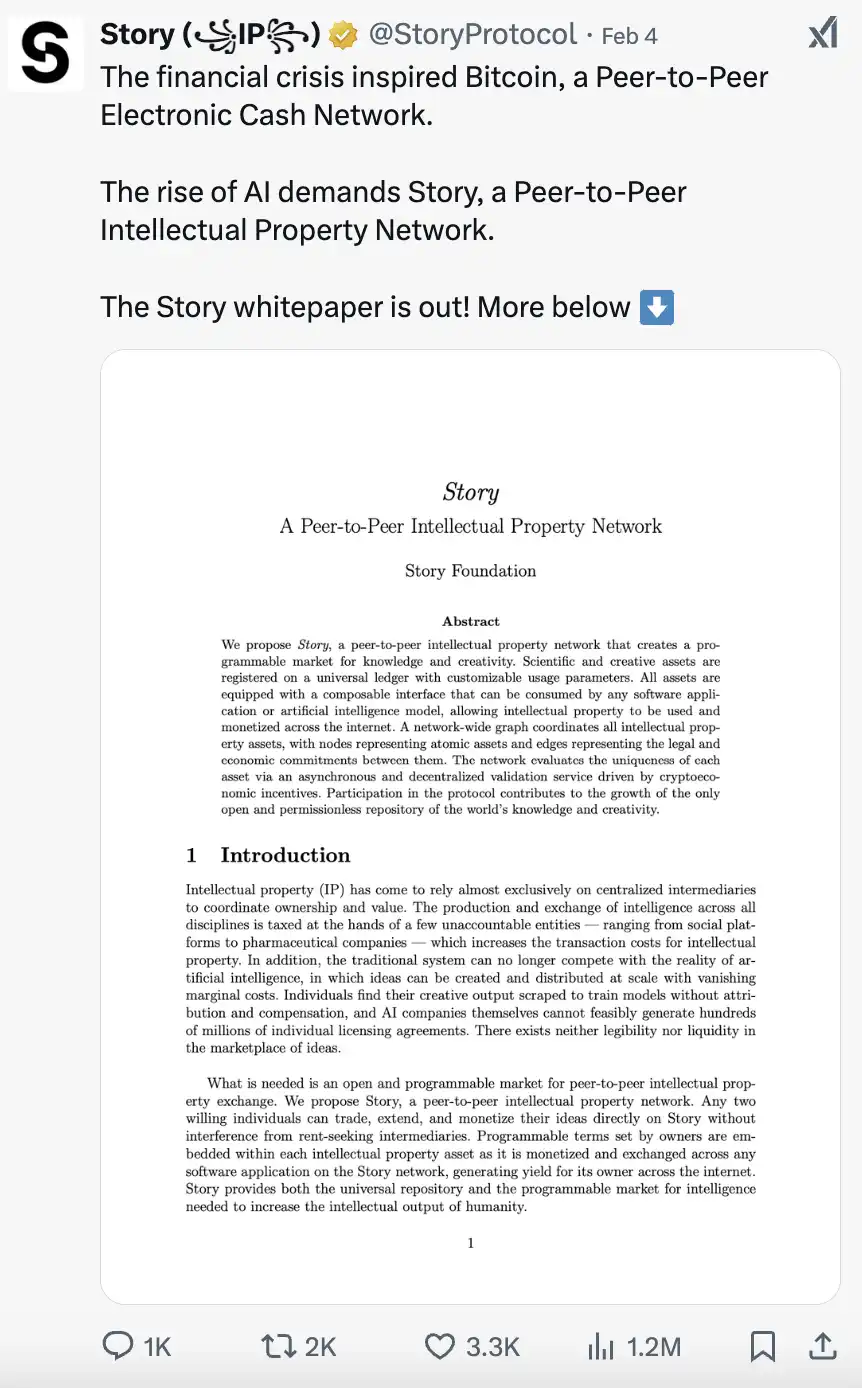
To gain a deep understanding of all the concepts, we recommend reading the whitepaper. But in short, Story provides:
Programmable IP
The Story Protocol allows creators to register their intellectual property on the blockchain, making it "programmable." This means that IP rights, licensing terms, and monetization rules can be encoded into smart contracts, enabling automated licensing and royalty distribution.
Example: As a creator, you can set specific conditions, such as allowing the community to issue meme coins based on that IP, but [x]% of the token supply must be allocated to the original creator. These conditions will be automatically enforced by smart contracts, ensuring fair distribution and compliance without intermediaries.
Tokenization of IP Assets
Story enhances the liquidity of intellectual property by putting it on-chain and tokenizing it. Story ensures that any IP asset can always be licensed, traded, and monetized while maintaining legal protection and ownership. This approach can securitize the value of IP, unlocking new opportunities for IP holders, investors, and global fans.
Story also incorporates a PT/YT mechanism similar to @pendle_fi, separating IP ownership (NFT representation) from cash flow/royalty income streams. This separation provides greater flexibility in managing and monetizing IP assets. Interestingly, there are projects in the market similar to Pendle that tokenize royalty income rights, allowing investors to bet on future royalty income.
Before introducing the core protocol, it is important to note that Story's ecosystem is becoming one of the most attractive tracks of this cycle. With a diverse range of use cases and strategic partnerships, Story L1 may host a set of heavyweight intellectual properties, including chart-topping songs by global top artists, a massive IP universe co-created by the community (perhaps challenging "Star Wars"), AI-generated IP ecosystems, etc.
Popular Story Ecosystem Projects
Aria
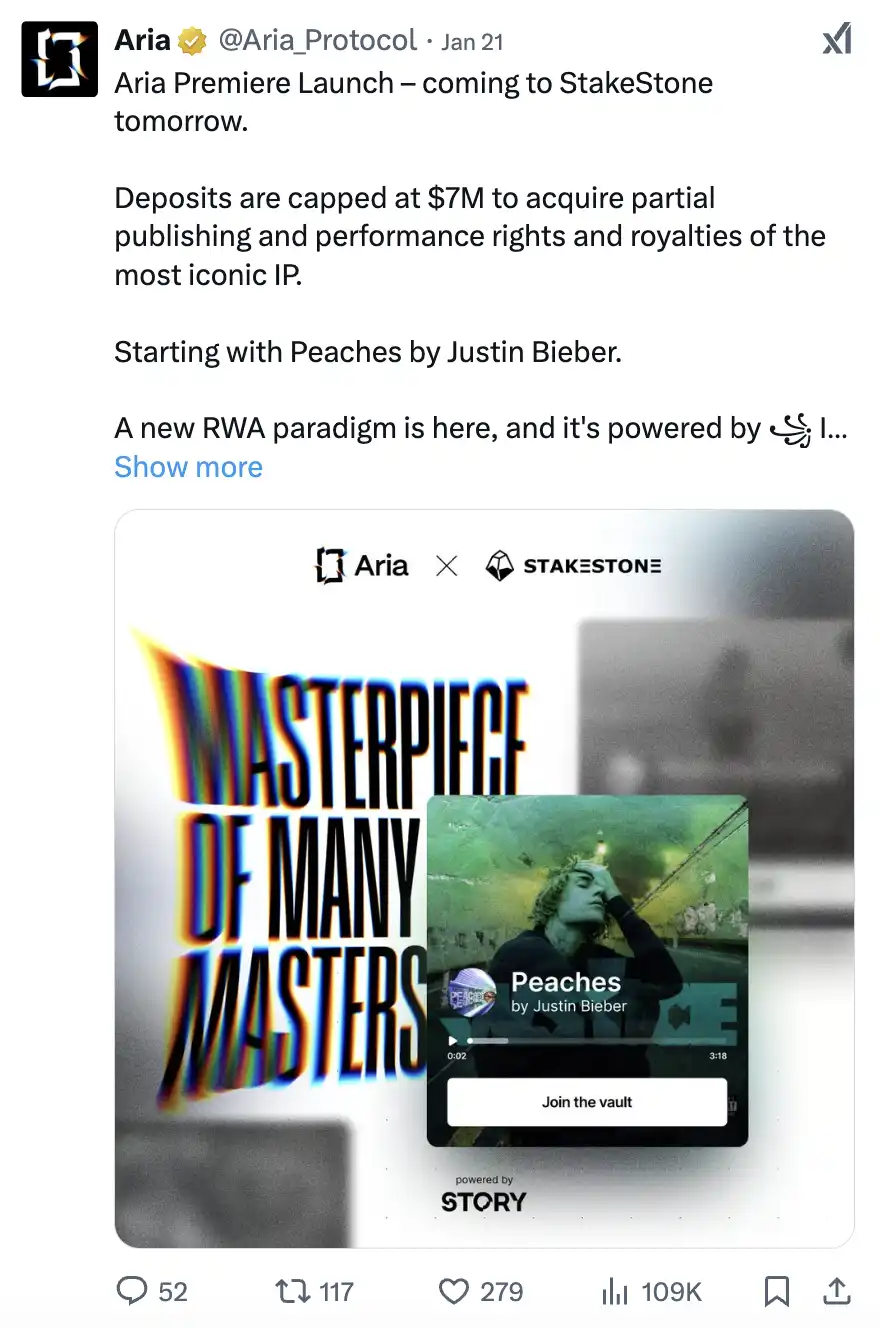
IP Tokenization + RWAs (Real World Assets) = Super Combo
Aria is putting A-list IPs such as Justin Bieber's "Peaches" on-chain, allowing anyone to invest in or build on their favorite songs, books, movies, artworks, patents, brands, AI training data—virtually any asset.
Currently, Aria has tokenized two IPs, including Miley Cyrus & Dua Lipa's "Prisoner".
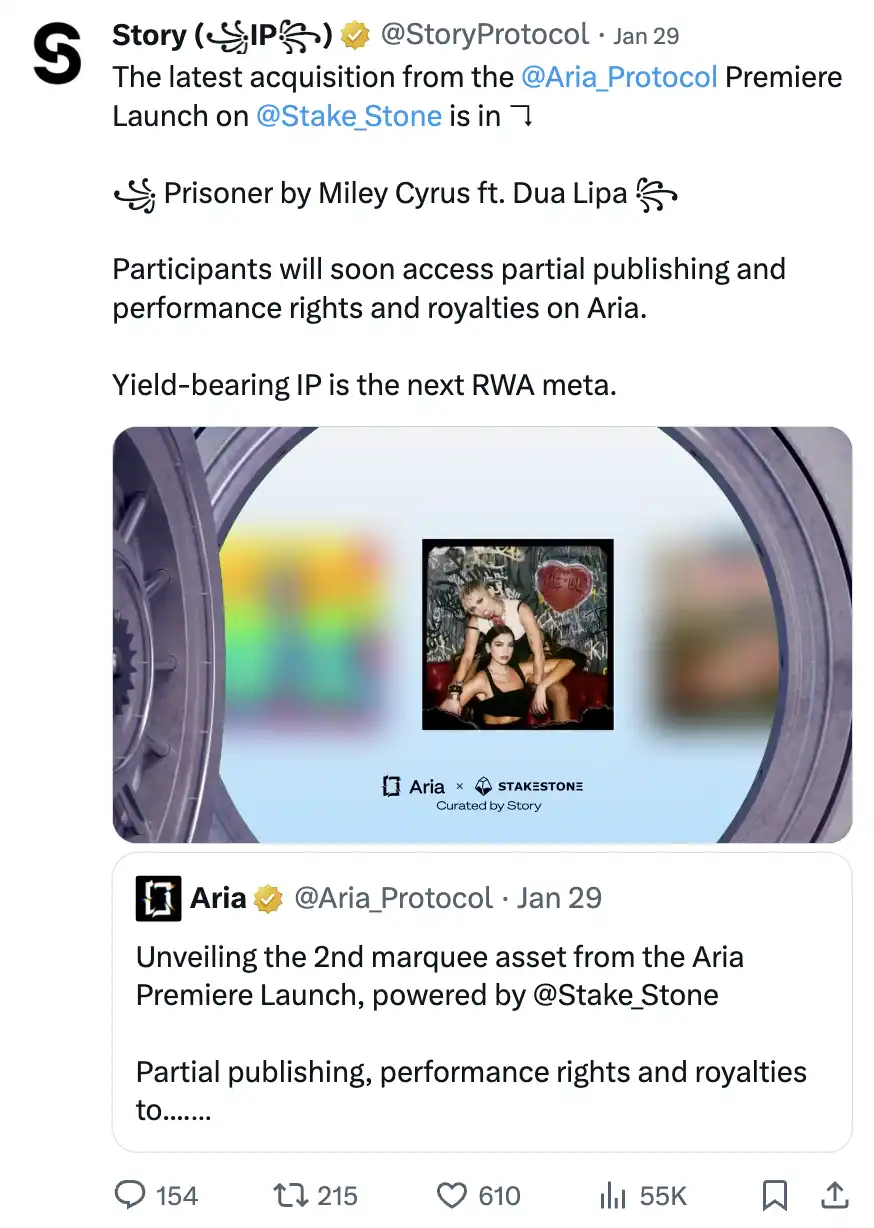
These IPs are part of Aria's collaboration with @Stake_Stone in the Aria Premiere Launch, which raised $7 million in 9 minutes. The funds were used to acquire over 50 partial publishing and performance rights, generating revenue through Web2 royalties, Story, Aria, and StakeStone.
Market rumors suggest that a top-tier Korean idol brand (starting with B) may be the next acquisition target.
IPdotWorld
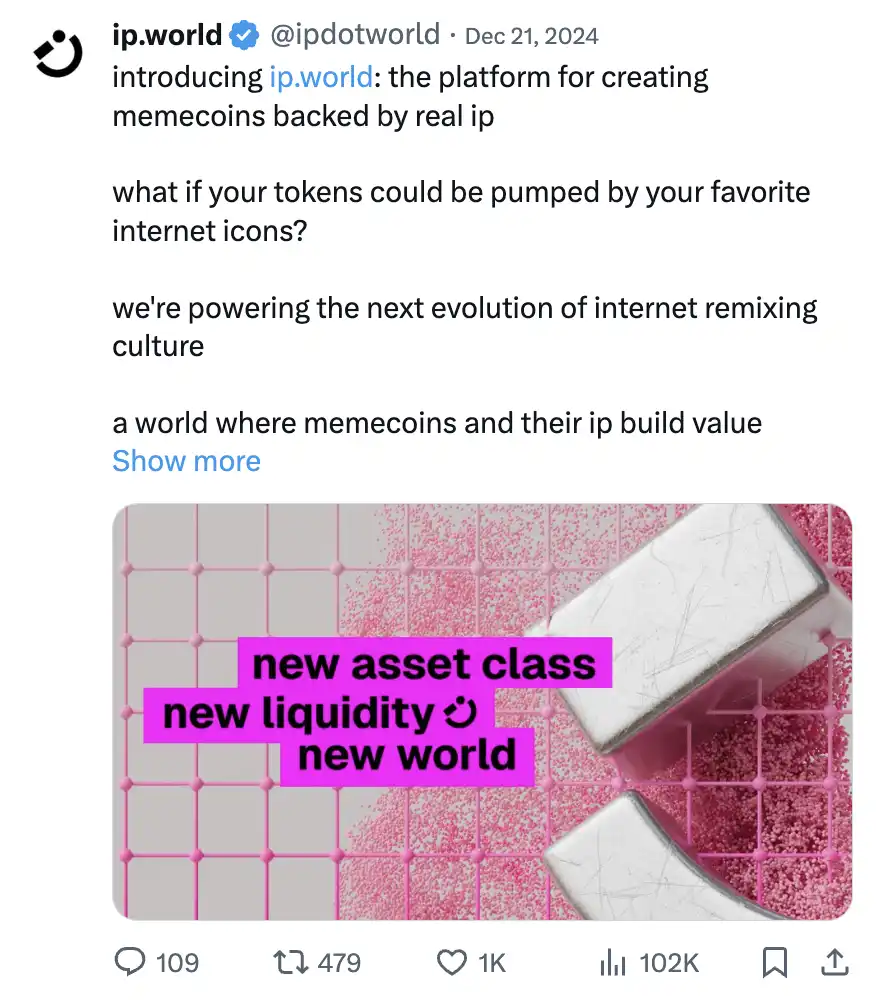
Remember Chill Guy and the $CHILLGUY meme coin he was anonymously airdropped on in CT? The original creator, "Philip Banks," tried to enforce his rights but ultimately failed.
That's where @ipdotworld comes in—it provides a platform to bind meme coins with real intellectual property. When meme coins are minted, a certain percentage of the supply is reserved for validated IP holders, ensuring creators receive their due.
Verio
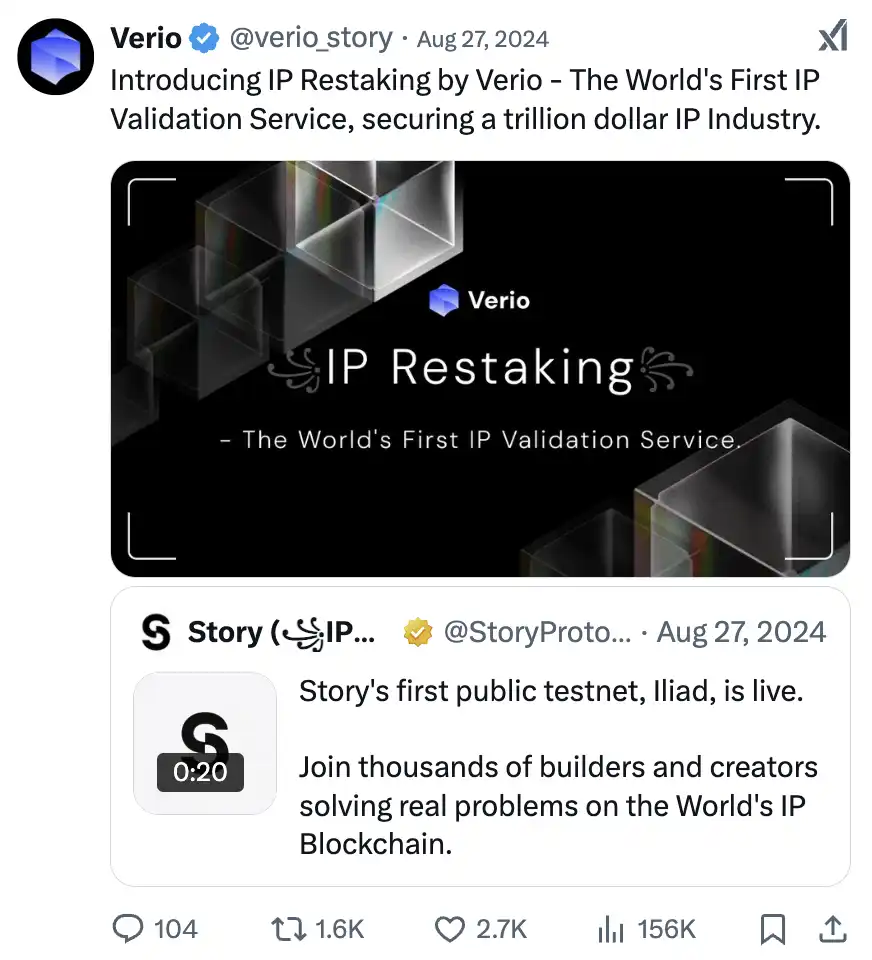
@verio_story is the $IP staking layer/IP verification service in the Story ecosystem.
By staking $IP, users can vouch for the authenticity of assets, helping filter out fraudulent IP claims. Similar to Ethereum's restaking mechanism, $IP staking leverages a cryptoeconomic trust model to validate intellectual property.
$vIP (LST Version) is similar to stETH and can be used in the Story ecosystem's DeFi system.
Jutsu World
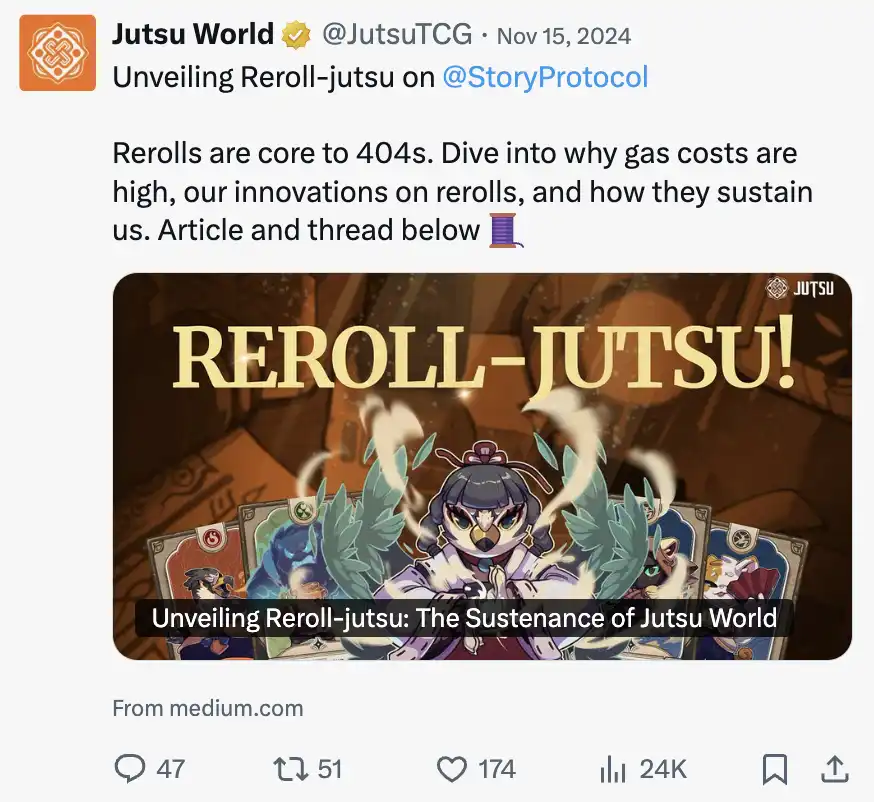
@JutsuTCG is an on-chain card game in the Story ecosystem, utilizing an enhanced ERC404, providing a dynamic restaking mechanism to enhance the gaming experience.
Projects Soon to Release Tokens/NFTs on Story Mainnet
Benjamin / Unleashed
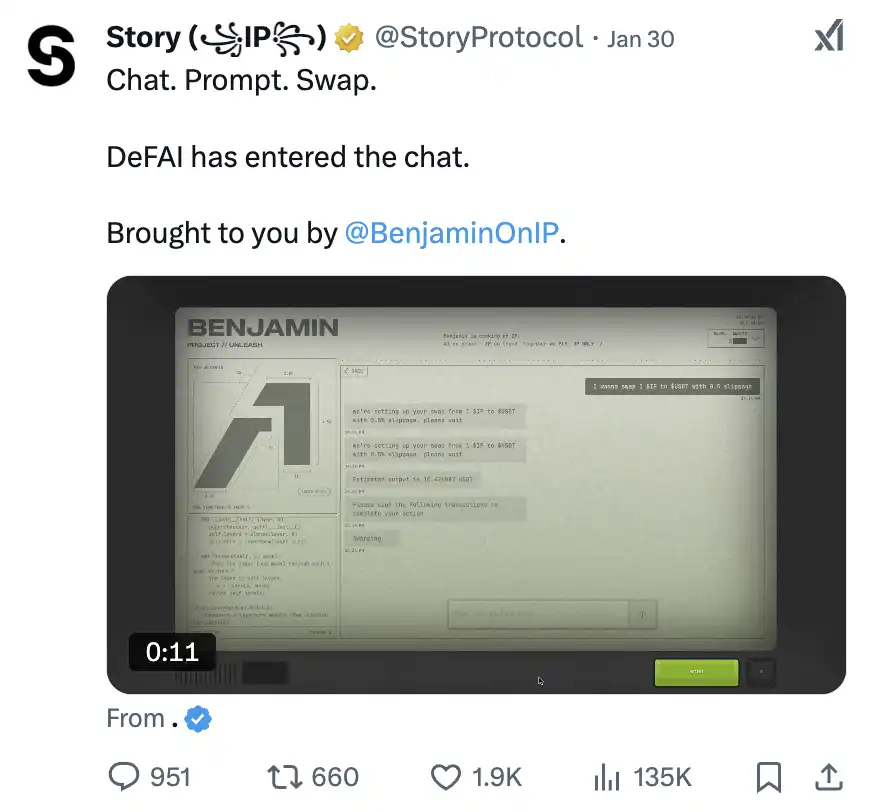
@BenjaminOnIp is the first DeFAI agent in the Story ecosystem, aiming to be the gateway to DeFi in the Story ecosystem.
Managed by @UnleashProtocol, the protocol is a leading money market and IP launchpad in the Story ecosystem.
Unleash Protocol plans to evolve the AI agent into personalized IP characters, not just mascots or memes, possibly interacting based on prototypes such as Thomas Shelby or Steve Jobs.
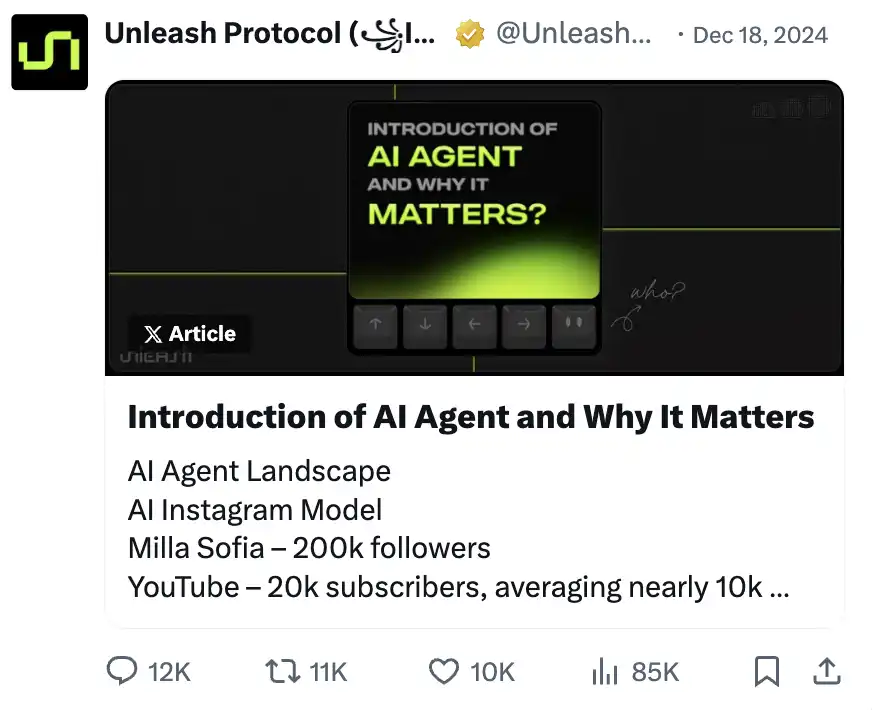
Benjamin is set to have a token launch on @FjordFoundry, expected to go live within 24 hours.
What the Freg
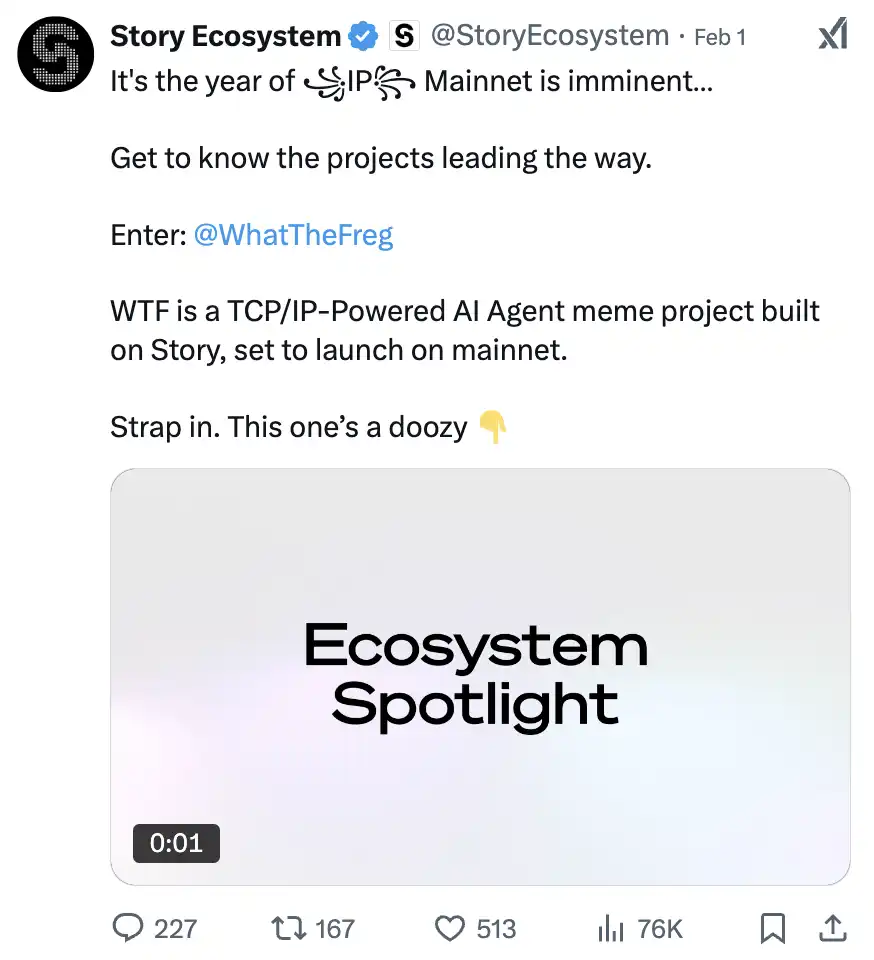
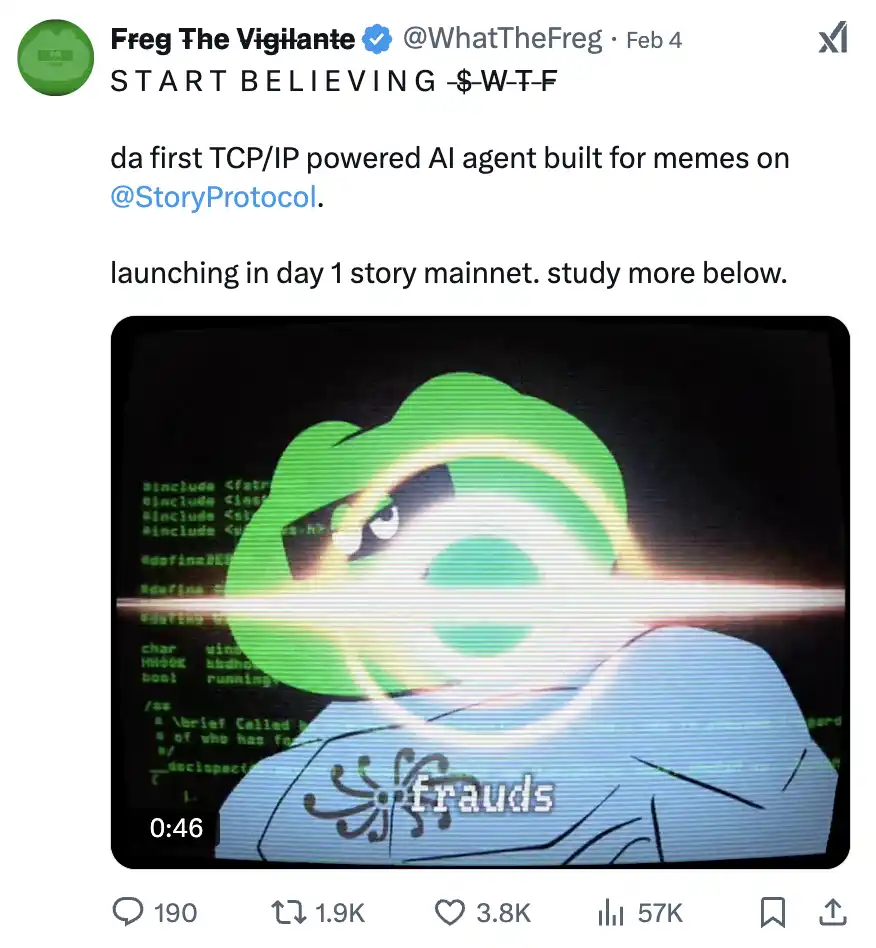
@WhatTheFreg is the first AI agent meme coin in the Story ecosystem, leveraging Story's TCP/IP standard (Story ecosystem allows for the trading of IP between AI agents protocol).
It is the arch-nemesis of Pepe, aiming to challenge counterfeit meme culture in Web3.
SoloAI
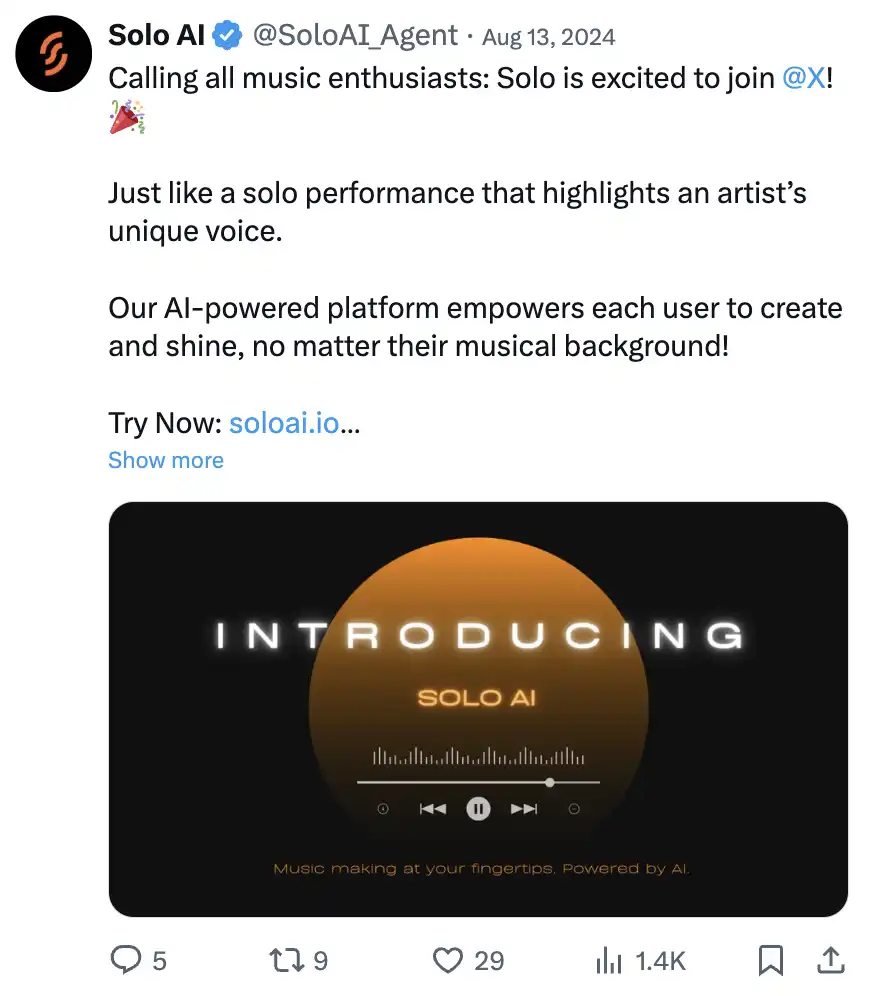
@SoloAI_Agent, supported by @sequoia, is an AI-driven music creation platform that enables everyone to easily create music without the need for a professional background.
Mimboku

@mimboku_story is a top-tier NFT project in the Story ecosystem (similar to Bit Bears on @berachain).
This will be the first OG-level collectibles series within the Story ecosystem, with the "possibility" of receiving airdrops and incentives from other projects.
The minting date is yet to be determined but is expected shortly after the Story mainnet launch.
If you actively participate in Discord discussions, or create high-quality content/memes/artwork, you still have a chance to get on the whitelist (WL).
Summary
The Story ecosystem is becoming one of the most exciting innovations in Web3. Whether it's music, memes, AI, or trading cards, Story is building a programmable, liquidity-rich IP economy that empowers creators to control their future.
The Story mainnet is about to launch, so stay tuned!
You may also like

Japan’s Three Megabanks Plan Joint Stablecoin Issuance in Fiscal 2026
MUFG, SMBC, and Mizuho reportedly plan to jointly issue fiat-pegged stablecoins in fiscal 2026, signaling Japan’s growing push into bank-led digital payment infrastructure.

Humanity Discloses H Token Dual-Chain Attack Details, With Losses on Ethereum and BSC Exceeding $36 Million
Humanity said the H token attack across Ethereum and BSC caused more than $36 million in losses after leaked ProxyAdmin keys enabled malicious contract upgrades and token minting.

White House Discusses CLARITY Act With Law Enforcement Ahead of Senate Vote
The White House discussed the CLARITY Act with law enforcement ahead of a Senate vote, focusing on illicit finance risks and developer protections.

$75 billion in foreign capital has fled, and South Korean retail investors have absorbed it all using leverage

Bitcoin Trading Guide 2026: Strategies for Experienced Traders

What Is XAUT and PAXG? Why Tokenized Gold Is Booming in 2026

Cryptocurrency CEXs are flocking to sell US stocks, and traditional brokerages are facing an "uninvited guest."

Will the SpaceX IPO Hurt Bitcoin? Here's What Traders Are Watching
Foreign selling in the South Korean stock market accelerates, with cumulative net sales reportedly reaching $75 billion this year
On June 9, The Kobeissi Letter, citing Goldman Sachs data, reported that global investors are selling South Korean stocks at an unusually rapid pace. In the latest trading session, foreign investors sold about $801 million worth of Kospi constituent stocks again; total foreign outflows last week reached about $10 billion, and the market has been in net foreign selling on nearly every trading day over the past month. According to the data cited in the report, foreign investors have sold about $75 billion worth of South Korean stocks so far this year. Meanwhile, South Korean retail and institutional investors together recorded roughly $69 billion in net buying over the same period, suggesting that the market’s main buying support has come from domestic capital rather than returning overseas funds. The information currently disclosed still mainly comes from The Kobeissi Letter’s retelling and Goldman Sachs data summaries, while public details on the statistical period and the specific definition of “selling” remain relatively limited.

Fortune Warns of Strategy’s Financing Structure Risks as Bitcoin Premium Narrows
Fortune warned that Strategy’s Bitcoin treasury model faces growing financing risks as MSTR’s net asset premium narrows and preferred stock dividend pressure increases.

Ferrari Challenge Le Mans: Carl Moon to Dominate in WEEX Livery

Sahara AI Responds to SAHARA’s Sharp Drop: No Contract or Product Security Issues Found, Internal Investigation Underway
Sahara AI responded to SAHARA’s 60% price drop, saying no token contract or product security issues have been found and an internal investigation is underway.

WEEX Deposit/Withdrawal Dynamic Island: Your Asset Status, Always in Sight
Scaling Crypto Derivatives: The Digital Asset Infrastructure Behind High-Volume Trading
In the fast-moving digital asset ecosystem, derivatives platforms face an extreme architectural test. High-leverage futures markets demand more than just standard security—they require absolute operational precision, zero-latency matching engines, and ironclad structural scalability, all while navigating intense market volatility.
As global platforms scale to meet these demands, the industry is shifting away from rigid, monolithic setups toward a more agile, "decoupled" infrastructure philosophy.
The Blueprint for High-Volume Copy TradingFor elite global exchanges like WEEX (founded in 2018), this architectural choice becomes critical when scaling high-volume retail features like social copy trading. When thousands of users automatically mirror the real-time strategies of elite traders simultaneously, it triggers sudden, monumental spikes in concurrent transactional volume.
To prevent execution latency or settlement bottlenecks during these peak volatility events, a platform's primary engine must remain entirely dedicated to risk management, copy-trade synchronization, and order matching.
The Architectural Rule: New-generation platforms must separate front-end user execution engines from heavy backend infrastructural overhead to eliminate operational friction.
By separating these layers, platforms can maintain complete sovereignty over their trading environments and user experiences while strategically aligning with institutional-grade infrastructure ecosystems. This strategic framework allows modern exchanges to leverage advanced Digital Asset Custody infrastructure such as Cobo’s behind the scenes, ensuring that backend wallet management scales elastically alongside trading spikes.
Capitalizing on Market Momentum and 400× LeverageIn a derivatives arena where platforms offer up to 400× leverage on perpetual contracts, capital efficiency and market agility are core business metrics. To capture market momentum, an exchange needs the ability to rapidly expand its asset offerings, supporting everything from legacy crypto assets to sudden, trending altcoins across a massive library of trading pairs.
Adopting a flexible, scalable Wallet-as-a-Service (WaaS) solution such as Cobo’s could completely rewrite the development timeline for high-growth exchanges. Instead of spending months of engineering capital building out custom backend wallet architectures for every new blockchain network, platforms can deploy localized infrastructure in days.
This agility allows platforms to instantly scale their listings to over a thousand trading pairs without compromising security or delaying time-to-market. It mirrors the exact operational advantages seen during high-velocity market events, similar to how advanced wallet infrastructure empowers platforms during sudden asset surges; allowing exchanges to pass that speed and liquidity directly to their global user base.
A Mature Foundation for GrowthThe synergy between trusted infrastructure ecosystems and global trading platforms represents the natural evolution of a maturing crypto market. As WEEX continues to scale its global spot and derivatives offerings for over 6 million users, adopting robust backend paradigms proves that platforms no longer have to compromise between cutting-edge trading velocity and uncompromised structural security.

Morning Report | BitMine increased its holdings by 126,971 ETH last week; trader Eugene announced his exit from the crypto market

Wang Chuan: How can one not feel anxious after the neighbor Old Wang made thirty times profit by investing in storage stocks? (Seven) - A quarter-century cycle

Get Paid to Onboard? Try WEEX’s New Homepage with Rewards for Registration, Deposit & Trade
WEEX Custom Layout: Build Your Perfect Trading Workspace in Seconds
Japan’s Three Megabanks Plan Joint Stablecoin Issuance in Fiscal 2026
MUFG, SMBC, and Mizuho reportedly plan to jointly issue fiat-pegged stablecoins in fiscal 2026, signaling Japan’s growing push into bank-led digital payment infrastructure.
Humanity Discloses H Token Dual-Chain Attack Details, With Losses on Ethereum and BSC Exceeding $36 Million
Humanity said the H token attack across Ethereum and BSC caused more than $36 million in losses after leaked ProxyAdmin keys enabled malicious contract upgrades and token minting.
White House Discusses CLARITY Act With Law Enforcement Ahead of Senate Vote
The White House discussed the CLARITY Act with law enforcement ahead of a Senate vote, focusing on illicit finance risks and developer protections.
$75 billion in foreign capital has fled, and South Korean retail investors have absorbed it all using leverage
Bitcoin Trading Guide 2026: Strategies for Experienced Traders
What Is XAUT and PAXG? Why Tokenized Gold Is Booming in 2026


