
Sam Altman's Latest Article: Fully Committed to AI Agent, Believing It Will Reshape the World Economy


Original Article Title: Three Observations
Original Article Author: Sam Altman
Original Article Compilation, Editing: AIGC Open Community
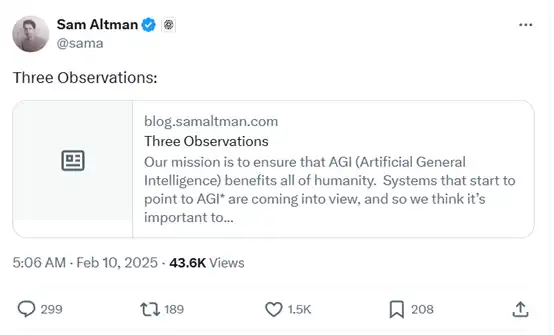
At 5 am this morning, Sam Altman, Co-Founder and CEO of OpenAI, published a deep article titled "Three Observations" on his personal blog.
The article mainly puts forward 3 observations about the AI world: the intelligence level of an AI model is roughly equal to the logarithm of the resources used to train and run it;
The cost of using AI at a specific level roughly decreases by a factor of 10 every 12 months, and lower prices lead to more usage; the societal and economic value created by linearly increasing intelligence is super-exponentially growing.
The article also emphasizes that OpenAI is fully deploying AI Agents, these thousands of intelligent entities will eventually be widely used, becoming virtual colleagues in various business scenarios. The performance of junior Agents may be somewhat lacking, but they will still permeate various fields reshaping the world economy.
The following is the original content:
Our mission is to ensure that General AI (AGI) can benefit all of humanity.
The beginnings of systems pointing towards AGI are already visible; therefore, we feel it is necessary to understand the moment we are in. AGI is a somewhat ambiguous term, but generally, we define it as a system capable of solving increasingly complex problems at a human level across numerous domains.
Humans are tool builders, inherently driven by exploration and creation, making the world progressively better. Each generation progresses on the discoveries of its predecessors, creating more powerful tools—electricity, transistors, computers, the internet, and the upcoming AGI.
In a sense, AGI is just another tool in the progression ladder collectively built by humans. But in another sense, the emergence of AGI marks a whole new beginning, making it hard not to feel like "this time it really is different." The economic growth in front of us looks astounding, and we can even envision a world that can cure all diseases, give people more time with family, and unleash creativity to its fullest.
Perhaps within a decade, everyone on Earth will have capabilities exceeding those of today's most influential people.
We continue to witness rapid progress in AI development. Here are three observations about the AI economy:
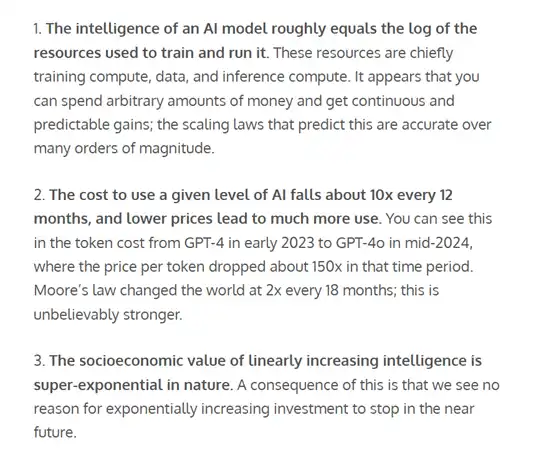
1. The intelligence level of an AI model is roughly equal to the logarithm of the resources used to train and run it. These resources mainly include training computational power, data, and inference computational power. It seems that as long as you are willing to invest any amount of funds, you can achieve continuous and predictable returns. The law of the scale of these returns is accurate across multiple orders of magnitude.
2. The cost of using AI at a certain level decreases by approximately 10 times every 12 months, and lower prices lead to more usage. You can see this in the token cost change from early 2023's GPT-4 to mid-2024's GPT-4o, where the price per token decreased by about 150 times over this year and a half.
Moore's Law doubled performance every 18 months, changing the world; however, the rate at which AI costs are dropping is even more incredible.
3. The socioeconomic value created by linear growth in intelligence is super-exponentially increasing. This result suggests that there is no immediate reason to expect that investment in exponential growth will stop in the near term.
If these three observations continue to hold true, their impact on society will be enormous.
We are now introducing AI Agents that will eventually be widely used like virtual colleagues.
Let's take the example of a software engineering Agent, which we consider particularly important. Imagine that this Agent can eventually perform tasks most senior company software engineers with several years of experience can accomplish (tasks that can take up to several days). It may not come up with the greatest new ideas, requires significant human supervision and guidance, and excels in some aspects while may perform poorly in others.
But still, it can be envisioned as a real yet relatively junior virtual colleague. Now imagine having 1000 of such Agents. Or 1 million. Then imagine having such Agents in every knowledge work domain.
In a sense, AI may be economically similar to the transistor—a significant scientific discovery that can be massively scaled and permeate into every corner of the economy. We may not focus too much on transistors or transistor companies, but we will expect our computers, TVs, cars, toys, etc., to perform miraculous feats.
The world will not change overnight, it never has. In the short term, life will still be largely the same, with people in 2025 spending most of their time much like they did in 2024. We will still fall in love, start families, argue online, go hiking, etc.
But the future will come at us in an undeniable way, with massive long-term societal and economic changes. We will find new things to do, new ways to help each other, and new forms of competition, but these may be very different from today's jobs.
Autonomy, volition, and determination may become extremely important. Making the right decisions about what to do and how to navigate a changing world will be of immense value; resilience and adaptability will be skills worth cultivating. AGI will be the most potent lever of human intent, enabling individuals to have a greater impact than ever before, rather than a lesser one.
We expect the impact of AGI to be uneven. While some industries might see little change, scientific progress may accelerate beyond today, with this AGI impact outweighing everything else.
The prices of many goods may ultimately plummet (currently, cognitive and energy costs limit many things), while luxury goods and some inherently scarce resources (like land) may see more dramatic price increases.
From a technological standpoint, the path forward seems fairly clear. However, public policy and collective opinion are critical in how AGI is integrated into society. One reason we're launching products early is to give society and tech time to co-evolve.
AI will permeate every sector of the economy and society, with everything expected to become smarter. Many anticipate the need to afford people more control over tech than ever before, including more open sourcing, and accepting the need to balance security with personal empowerment.
While we never want to act recklessly, and there may be some unwelcome significant decisions and constraints related to AGI safety, directionally, as we get closer to AGI, we believe a trend toward more individual empowerment is critical. Another possible road we can see is AI being used by authoritarian governments to control their populations through extensive surveillance and autonomy deprivation.
Ensuring broad distribution of the benefits of AGI is crucial. Historical impacts of technological progress suggest that most of the metrics we care about (health outcomes, economic prosperity, etc.) tend to improve on average and in the long run, but increasing equality does not seem to be technology-driven, and achieving this properly may require new ideas.
In particular, the power balance between capital and labor may be disrupted, which may require early intervention. We are open to some seemingly strange ideas, such as allocating a certain "computational budget" to every person on Earth so they can harness significant AI capabilities. However, we can also see many ways to achieve the desired effects through continuously lowering the cost of intelligence.
By 2035, everyone should be able to access intelligence capabilities equivalent to the total intelligence of all people in 2025; everyone should be able to access unlimited wisdom and leverage it in any way they can imagine. Today, many talented individuals around the world do not have sufficient resources to fully express themselves. If we can change this, the world will create tremendous value, bringing enormous benefits to all of us.
You may also like

Japan’s Three Megabanks Plan Joint Stablecoin Issuance in Fiscal 2026
MUFG, SMBC, and Mizuho reportedly plan to jointly issue fiat-pegged stablecoins in fiscal 2026, signaling Japan’s growing push into bank-led digital payment infrastructure.

Humanity Discloses H Token Dual-Chain Attack Details, With Losses on Ethereum and BSC Exceeding $36 Million
Humanity said the H token attack across Ethereum and BSC caused more than $36 million in losses after leaked ProxyAdmin keys enabled malicious contract upgrades and token minting.

White House Discusses CLARITY Act With Law Enforcement Ahead of Senate Vote
The White House discussed the CLARITY Act with law enforcement ahead of a Senate vote, focusing on illicit finance risks and developer protections.

$75 billion in foreign capital has fled, and South Korean retail investors have absorbed it all using leverage

Bitcoin Trading Guide 2026: Strategies for Experienced Traders

What Is XAUT and PAXG? Why Tokenized Gold Is Booming in 2026

Cryptocurrency CEXs are flocking to sell US stocks, and traditional brokerages are facing an "uninvited guest."

Will the SpaceX IPO Hurt Bitcoin? Here's What Traders Are Watching
Foreign selling in the South Korean stock market accelerates, with cumulative net sales reportedly reaching $75 billion this year
On June 9, The Kobeissi Letter, citing Goldman Sachs data, reported that global investors are selling South Korean stocks at an unusually rapid pace. In the latest trading session, foreign investors sold about $801 million worth of Kospi constituent stocks again; total foreign outflows last week reached about $10 billion, and the market has been in net foreign selling on nearly every trading day over the past month. According to the data cited in the report, foreign investors have sold about $75 billion worth of South Korean stocks so far this year. Meanwhile, South Korean retail and institutional investors together recorded roughly $69 billion in net buying over the same period, suggesting that the market’s main buying support has come from domestic capital rather than returning overseas funds. The information currently disclosed still mainly comes from The Kobeissi Letter’s retelling and Goldman Sachs data summaries, while public details on the statistical period and the specific definition of “selling” remain relatively limited.

Fortune Warns of Strategy’s Financing Structure Risks as Bitcoin Premium Narrows
Fortune warned that Strategy’s Bitcoin treasury model faces growing financing risks as MSTR’s net asset premium narrows and preferred stock dividend pressure increases.

Ferrari Challenge Le Mans: Carl Moon to Dominate in WEEX Livery

Sahara AI Responds to SAHARA’s Sharp Drop: No Contract or Product Security Issues Found, Internal Investigation Underway
Sahara AI responded to SAHARA’s 60% price drop, saying no token contract or product security issues have been found and an internal investigation is underway.

WEEX Deposit/Withdrawal Dynamic Island: Your Asset Status, Always in Sight
Scaling Crypto Derivatives: The Digital Asset Infrastructure Behind High-Volume Trading
In the fast-moving digital asset ecosystem, derivatives platforms face an extreme architectural test. High-leverage futures markets demand more than just standard security—they require absolute operational precision, zero-latency matching engines, and ironclad structural scalability, all while navigating intense market volatility.
As global platforms scale to meet these demands, the industry is shifting away from rigid, monolithic setups toward a more agile, "decoupled" infrastructure philosophy.
The Blueprint for High-Volume Copy TradingFor elite global exchanges like WEEX (founded in 2018), this architectural choice becomes critical when scaling high-volume retail features like social copy trading. When thousands of users automatically mirror the real-time strategies of elite traders simultaneously, it triggers sudden, monumental spikes in concurrent transactional volume.
To prevent execution latency or settlement bottlenecks during these peak volatility events, a platform's primary engine must remain entirely dedicated to risk management, copy-trade synchronization, and order matching.
The Architectural Rule: New-generation platforms must separate front-end user execution engines from heavy backend infrastructural overhead to eliminate operational friction.
By separating these layers, platforms can maintain complete sovereignty over their trading environments and user experiences while strategically aligning with institutional-grade infrastructure ecosystems. This strategic framework allows modern exchanges to leverage advanced Digital Asset Custody infrastructure such as Cobo’s behind the scenes, ensuring that backend wallet management scales elastically alongside trading spikes.
Capitalizing on Market Momentum and 400× LeverageIn a derivatives arena where platforms offer up to 400× leverage on perpetual contracts, capital efficiency and market agility are core business metrics. To capture market momentum, an exchange needs the ability to rapidly expand its asset offerings, supporting everything from legacy crypto assets to sudden, trending altcoins across a massive library of trading pairs.
Adopting a flexible, scalable Wallet-as-a-Service (WaaS) solution such as Cobo’s could completely rewrite the development timeline for high-growth exchanges. Instead of spending months of engineering capital building out custom backend wallet architectures for every new blockchain network, platforms can deploy localized infrastructure in days.
This agility allows platforms to instantly scale their listings to over a thousand trading pairs without compromising security or delaying time-to-market. It mirrors the exact operational advantages seen during high-velocity market events, similar to how advanced wallet infrastructure empowers platforms during sudden asset surges; allowing exchanges to pass that speed and liquidity directly to their global user base.
A Mature Foundation for GrowthThe synergy between trusted infrastructure ecosystems and global trading platforms represents the natural evolution of a maturing crypto market. As WEEX continues to scale its global spot and derivatives offerings for over 6 million users, adopting robust backend paradigms proves that platforms no longer have to compromise between cutting-edge trading velocity and uncompromised structural security.

Morning Report | BitMine increased its holdings by 126,971 ETH last week; trader Eugene announced his exit from the crypto market

Wang Chuan: How can one not feel anxious after the neighbor Old Wang made thirty times profit by investing in storage stocks? (Seven) - A quarter-century cycle

Get Paid to Onboard? Try WEEX’s New Homepage with Rewards for Registration, Deposit & Trade
WEEX Custom Layout: Build Your Perfect Trading Workspace in Seconds
Japan’s Three Megabanks Plan Joint Stablecoin Issuance in Fiscal 2026
MUFG, SMBC, and Mizuho reportedly plan to jointly issue fiat-pegged stablecoins in fiscal 2026, signaling Japan’s growing push into bank-led digital payment infrastructure.
Humanity Discloses H Token Dual-Chain Attack Details, With Losses on Ethereum and BSC Exceeding $36 Million
Humanity said the H token attack across Ethereum and BSC caused more than $36 million in losses after leaked ProxyAdmin keys enabled malicious contract upgrades and token minting.
White House Discusses CLARITY Act With Law Enforcement Ahead of Senate Vote
The White House discussed the CLARITY Act with law enforcement ahead of a Senate vote, focusing on illicit finance risks and developer protections.
$75 billion in foreign capital has fled, and South Korean retail investors have absorbed it all using leverage
Bitcoin Trading Guide 2026: Strategies for Experienced Traders
What Is XAUT and PAXG? Why Tokenized Gold Is Booming in 2026


