
Jupiter Empire Expansion History: Is Vertical Integration the Endgame of the Cryptocurrency Industry?



Original Article Title: Jupiter Crypto Conglomerate
Original Article Author: Marco Manoppo, Investor at Primitive Ventures
Original Article Translation: Ashley, BlockBeats
Editor's Note: Jupiter announced several major initiatives at the Catstanbul Summit, including acquisitions, AI funding, token buyback and burn, as well as the launch of the fully interoperable chain network Jupnet, showcasing its vertical integration ambitions. This article analyzes its business strategy and discusses how in a permissionless crypto environment, brand, community, and user experience determine value capture, revealing the inevitable trend towards integration in applications.
The following is the original content (slightly reorganized for readability):
Last month, Jupiter made a series of major announcements at its flagship event, Catstanbul. To summarize—there was a wealth of information. There was the Burning Cat, acquisition announcements, and most importantly: Jupiter publicly acknowledged that its ambitions extend beyond the current ecosystem. In today's article, we will dissect Jupiter's latest business strategy and discuss why over a sufficiently long period, every crypto application that controls users will ultimately choose vertical integration to maximize value capture. Let's delve into it.
TL;DR
Acquisitions
Jupiter acquired a majority stake in Moonshot, a popular mobile trading app that generated $35 million in fee revenue following the Trump Meme Coin craze. At the same time, Jupiter also completed a full acquisition of Solana DeFi asset management tool Sonar Watch.
Funding Support
Jupiter is partnering with Shaw from ElizaOS to allocate $10 million in support of AI developers launching through Jupiter Launchpad.
Token Buyback
50% of Jupiter's protocol transaction fees will be used for JUP token buybacks.
Token Burn
3 billion JUP tokens (approximately $3.6 billion) have been burned to reduce supply and decrease the protocol's fully diluted valuation (FDV).
Jupnet
The Jupiter project is set to launch Jupnet, a fully interconnected network designed to integrate the entire crypto ecosystem into a single decentralized ledger, maximizing convenience for users and developers.
Truth be told, this is one of the strongest product roadmaps and new project announcements I've seen in recent quarters. The Jupiter team's execution is top-notch, from their extremely detailed communication (Meow basically posts long threads on Twitter every day) to the high level of transparency they maintain with the community, demonstrating outstanding execution capabilities.
Here's a typical example:
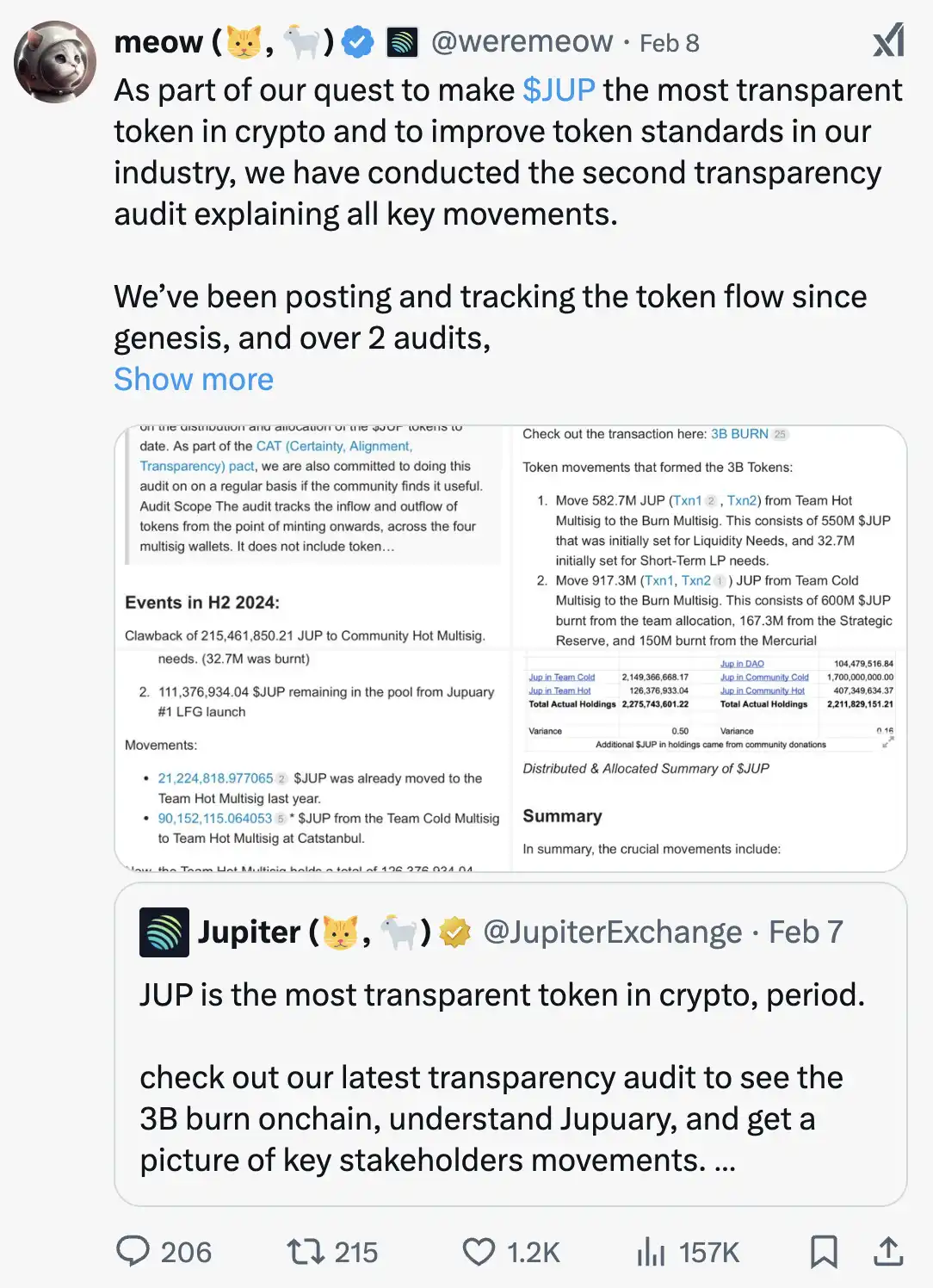
Jupiter recently released a transparency audit report, detailing the team's key fund flows. "We have been publicly tracking token movement since Genesis and have audited all token flows (excluding 1 JUP) twice, consolidating tokens into certified wallets."
Read that last sentence again. For any crypto protocol that has completed its TGE, making the best effort to track ownership of every token is crucial. Similarly, public companies clearly document the ownership structure of their shares. In the crypto space, tracking ownership is relatively more challenging due to the permissionless nature of blockchain, but there are still tools that can help teams achieve a high degree of accuracy in tracking.
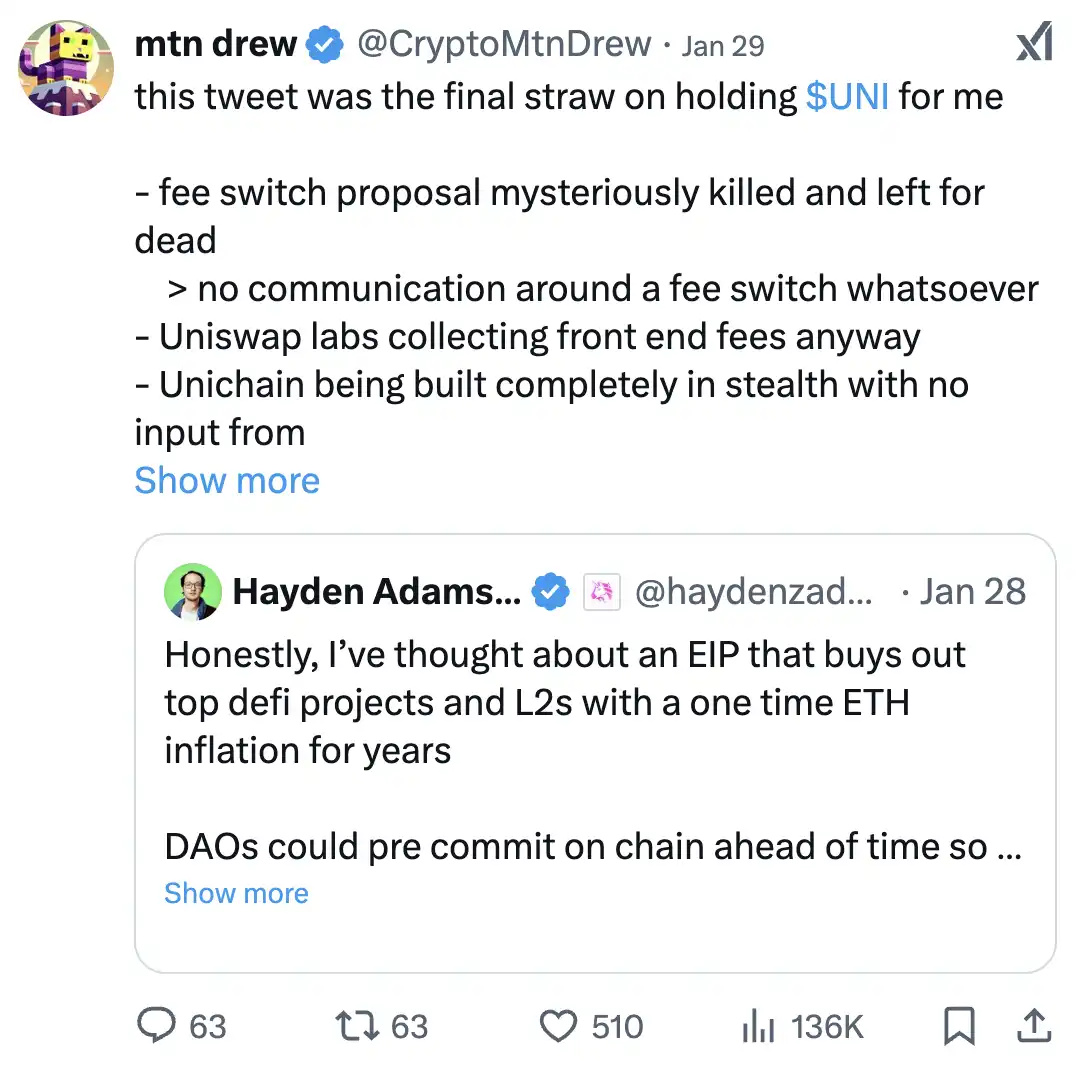
Meanwhile, Uniswap…
Given enough time, every app will integrate vertically
The key point of today's article is this: the business strategy in the crypto world fundamentally differs from the business models in traditional permissioned environments.
Outside the crypto industry, enterprises typically build a "moat" through regulatory barriers, long-term B2B contracts, proprietary innovation, and so on.
However, in the crypto industry, this kind of "moat" largely ceases to exist because the permissionless nature of blockchain allows anyone to build on existing products, and users can almost always opt for alternatives.
Therefore, what truly matters is branding, user experience, and community, as with the industry's maturation, we will see more and more experienced entrepreneurs enter the crypto race, building on existing infrastructure and launching vampire attacks on existing industry giants.
Ironically, this mirrors exactly what Deepseek is currently doing with OpenAI.
Ultimately, in the cryptocurrency space, the "moat" will evolve into the following three points:
· Brand → Users trust you
· Genuine Community → Users want to be part of your organization and enjoy true ownership (via revenue sharing)
· User Experience → Users love your product
Aggregation Strategy in Permissionless Environments Is Wise
Prior to Jupiter's success, many were skeptical of the aggregation model, especially in the EVM ecosystem where the model didn't shine. For example, 1inch failed to surpass Uniswap in market value because most users still preferred using Uniswap directly (too lazy to switch) or opted for other MEV-friendly DEXs like CoW Swap.
However, in the Solana ecosystem, Jupiter managed to convince users that it offered the best trading experience, successfully aggregated traffic, and captured value.
Frankly, I'm not sure when this shift occurred. I remember during the 2020-2021 DeFi Summer, I used both Orca and Raydium while also trying early versions of Jupiter. If I recall correctly, by the end of DeFi Summer, the user experience of Orca and Raydium had become quite poor, reasons being:
· Lack of a unified token standard (e.g., multiple bridged versions of USDC)
· UI lag
This poor user experience could still be seen a year later.
Jupiter used to display the best trade path to prove its exchange rate was optimal. In hindsight, this was a very astute move as there wasn't a clear DEX market winner in the Solana ecosystem at the time. Even though Raydium had the highest market share, its market dominance was nowhere near Uniswap on Ethereum.
Exemplary Business Strategy and Operations
In simple terms, Jupiter excels in its core business—providing Solana users with the best token swap experience. Many protocols in the EVM ecosystem have attempted a similar strategy, but few have succeeded. Additionally, the Jupiter team was initially formed by Racoon Dev led by Meow, which means that during the bear market, they were able to sustain operations with a few engineers in low-cost emerging markets, minimizing fund consumption.
Not all successful startups need the "sexy startup angle"; many successful crypto entrepreneurs initially operated development studios. This "traditional service-oriented business" can teach extremely efficient cost management practices and show founders how to strategically tap into market opportunities.
By 2024, this savvy business operation capability was fully demonstrated in the Jupiter team.
In just 12 months, Jupiter acquired 5 teams:
· Moonshot: Acquired this platform focused on mobile meme trading
· SonarWatch: Acquired on-chain asset management tool
· Ultimate Wallet: Acquired self-custody wallet
· Coinhall: Acquired decentralized exchange terminal
· SolanaFM: Acquired blockchain explorer

Forgive my bluntness, but this is truly a genius-level move. Some of the acquired projects faced fierce competition and market challenges, making them excellent acquisition targets. Moreover, I have no insider information, but I wouldn't be surprised if these acquisitions were mainly done through the JUP token. Considering JUP's current FDV, the Jupiter team undoubtedly expanded its footprint at a low cost and onboarded a group of excellent developers.
Conclusion
This idea is not new. Nascent's Dan Elitzer wrote an article titled "The Inevitability of UNIchain" in 2022, with the core point being: "As applications scale, control over block space becomes increasingly important... The solution is to build a dedicated chain or Rollup managed by validators invested in the application's success."
My view is similar but more straightforward—this is an embodiment of human nature in capitalist business society: optimizing value capture, vertical integration.
The crypto industry is still operated by humans, and we still can't shake off our innate desire to control the value chain. Let's be realistic here.
You may also like

Morning Report | BitMine increased its holdings by 126,971 ETH last week; trader Eugene announced his exit from the crypto market

Wang Chuan: How can one not feel anxious after the neighbor Old Wang made thirty times profit by investing in storage stocks? (Seven) - A quarter-century cycle

Cryptocurrency CEXs are flocking to sell US stocks, and traditional brokerages are facing an "uninvited guest."

$75 billion in foreign capital has fled, and South Korean retail investors have absorbed it all using leverage

Japan’s Three Megabanks Plan Joint Stablecoin Issuance in Fiscal 2026
MUFG, SMBC, and Mizuho reportedly plan to jointly issue fiat-pegged stablecoins in fiscal 2026, signaling Japan’s growing push into bank-led digital payment infrastructure.

Humanity Discloses H Token Dual-Chain Attack Details, With Losses on Ethereum and BSC Exceeding $36 Million
Humanity said the H token attack across Ethereum and BSC caused more than $36 million in losses after leaked ProxyAdmin keys enabled malicious contract upgrades and token minting.
White House Discusses CLARITY Act With Law Enforcement Ahead of Senate Vote
The White House discussed the CLARITY Act with law enforcement ahead of a Senate vote, focusing on illicit finance risks and developer protections.

Bitcoin Trading Guide 2026: Strategies for Experienced Traders

What Is XAUT and PAXG? Why Tokenized Gold Is Booming in 2026

Will the SpaceX IPO Hurt Bitcoin? Here's What Traders Are Watching

Foreign selling in the South Korean stock market accelerates, with cumulative net sales reportedly reaching $75 billion this year
On June 9, The Kobeissi Letter, citing Goldman Sachs data, reported that global investors are selling South Korean stocks at an unusually rapid pace. In the latest trading session, foreign investors sold about $801 million worth of Kospi constituent stocks again; total foreign outflows last week reached about $10 billion, and the market has been in net foreign selling on nearly every trading day over the past month. According to the data cited in the report, foreign investors have sold about $75 billion worth of South Korean stocks so far this year. Meanwhile, South Korean retail and institutional investors together recorded roughly $69 billion in net buying over the same period, suggesting that the market’s main buying support has come from domestic capital rather than returning overseas funds. The information currently disclosed still mainly comes from The Kobeissi Letter’s retelling and Goldman Sachs data summaries, while public details on the statistical period and the specific definition of “selling” remain relatively limited.

Fortune Warns of Strategy’s Financing Structure Risks as Bitcoin Premium Narrows
Fortune warned that Strategy’s Bitcoin treasury model faces growing financing risks as MSTR’s net asset premium narrows and preferred stock dividend pressure increases.

Ferrari Challenge Le Mans: Carl Moon to Dominate in WEEX Livery

Sahara AI Responds to SAHARA’s Sharp Drop: No Contract or Product Security Issues Found, Internal Investigation Underway
Sahara AI responded to SAHARA’s 60% price drop, saying no token contract or product security issues have been found and an internal investigation is underway.

WEEX Deposit/Withdrawal Dynamic Island: Your Asset Status, Always in Sight
Scaling Crypto Derivatives: The Digital Asset Infrastructure Behind High-Volume Trading
In the fast-moving digital asset ecosystem, derivatives platforms face an extreme architectural test. High-leverage futures markets demand more than just standard security—they require absolute operational precision, zero-latency matching engines, and ironclad structural scalability, all while navigating intense market volatility.
As global platforms scale to meet these demands, the industry is shifting away from rigid, monolithic setups toward a more agile, "decoupled" infrastructure philosophy.
The Blueprint for High-Volume Copy TradingFor elite global exchanges like WEEX (founded in 2018), this architectural choice becomes critical when scaling high-volume retail features like social copy trading. When thousands of users automatically mirror the real-time strategies of elite traders simultaneously, it triggers sudden, monumental spikes in concurrent transactional volume.
To prevent execution latency or settlement bottlenecks during these peak volatility events, a platform's primary engine must remain entirely dedicated to risk management, copy-trade synchronization, and order matching.
The Architectural Rule: New-generation platforms must separate front-end user execution engines from heavy backend infrastructural overhead to eliminate operational friction.
By separating these layers, platforms can maintain complete sovereignty over their trading environments and user experiences while strategically aligning with institutional-grade infrastructure ecosystems. This strategic framework allows modern exchanges to leverage advanced Digital Asset Custody infrastructure such as Cobo’s behind the scenes, ensuring that backend wallet management scales elastically alongside trading spikes.
Capitalizing on Market Momentum and 400× LeverageIn a derivatives arena where platforms offer up to 400× leverage on perpetual contracts, capital efficiency and market agility are core business metrics. To capture market momentum, an exchange needs the ability to rapidly expand its asset offerings, supporting everything from legacy crypto assets to sudden, trending altcoins across a massive library of trading pairs.
Adopting a flexible, scalable Wallet-as-a-Service (WaaS) solution such as Cobo’s could completely rewrite the development timeline for high-growth exchanges. Instead of spending months of engineering capital building out custom backend wallet architectures for every new blockchain network, platforms can deploy localized infrastructure in days.
This agility allows platforms to instantly scale their listings to over a thousand trading pairs without compromising security or delaying time-to-market. It mirrors the exact operational advantages seen during high-velocity market events, similar to how advanced wallet infrastructure empowers platforms during sudden asset surges; allowing exchanges to pass that speed and liquidity directly to their global user base.
A Mature Foundation for GrowthThe synergy between trusted infrastructure ecosystems and global trading platforms represents the natural evolution of a maturing crypto market. As WEEX continues to scale its global spot and derivatives offerings for over 6 million users, adopting robust backend paradigms proves that platforms no longer have to compromise between cutting-edge trading velocity and uncompromised structural security.

Get Paid to Onboard? Try WEEX’s New Homepage with Rewards for Registration, Deposit & Trade
WEEX Custom Layout: Build Your Perfect Trading Workspace in Seconds
Morning Report | BitMine increased its holdings by 126,971 ETH last week; trader Eugene announced his exit from the crypto market
Wang Chuan: How can one not feel anxious after the neighbor Old Wang made thirty times profit by investing in storage stocks? (Seven) - A quarter-century cycle
Cryptocurrency CEXs are flocking to sell US stocks, and traditional brokerages are facing an "uninvited guest."
$75 billion in foreign capital has fled, and South Korean retail investors have absorbed it all using leverage
Japan’s Three Megabanks Plan Joint Stablecoin Issuance in Fiscal 2026
MUFG, SMBC, and Mizuho reportedly plan to jointly issue fiat-pegged stablecoins in fiscal 2026, signaling Japan’s growing push into bank-led digital payment infrastructure.
Humanity Discloses H Token Dual-Chain Attack Details, With Losses on Ethereum and BSC Exceeding $36 Million
Humanity said the H token attack across Ethereum and BSC caused more than $36 million in losses after leaked ProxyAdmin keys enabled malicious contract upgrades and token minting.


