
Is the Aave-to-Solana move worth debating?


Yesterday, Virtuals Protocol announced that the VIRTUAL token is now tradable on the Solana blockchain, with its official LP now live on Meteora and preparations underway for Virtual Protocol's Launchpad on Solana. Meanwhile, Nansen CEO Alex Svanevik tweeted about when Aave would be available on Solana, mentioning Aave team members and Solana's founder.
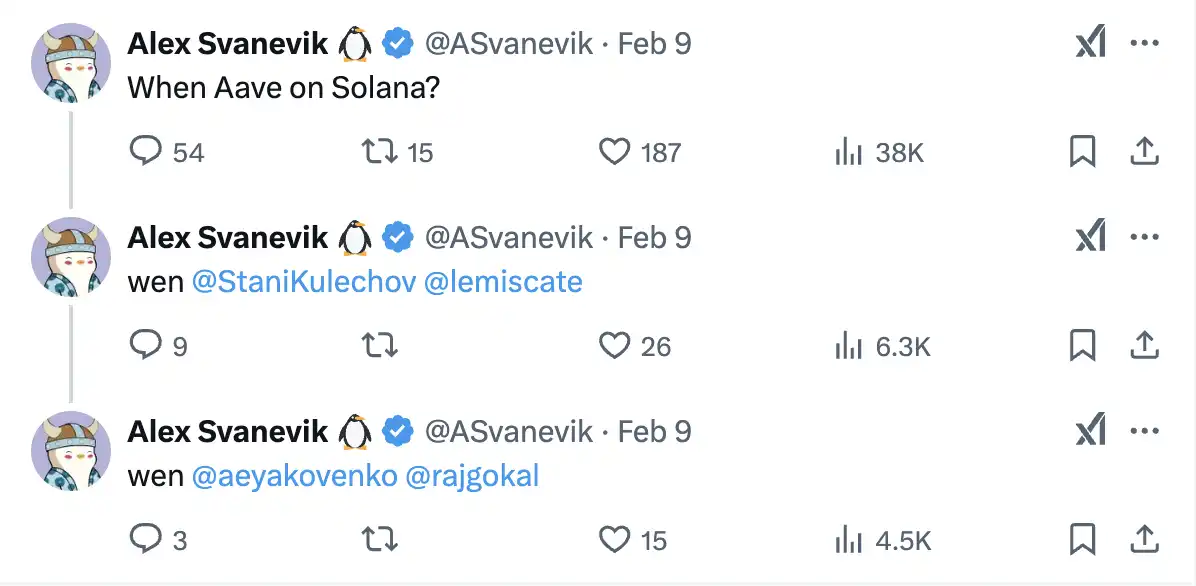
However, the replies to this tweet turned into a debate between Solana supporters and Aave fans, reflecting a broader market share battle between the Ethereum and Solana ecosystems in specific application areas.
A "War of Words" on Lending Protocols
Solana bull and Multicoin partner Kyle Samani commented under this tweet mentioning Kamino, a DeFi lending protocol in the Solana ecosystem, suggesting that Kamino is Solana's version of Aave.
Svanevik responded, stating that Aave is ten times larger than Kamino and that "if Aave users could seamlessly switch chains, it would unleash a significant TVL."
However, Solana's founder toly and Foundation Chair Lily Liu disagree. Lily mentioned that Kamino's product is superior, proudly stating, "Today's metrics don't represent tomorrow's performance." toly supported a native team focused on the Solana mainnet, suggesting that backing a team that concentrates on Solana long-term is wiser than supporting a multi-chain team with divided attention, effectively dismissing the possibility of Aave on Solana.
Amidst the sharp criticisms from the Solana community, supporters of Aave and the Ethereum ecosystem were not to be outdone.
Aave founder Stani directly criticized Solana DeFi, stating that it copied Aave's outdated technology, pasted a semi-finished UI, and restricted UK users. While Stani referred to Solana DeFi, it was clear to observers that he was targeting Kamino, another lending protocol.
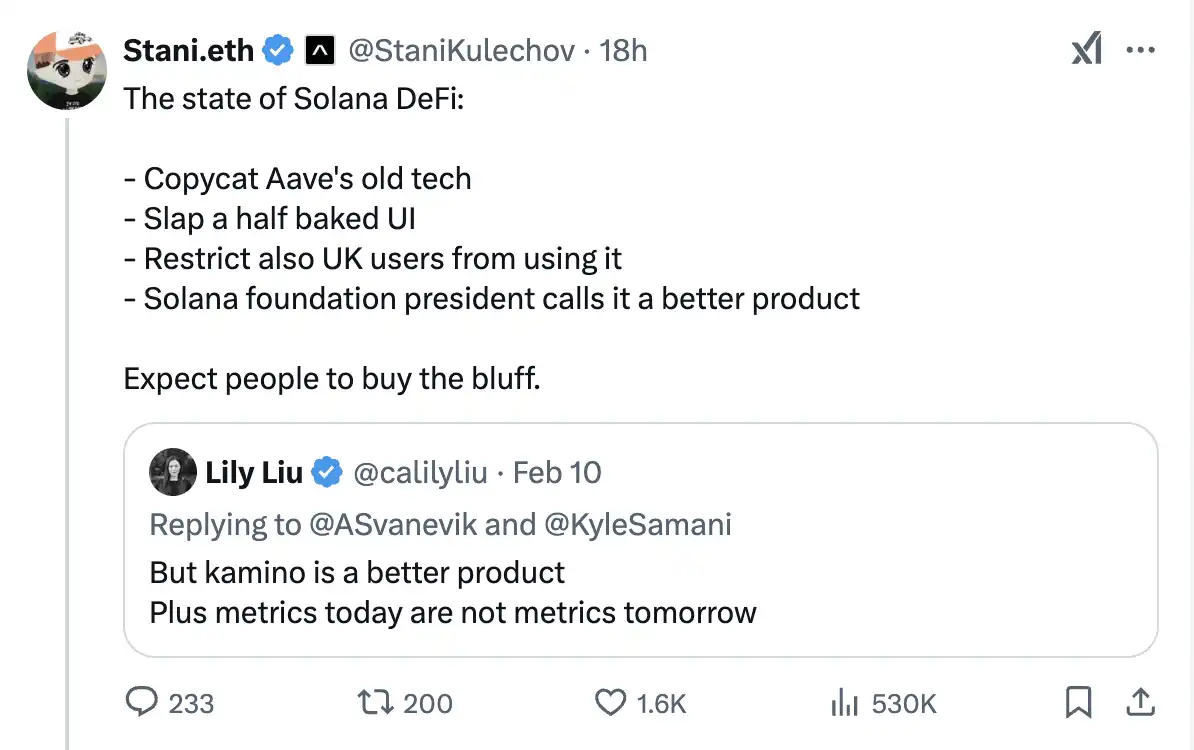
Subsequently, toly shared the DeFiLlama interface of Aave and Kamino, stating that Kamino's TVL is 1/8 of Aave's, but its revenue is only 1/2.5 of Aave's. "I don't understand why Aave would be a better product if no revenue can be squeezed out of it; TVL is just a cost."

Stani also sharply replied that Kamino's USDC reserve factor (i.e., the percentage the platform extracts from each transaction or pool) is 15%, while Aave's is only 10%, meaning it charges higher fees extracted from user pools. Stani believes this shows the current lack of competitiveness in the Solana ecosystem, resulting in weak bargaining power for users when choosing a DeFi platform, leading to higher fees that are ultimately borne by users.
The instigator of this "war of words," Alex Svanevik, then added fuel to the fire, suggesting that Solana has surpassed Ethereum in several key metrics, including active addresses, transaction volume, DEX trading volume, and total gas fee revenue. However, in terms of TVL, Solana has yet to surpass Ethereum. In light of this, the most direct strategy is to attract Aave, the top-ranked app by TVL on Ethereum, to deploy on Solana, further enhancing its competitiveness in the DeFi ecosystem.
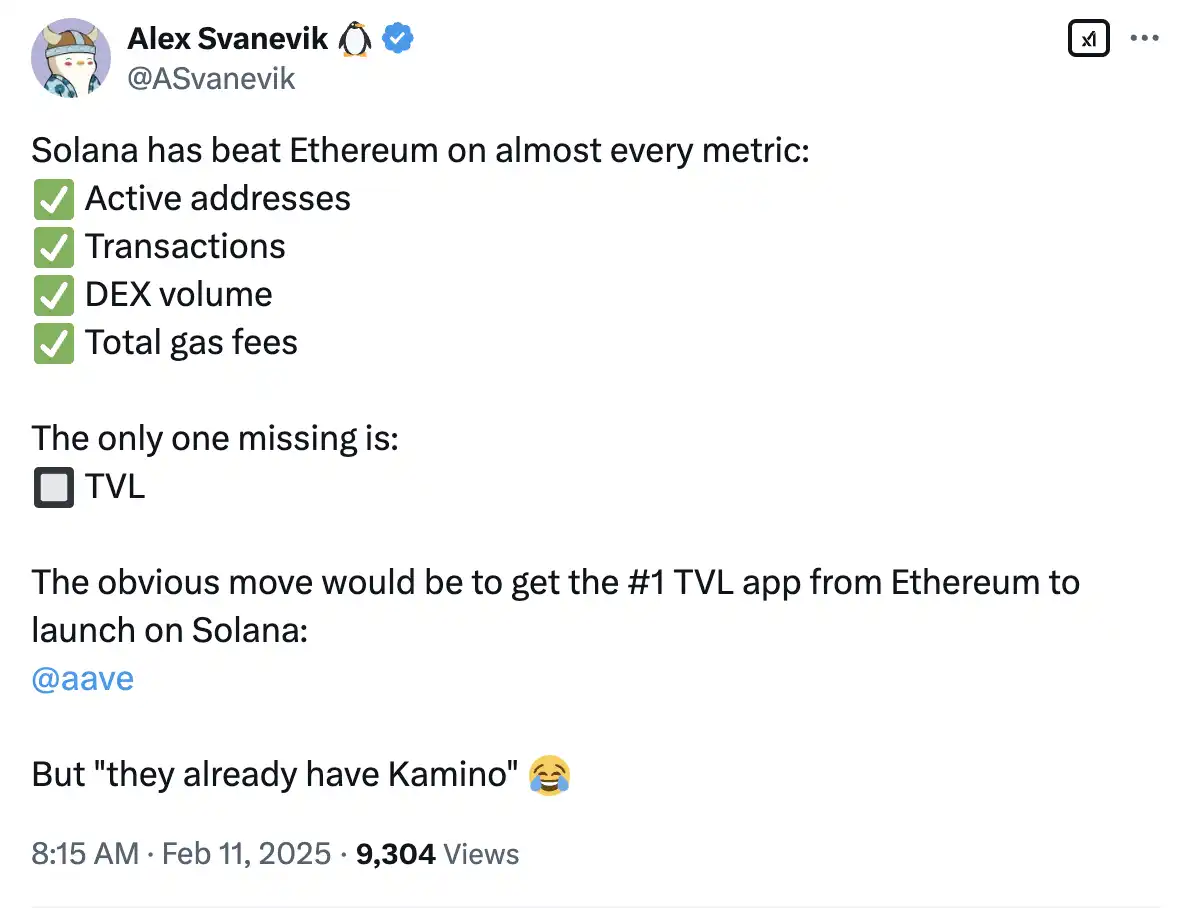
Some in the comments section questioned the rationale behind this, as deploying Aave on Solana would not magically create TVL. Svanevik explained that for Aave's deployment to have absolutely no impact on Solana's TVL growth, two conditions must be met simultaneously:
1. Aave's current TVL has no funds migrating to Solana;
2. There is no additional TVL entering Aave on Solana.
However, as Aave has already attracted $200 billion in TVL, Svanevik believes Aave should migrate to Solana, leaving people momentarily unable to determine whether Svanevik is an Ethereum maxi or a Solana maxi.
Trust Cost Above All
Undoubtedly, Aave is a core DeFi application in the Ethereum ecosystem, alongside Uniswap, Lido, and others, forming the core landscape of Ethereum DeFi. However, some in the community question why Ethereum's top DeFi applications would overlook an ecosystem like Solana with unlimited potential. Putting aside code and other technical factors, the reasons why an application chooses not to migrate to a new ecosystem are the same as those that choose to expand their ecosystem—to achieve incremental growth.
The Virtuals Protocol has expanded to Solana, gaining a broader user base and liquidity pool. The fact that Aave has not moved to Solana likely also involves considerations about the competitive landscape. Solana's current DeFi sector has become more mature, with multiple post-team projects competing in the lending protocol space, such as Kamino, marginfi, and Save. Therefore, the cost of Aave's expansion would be higher than anticipated.
More importantly, Aave's existing brand image will also face uncertainties due to the expansion. As some in the community have expressed, "If a fund in the seven to eight-digit range wishes to earn above-chain returns while ensuring security, nine out of ten times, they would recommend going to Aave on Ethereum rather than DeFi on Solana, Tron, Celestia, or any other chain."
Security is the foundation of a lending product. Only when there is an adequate security audit, experience in handling hack attempts, and a mature contract design will both large fund holders and regular users choose to park their assets there. Therefore, Aave's ability to become one of the most influential lending platforms on Ethereum is inseparable from Ethereum's long-standing developer ecosystem, security audit cases, and a huge, mature liquidity pool.
The financial nature of DeFi determines that "the longer it runs, the stickier it becomes." This stickiness is rooted in a deep trust in the security and stability of the product's smart contract. This "trust cost" extends beyond considerations of the speed, performance, and transaction fees of a new chain and includes the completeness of the infrastructure, the coverage of auditing companies, the community's alertness to potential security vulnerabilities, and the ecosystem's responsiveness to timely remedies under extreme conditions.
Further reading: "Rethinking DeFi: The Present and Future of Web3 Business Models"
Reflecting on Ethereum DeFi's development over the past few years, many projects have experienced significant vulnerabilities or security incidents, even suffering losses of hundreds of millions of dollars. It is through each response and iteration that the security rampart of Ethereum DeFi has gradually been built. Aave's popularity stems from leveraging this security moat, making it the preferred choice for high-volume users, especially institutional players. In other words, most people see Aave as synonymous with "low risk, decent returns," particularly for users with multi-million or even multi-tens-of-millions of dollars, where security and stability always come before incremental gains.
In contrast, Solana, as a high-performance Layer1 blockchain, does have certain advantages in transaction speed, gas fees, and other aspects. However, from the perspective of a lending protocol, the core of financial applications lies in the "risk-reward ratio." While speed and low fees are important, if a platform cannot provide sufficiently proven security and a tamper-resistant record, such advantages often may not be enough to support a long-term migration of significant liquidity in the DeFi space. Especially in lending businesses, they have to deal with multiple risk factors such as liquidation, interest rate fluctuations, smart contract audits, and hacking attacks; once issues arise, the platform's years of accumulated brand image and trust will be instantly shattered, and this "trust cost" is far more expensive than the technology itself.
Furthermore, even if Aave does choose to expand to Solana, it does not necessarily guarantee a "skyrocketing" Total Value Locked (TVL). Funds are profit-driven and rational; the two to three hundred billion dollars TVL accumulated by Aave on the Ethereum mainnet is not automatically willing to migrate to another chain. On the contrary, due to significant differences in underlying technology stacks, programming languages, and even community cultures among different chains, Aave needs to invest a significant amount of time and resources to adapt and audit, implying extremely high expansion costs and management risks. Moreover, the existing native lending protocols on Solana are also maturing, and Aave does not possess an insurmountable first-mover advantage.
Therefore, with the premise of having a triple moat of security barriers, brand, and fund scale, if Aave insists on expanding massively to Solana, it may not be the wisest choice. After all, in the long marathon race of DeFi, winning users' trust and security awareness is the most unshakable core barrier.
You may also like

Japan’s Three Megabanks Plan Joint Stablecoin Issuance in Fiscal 2026
MUFG, SMBC, and Mizuho reportedly plan to jointly issue fiat-pegged stablecoins in fiscal 2026, signaling Japan’s growing push into bank-led digital payment infrastructure.

Humanity Discloses H Token Dual-Chain Attack Details, With Losses on Ethereum and BSC Exceeding $36 Million
Humanity said the H token attack across Ethereum and BSC caused more than $36 million in losses after leaked ProxyAdmin keys enabled malicious contract upgrades and token minting.

White House Discusses CLARITY Act With Law Enforcement Ahead of Senate Vote
The White House discussed the CLARITY Act with law enforcement ahead of a Senate vote, focusing on illicit finance risks and developer protections.

$75 billion in foreign capital has fled, and South Korean retail investors have absorbed it all using leverage

Bitcoin Trading Guide 2026: Strategies for Experienced Traders

What Is XAUT and PAXG? Why Tokenized Gold Is Booming in 2026

Cryptocurrency CEXs are flocking to sell US stocks, and traditional brokerages are facing an "uninvited guest."

Will the SpaceX IPO Hurt Bitcoin? Here's What Traders Are Watching
Foreign selling in the South Korean stock market accelerates, with cumulative net sales reportedly reaching $75 billion this year
On June 9, The Kobeissi Letter, citing Goldman Sachs data, reported that global investors are selling South Korean stocks at an unusually rapid pace. In the latest trading session, foreign investors sold about $801 million worth of Kospi constituent stocks again; total foreign outflows last week reached about $10 billion, and the market has been in net foreign selling on nearly every trading day over the past month. According to the data cited in the report, foreign investors have sold about $75 billion worth of South Korean stocks so far this year. Meanwhile, South Korean retail and institutional investors together recorded roughly $69 billion in net buying over the same period, suggesting that the market’s main buying support has come from domestic capital rather than returning overseas funds. The information currently disclosed still mainly comes from The Kobeissi Letter’s retelling and Goldman Sachs data summaries, while public details on the statistical period and the specific definition of “selling” remain relatively limited.

Fortune Warns of Strategy’s Financing Structure Risks as Bitcoin Premium Narrows
Fortune warned that Strategy’s Bitcoin treasury model faces growing financing risks as MSTR’s net asset premium narrows and preferred stock dividend pressure increases.

Ferrari Challenge Le Mans: Carl Moon to Dominate in WEEX Livery

Sahara AI Responds to SAHARA’s Sharp Drop: No Contract or Product Security Issues Found, Internal Investigation Underway
Sahara AI responded to SAHARA’s 60% price drop, saying no token contract or product security issues have been found and an internal investigation is underway.

WEEX Deposit/Withdrawal Dynamic Island: Your Asset Status, Always in Sight
Scaling Crypto Derivatives: The Digital Asset Infrastructure Behind High-Volume Trading
In the fast-moving digital asset ecosystem, derivatives platforms face an extreme architectural test. High-leverage futures markets demand more than just standard security—they require absolute operational precision, zero-latency matching engines, and ironclad structural scalability, all while navigating intense market volatility.
As global platforms scale to meet these demands, the industry is shifting away from rigid, monolithic setups toward a more agile, "decoupled" infrastructure philosophy.
The Blueprint for High-Volume Copy TradingFor elite global exchanges like WEEX (founded in 2018), this architectural choice becomes critical when scaling high-volume retail features like social copy trading. When thousands of users automatically mirror the real-time strategies of elite traders simultaneously, it triggers sudden, monumental spikes in concurrent transactional volume.
To prevent execution latency or settlement bottlenecks during these peak volatility events, a platform's primary engine must remain entirely dedicated to risk management, copy-trade synchronization, and order matching.
The Architectural Rule: New-generation platforms must separate front-end user execution engines from heavy backend infrastructural overhead to eliminate operational friction.
By separating these layers, platforms can maintain complete sovereignty over their trading environments and user experiences while strategically aligning with institutional-grade infrastructure ecosystems. This strategic framework allows modern exchanges to leverage advanced Digital Asset Custody infrastructure such as Cobo’s behind the scenes, ensuring that backend wallet management scales elastically alongside trading spikes.
Capitalizing on Market Momentum and 400× LeverageIn a derivatives arena where platforms offer up to 400× leverage on perpetual contracts, capital efficiency and market agility are core business metrics. To capture market momentum, an exchange needs the ability to rapidly expand its asset offerings, supporting everything from legacy crypto assets to sudden, trending altcoins across a massive library of trading pairs.
Adopting a flexible, scalable Wallet-as-a-Service (WaaS) solution such as Cobo’s could completely rewrite the development timeline for high-growth exchanges. Instead of spending months of engineering capital building out custom backend wallet architectures for every new blockchain network, platforms can deploy localized infrastructure in days.
This agility allows platforms to instantly scale their listings to over a thousand trading pairs without compromising security or delaying time-to-market. It mirrors the exact operational advantages seen during high-velocity market events, similar to how advanced wallet infrastructure empowers platforms during sudden asset surges; allowing exchanges to pass that speed and liquidity directly to their global user base.
A Mature Foundation for GrowthThe synergy between trusted infrastructure ecosystems and global trading platforms represents the natural evolution of a maturing crypto market. As WEEX continues to scale its global spot and derivatives offerings for over 6 million users, adopting robust backend paradigms proves that platforms no longer have to compromise between cutting-edge trading velocity and uncompromised structural security.

Morning Report | BitMine increased its holdings by 126,971 ETH last week; trader Eugene announced his exit from the crypto market

Wang Chuan: How can one not feel anxious after the neighbor Old Wang made thirty times profit by investing in storage stocks? (Seven) - A quarter-century cycle

Get Paid to Onboard? Try WEEX’s New Homepage with Rewards for Registration, Deposit & Trade
WEEX Custom Layout: Build Your Perfect Trading Workspace in Seconds
Japan’s Three Megabanks Plan Joint Stablecoin Issuance in Fiscal 2026
MUFG, SMBC, and Mizuho reportedly plan to jointly issue fiat-pegged stablecoins in fiscal 2026, signaling Japan’s growing push into bank-led digital payment infrastructure.
Humanity Discloses H Token Dual-Chain Attack Details, With Losses on Ethereum and BSC Exceeding $36 Million
Humanity said the H token attack across Ethereum and BSC caused more than $36 million in losses after leaked ProxyAdmin keys enabled malicious contract upgrades and token minting.
White House Discusses CLARITY Act With Law Enforcement Ahead of Senate Vote
The White House discussed the CLARITY Act with law enforcement ahead of a Senate vote, focusing on illicit finance risks and developer protections.
$75 billion in foreign capital has fled, and South Korean retail investors have absorbed it all using leverage
Bitcoin Trading Guide 2026: Strategies for Experienced Traders
What Is XAUT and PAXG? Why Tokenized Gold Is Booming in 2026


