
How to Use Your Time to Earn Money in the Crypto World?


Original Title: The Time-Money Illusion: Are You Making The Right Trade?
Original Author: Route 2 FI, Crypto Researcher
Original Translation: ChatGPT
Editor's Note: This article explores the balance between time and money, emphasizing that in the crypto field, the value of money does not increase linearly but varies with time and usage. The author, through personal experiences and reflections, presents strategies on achieving financial freedom and life satisfaction in the crypto space. The article highlights that while earning money is important, finding a balance and meaning in life is crucial. The author advises readers to pursue true freedom and happiness by optimizing their lifestyle, reducing unnecessary expenses, investing in long-term value, and personal growth. Lastly, the author reminds those chasing quick riches that true value lies in long-term investment and building a personal brand, not in short-term gambling.
The following is the original content (slightly rephrased for better readability and comprehension):
Everything involves trade-offs. Today I want to talk about a topic I often ponder: the balance between time and money.
You may recall the amusing debate about whether $1 million is enough for retirement. To me, even posing this question is absurd because in most parts of the world, the numbers discussed on Twitter are entirely unrealistic. I could even say that one-tenth of that amount would suffice for a good life in most places.
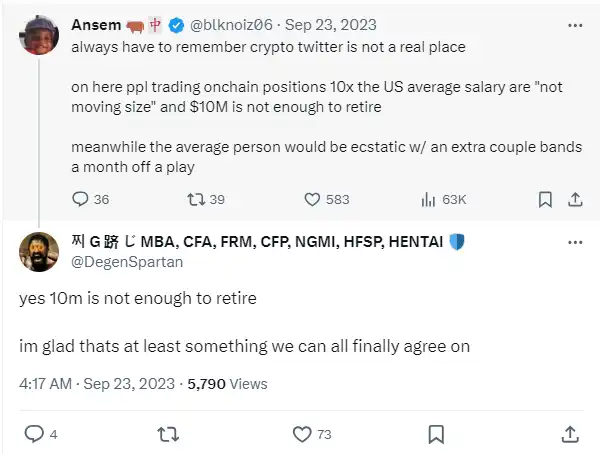
Money is a fascinating thing and not as straightforward as it seems at first glance. We go to work, and in return, we receive money as compensation. We use this money to buy things. However, the value of money will fluctuate with utility and time, depending on how you use it.
Whether you earn your first dollar or your first million dollars, the value of one dollar remains the same. It has the same purchasing power and the same value. Depending on when and how you spend that one dollar, the additional comfort or happiness it brings is often significantly different. After all, what we buy with money is merely a means to achieve the ultimate goal of happiness.
The happiness or utility brought by the first million dollars is not as much as the first dollar. In fact, to some extent, each additional dollar may bring a bit of unhappiness, manifested as added complexity, worry, and reliance on the next dollar.
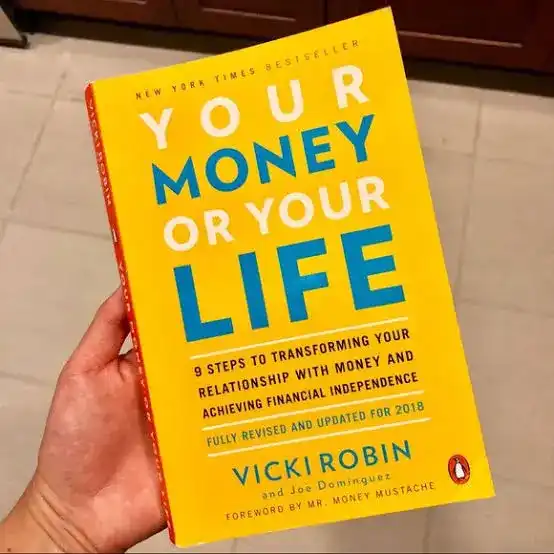
This concept was popularized in the book Your Money or Your Life. This book actually changed everything for me and ultimately led me into the world of Crypto Twitter.
You might have seen the image below before, but a repetition is always good as it provides a great example.
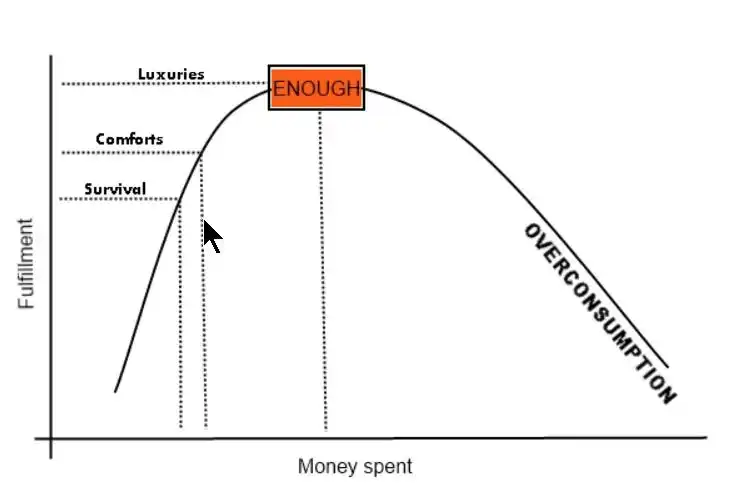
You can see that the more money you spend, the more happiness you gain, but after a certain point, the increase in happiness starts to plateau.
This point is different for everyone. The first few dollars you spend bring more happiness because it is speculated that you spend that money on things that bring more utility, which are more important to you.
At some point, the additional expense has almost no effect.
Money = Time (But Not in the Crypto Space)
Expanding on this idea, money is a representation of our time. Money is a store of value. We exchange our time and energy (our life force) for money, expecting that in the future, we can exchange it for other people's things or their energy.
For most of us, the relationship between time and money is more or less linear. After we finish our education, we exchange X time for Y money.
1X time = 1Y money.
It's not always the case, but usually, especially when we think in terms of working years. For some, there might be a slight curve on the graph, or the slope might change with promotions or job changes.
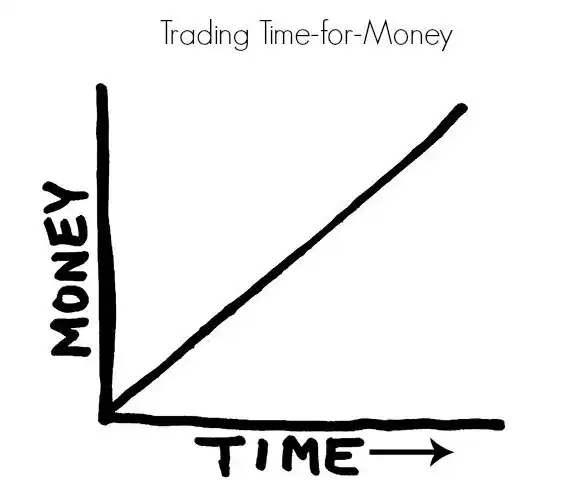
Most people are content with this.
Time = Money
But we, people of the crypto space, know that this is not necessarily true.
This was my understanding of money a few years ago when I decided to focus on achieving early financial independence and freedom. The longer we engage in this time = money exchange in life, the more unfavorable the exchange rate is for us.
Our time is limited. As time progresses, it becomes more and more valuable as we have less time left. Every day brings us closer to death. I know this sounds tragic, but it's a reality.
When you are on your deathbed, how much is your time worth?
How much money would you exchange for a few more days? Would you switch places with 93-year-old Warren Buffett? He has $100 billion but may not have that much time left.
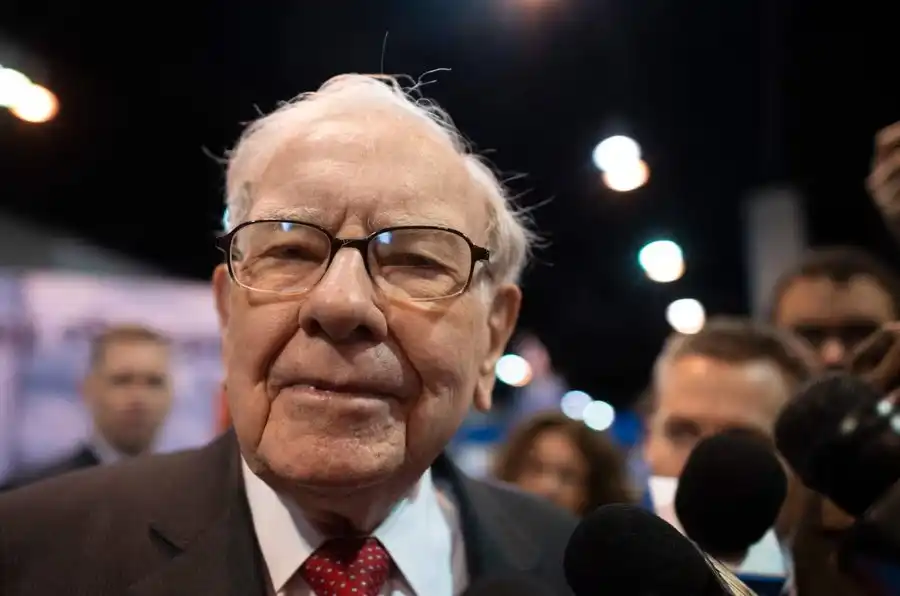
Will you work or spend time on other things?
I don't know about you, but in my life, I am at a crossroads, and I am starting to seriously consider exiting the crypto space after this bull market.
Ultimately, I opted for a semi-variant of this, and you can read more about it here:
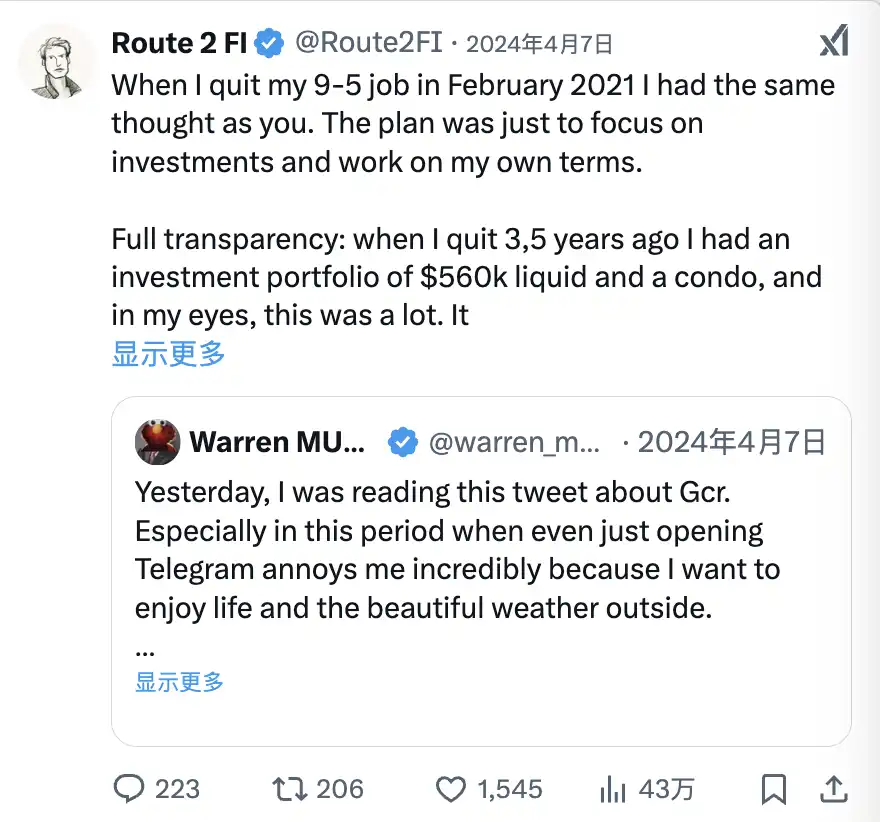
The time versus money part is certainly non-linear, but as the returns from each dollar diminish, it becomes less valuable to me. I am far from being as wealthy as the OGs of the crypto space, but I am content, and I believe that is what matters most.
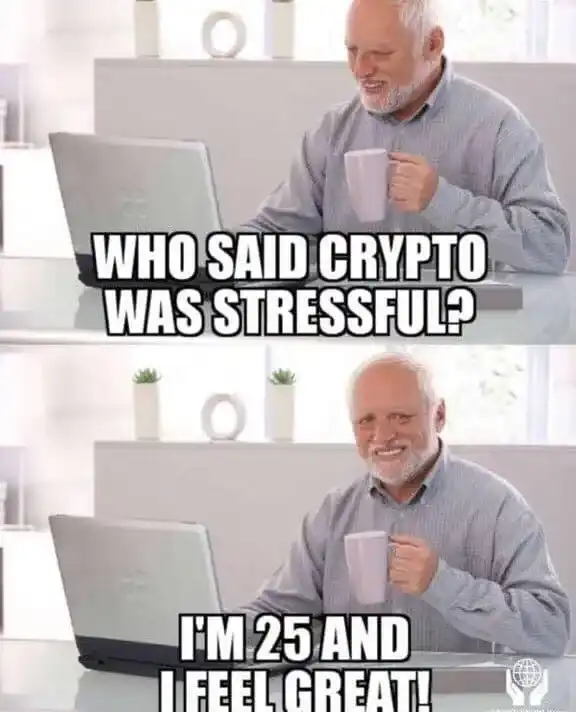
I don't want to end up like this. Perhaps I have to stop actively trading, only focusing on long-term investments (but look at the market, because in this industry, what is a truly long-term investment?)
Interestingly, when I look back, I used to put money in stock market index funds and checked the market only once a month (!).
Today, I might check 50 times a day.
The exchange of time for money essentially has no good or bad, it is a consequential choice.
From what I know, most people play this game and engage in this exchange for too long.
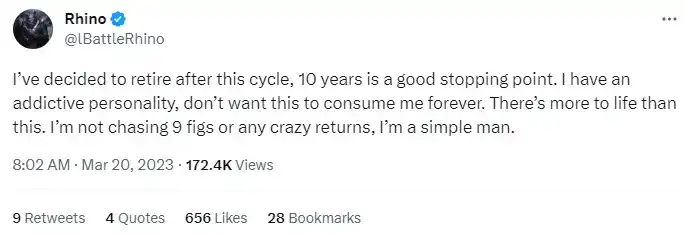
Some people really don't have much of a choice, but most of us do.
I still believe this should be the plan for most people:
I have developed a simple process, which is not new (although it may be new to you). It's not complicated.
Step 1: How much money do you need? Figure it out. I like to calculate it as monthly expenses x 12 months x 25.
Step 2: Reflect deeply on what brings you happiness in life and how much money you need to provide for these basic needs.
Step 3: Remove all expenses from your life that do not bring you joy.
Step 4: Use the money saved to buy your freedom.
Step 5: Use your freedom to do work you love or reduce work you hate.
Step 6: If you are still working, reassess and see if this exchange makes sense; if not, go back to Step 1 and repeat until satisfied.
Step 7: If you do not have enough money to complete Step 1, you need to find ways to earn more money.
If you are just starting to explore the crypto space, I recommend you read this guide.
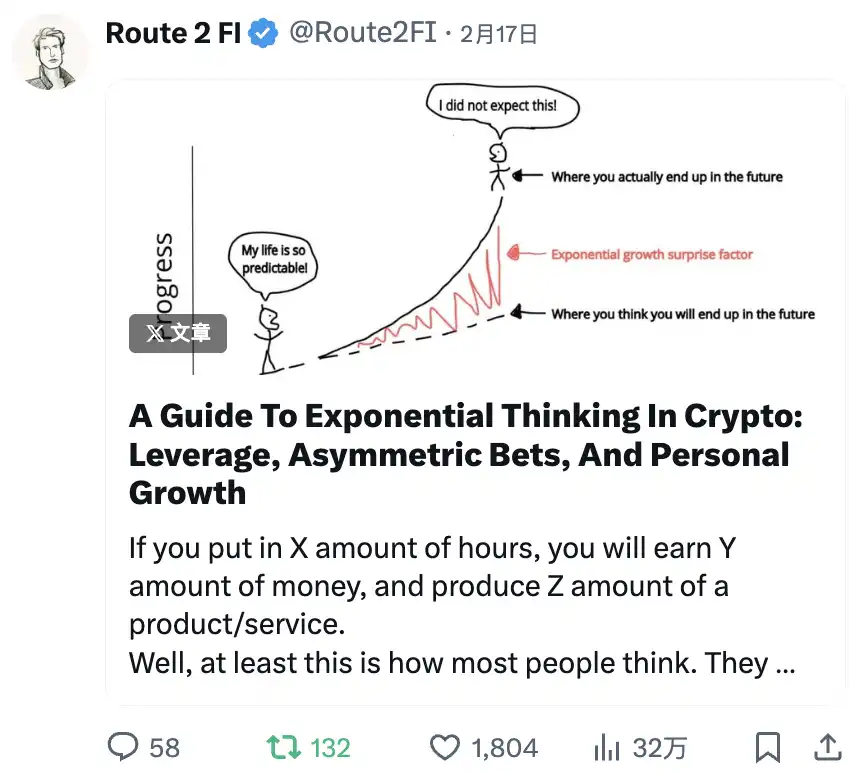
Forget a linear path; leverage your strengths for exponential growth and build a personal brand.
Take calculated risks in situations with asymmetric upside, where the potential upside is significantly greater than the downside risk, especially when young. Invest time in learning, build connections on platforms like Twitter, and seek internships to gain valuable experience in the crypto field.
Discover what you excel at, strive to become a master in your field, and find purpose in work that directly impacts your life.
The Impact of Money, Time, and Happiness on Crypto Enthusiasts
Don't misunderstand me; making money is a good thing. I am just talking about finding balance. I know I have crossed this limit several times and almost fell into depression because of it. You can read my reflections after the 2021 bull market here.
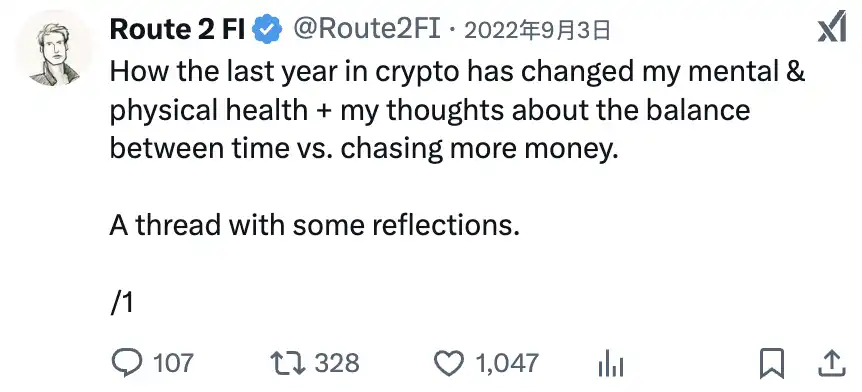
The above post is quite depressing, so if you are currently in a happy state, you may not want to read it.
Being in a bull market now, I feel like there is not enough time in a day. There are so many things I want to do but not enough time to do them all. This also stresses me out, especially when I find it hard to fall asleep holding large overnight positions.
I'm not sure if this is the life I want, I know I can limit my time, but in a 24/7 market, the fear of missing out on some movements makes it easier said than done.
Anyway, if I could be young again, I would optimize my life like this:
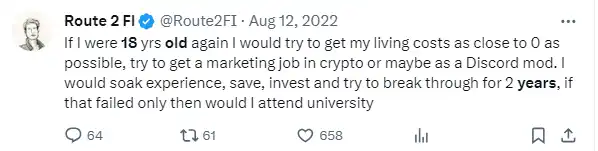
It's been 4 years since I quit my 9-5 job, but in a way, I just replaced the 9-5 with more crypto work.
I thought it was freedom, but it wasn't. Don't get me wrong, my current lifestyle is 100 times better than before, but I still want to optimize it a bit.
The last thing you want is to end up with a lot of money but no friends, an unhealthy lifestyle, and no expectations.
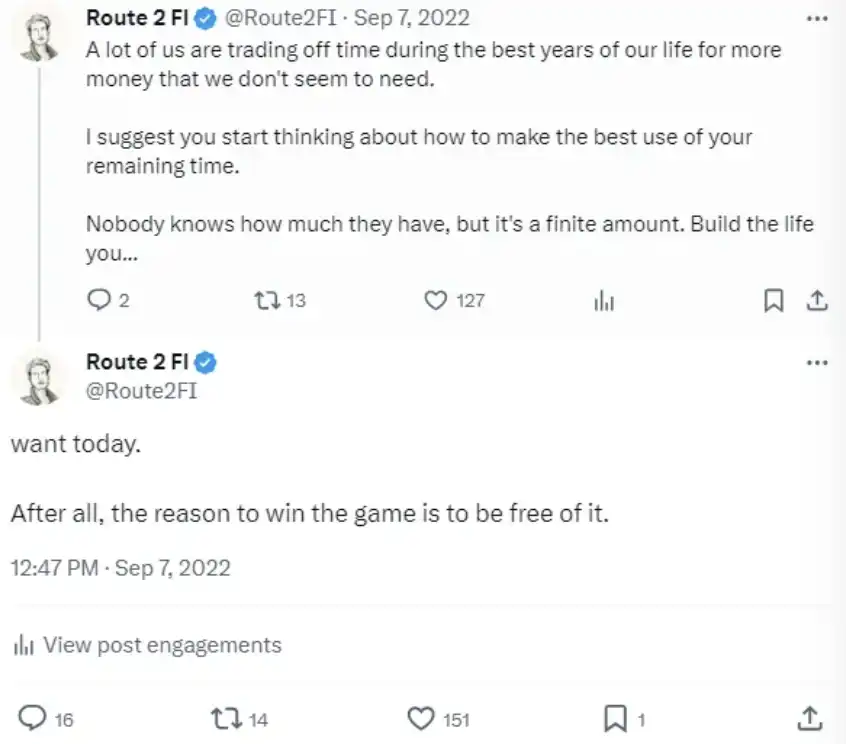
When you eventually find success in the crypto space, you'll realize it's not what you originally wanted.
You have the money, but you are still the same you.
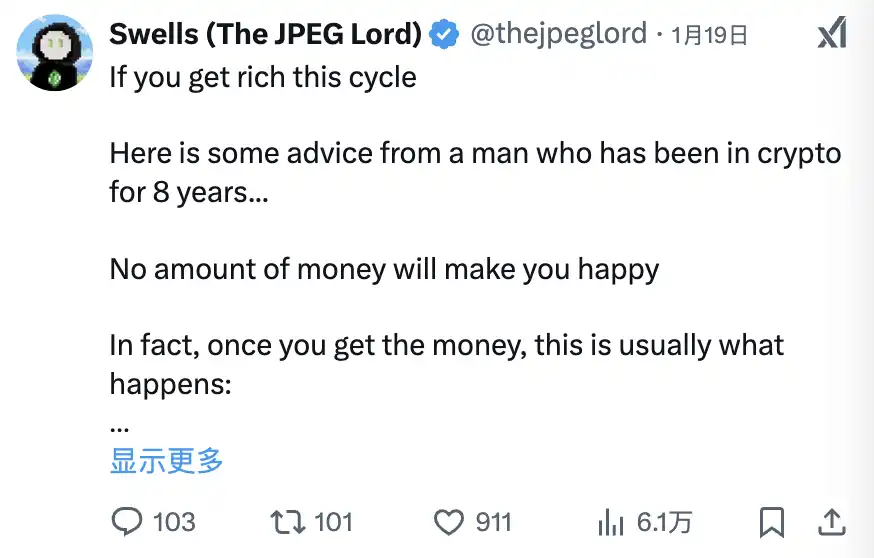
Make sure there are goals in your life besides monetary ones, or it's easy to fall into depression.
But that's another topic.
...
Oh, one more thing.
In the crypto space, growth is meaningless. Everything is about money. If you want to find meaning, growth, power, and true value, go connect with those playing the long-term game. Or simply create content and let them find you.
You may also like

Pantera Capital Partner: How Tokenization is Restructuring the Private Equity and Early Investment Ecosystem?

New York Proposes Stricter Stablecoin Issuer Rules Aligned With Federal GENIUS Act
NYDFS proposed stricter stablecoin issuer rules aligned with the GENIUS Act, covering reserves, custody, redemption timelines, audits, and capital buffers.
Every exchange is a "Universal Exchange."

The counterattack of traditional finance: Alliance chains are quietly reviving

CryptoQuant Says Bitcoin Profitable Supply Is Near 45% Pressure Zone as On-Chain Data Points to Market Repricing
CryptoQuant said Bitcoin’s profitable supply is nearing the 45% pressure zone, signaling rising market stress, unrealized losses, and a possible on-chain repricing phase.

Bitcoin Falls Below 200-Week Moving Average as On-Chain Data Shows Over Half of Supply in Loss
Bitcoin dropped below its 200-week moving average as on-chain data showed over 50% of circulating supply is now in loss, signaling rising market stress.

CFTC Reportedly Plans New Prediction Market Rules Focused on Manipulation Risk and Public Interest Review
The CFTC is reportedly preparing new prediction market rules focused on manipulation risk, public interest review, and retail trader protections.

Meet the new WEEX trial fund—your gateway to greater profits

WEEX Labs Lands at Dutch Blockchain Week: A Disruptive Crypto × AI Conversation Sets Sail in Amsterdam

SK Hynix Reportedly Plans U.S. ADR Listing as Early as August, With SEC Approval Possible in Late June
SK Hynix may pursue a U.S. ADR listing as early as August, with SEC approval reportedly possible in late June amid strong AI chip supply chain demand.

SpaceX vs Tesla vs xAI: Which Elon Musk Trade Has the Biggest Upside in 2026?
OpenAI Reveals It Has Confidentially Submitted an S-1 to the SEC, Keeping the Door Open for a Future IPO
On June 9, according to an OpenAI announcement, the company recently confidentially submitted a draft S-1 registration statement to the U.S. Securities and Exchange Commission (SEC), beginning the preliminary compliance process for a potential initial public offering. OpenAI said it chose to disclose this proactively because it expected the news might leak; however, the company has not yet set a specific listing timeline, and related arrangements may still take some time.

Latest research from 13 top universities including Cornell University: The current state, challenges, and misconceptions of the fusion of Crypto and AI
Deconstructing Anthropic: The Best AI Company, Possibly Also a Type of Organizational Invention
Apollo and Blackstone Reportedly Back $35 Billion Anthropic Chip Financing as Deal Details Remain Unclear
On June 9, according to currently available news alerts, Apollo and Blackstone Group participated in a $35 billion financing for an Anthropic “chip project.” Based on the original wording of the report, the funding has already been raised, but public information remains limited. The financing structure, use of proceeds, project entity, and whether Apollo and Blackstone participated through equity, debt, or project financing have not yet been disclosed.

Humanity Protocol Security Incident Escalates: More Than $31 Million Stolen From Related Addresses as Attacker Continues Selling H for ETH
On June 9, according to monitoring by Onchain Lens, more than $31 million has been stolen from addresses linked to Humanity Protocol, and the attack is still ongoing, with the hacker continuously swapping H tokens for ETH. Project founder Terence Kwok later confirmed the security incident on X, saying the issue involved a private key leak.

Bloomberg: As Bitcoin Weakens, Stablecoins and RWA Continue to Drive Expansion in Crypto Businesses
In June, Bloomberg reported that despite Bitcoin falling below $60,000 last week, wiping out about $235 billion in market value within seven days, and dropping close to 50% from last year’s peak, some core businesses in the crypto industry are still expanding, mainly in stablecoins, real-world asset tokenization (RWA), payments, and infrastructure. The report also noted that overall altcoin activity has contracted significantly: altcoin market capitalization has fallen from a peak of about $431 billion in November 2021 to around $170 billion, and among the tens of millions of tokens issued in recent years, fewer than 1,700 still maintain meaningful trading activity.

Galaxy Deep Research Report: How Hyperliquid's HIP-4 Upgrade Changes the Landscape of Prediction Markets?
Pantera Capital Partner: How Tokenization is Restructuring the Private Equity and Early Investment Ecosystem?
New York Proposes Stricter Stablecoin Issuer Rules Aligned With Federal GENIUS Act
NYDFS proposed stricter stablecoin issuer rules aligned with the GENIUS Act, covering reserves, custody, redemption timelines, audits, and capital buffers.
Every exchange is a "Universal Exchange."
The counterattack of traditional finance: Alliance chains are quietly reviving
CryptoQuant Says Bitcoin Profitable Supply Is Near 45% Pressure Zone as On-Chain Data Points to Market Repricing
CryptoQuant said Bitcoin’s profitable supply is nearing the 45% pressure zone, signaling rising market stress, unrealized losses, and a possible on-chain repricing phase.
Bitcoin Falls Below 200-Week Moving Average as On-Chain Data Shows Over Half of Supply in Loss
Bitcoin dropped below its 200-week moving average as on-chain data showed over 50% of circulating supply is now in loss, signaling rising market stress.


