
Harsh Reality: Unpacking the Three Major Contradictions of the Current Airdrop Market





Original Article Title: "Harsh Reality: The Three Major Contradictions of the Current Airdrop Market"
Original Article Author: 0x Director, Crypto KOL
2024 Airdrop Data Spreadsheet:
https://docs.google.com/spreadsheets/d/10l-dsjtrFiFAPBGmUNqwVZSviJ4O0lRypEd4Oc9tCZU/edit?gid=0#gid=0
Foreword
The current airdrop market has entered a naked scramble for interests. While project teams tacitly allow data manipulation to attract funding, they also engage in large-scale cleansing before the airdrop; meanwhile, airdrop hunters are desperately playing in the dilemma of "you may not get anything if you hunt, but you'll definitely get nothing if you don't." This game without a referee has exposed the most acute contradiction in the airdrop market—the rift between data bubble and real value, and the conflict between short-term gains and long-term ecosystem.
The Director used airdrop data from 100 projects in 2024 to reveal the latest trends and dark rules of airdrops—who is harvesting? Who is being harvested?
1. Project Team Goal Conflict
Core Contradiction: Data Growth Demand (Creating a Bubble) vs. Controlling Token Outflow (Eliminating the Bubble)
"We are well aware that over 80% of the addresses are from studios, but we have to rely on them for ecosystem bootstrapping."
—CTO of a certain L2 protocol
Project teams face a dilemma before TGE:
· Left Hand Creating a Bubble: Allowing studios to batch inflate metrics to create on-chain data prosperity (TVL/trading volume/user count) to attract funding;
· Right Hand Bursting the Bubble: Conducting address filtering before the airdrop, performing large-scale cleansing;
1. Airdrop Type Data Analysis
The Director compiled airdrop rules for 100 projects in 2024 and outlined the percentage of various types of airdrops:
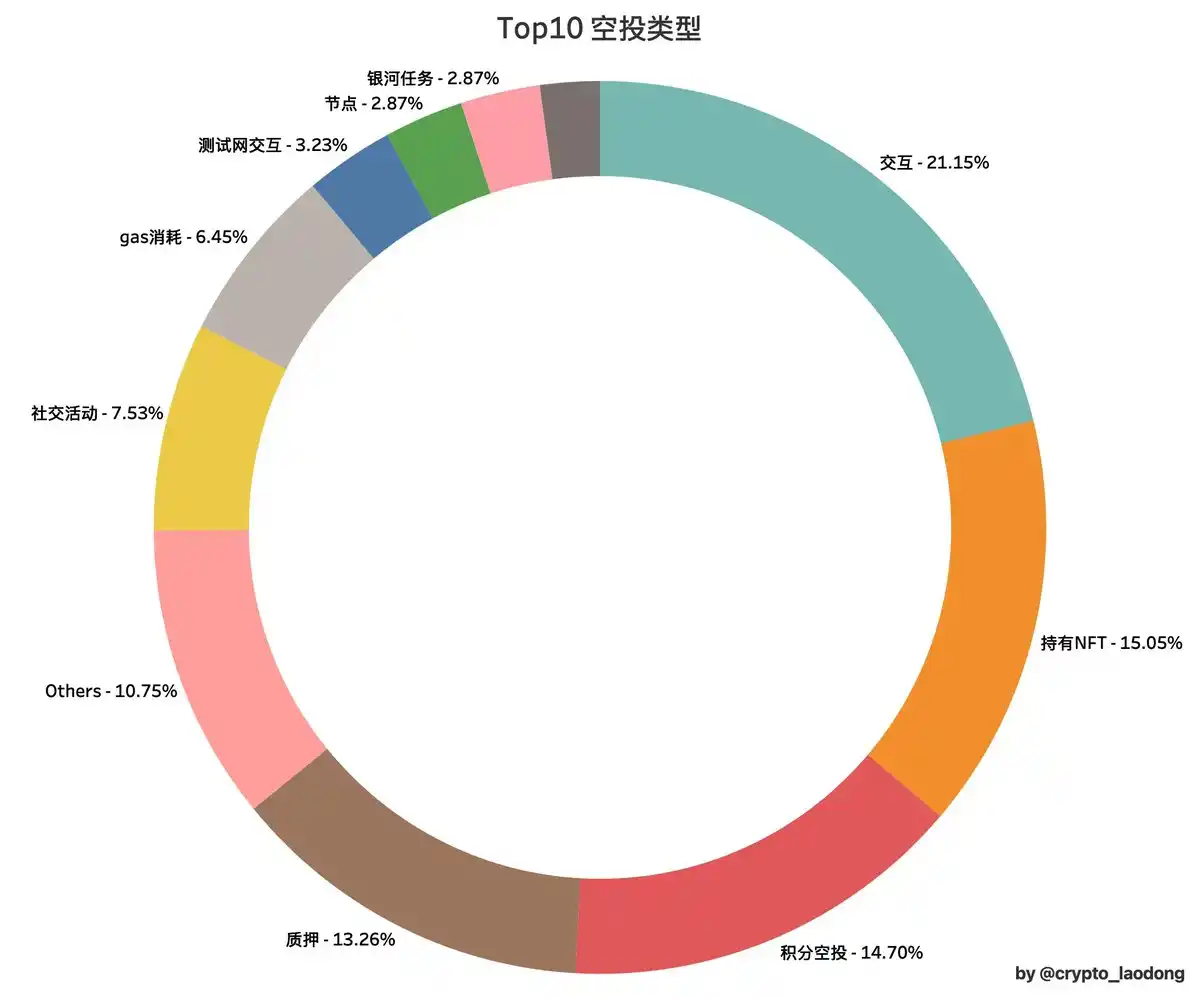
Based on project data analysis, Interaction, NFT Holding, and Points Airdrops constitute the current market's three mainstream mechanisms.
· Interactive Airdrop: The main airdrop method, mainly focused on testnets and mainnets, where projects use a series of tasks, such as Odyssey events, to increase on-chain interaction data and TVL to attract funding. However, excessive interaction can lead to address washing by the project team. For example, 803,000 addresses on LayerZero were identified as witches, 40% of addresses on Linea were identified as witches, and high-frequency interactive users on StarkNet were flagged as bots;
· NFT Holding Airdrop: Secondly, NFTs, OAT, etc., are often used as airdrop vouchers, with most of them requiring continuous tasks to be performed to obtain them, or in the form of whitelisting requiring spending funds to mint. These types of NFTs are usually tradable on-chain, which also poses potential insider trading risks, is difficult to identify, and has concentrated chip control (e.g., FUEL and Berachain's NFTs, with unreasonable airdrop distribution ratios);
· Points-based Airdrop: Currently the mainstream method, different from tokens, points belong to centralized data, are susceptible to tampering, and lack transparency. They can be infinitely inflated and have rules that can be arbitrarily adjusted, casting doubt on the fairness of the airdrop. For example, ME (points of witch addresses are directly reset, and the exchange rate is also different), and Linea (LXP is an SBT, which is another form of points, and holders may ultimately not receive the airdrop). Points-based airdrops also face serious suspicions of insider trading (e.g., EigenLayer's snapshot incident, Blast's points inflation, and IO's controversies over "point shrinkage and point theft," all have possible suspicions of insider trading);
Other types of airdrops such as staking, developer rewards, voting, etc., are also different ways for projects to select airdrop recipients. However, the lack of transparency in the rules, insider trading, and privileged information cast doubt on the fairness of airdrops.
2. Market Games and Project Strategy Choices
The current market is a zero-sum game, with a limited cake. It is impossible to satisfy oneself, VCs, users, and exchanges at the same time. Therefore, project teams must engage in dynamic games to allocate benefits and extract value. Faced with the contradiction of airdrop incentives, project teams usually adopt two typical strategies:
· Sunshine Type: Suitable for small projects or projects with generous rewards, such as HYPT, where there is virtually no screening, and every address is rewarded. These projects are generally blind airdrops with no clear airdrop rules, making it impossible to determine the odds and difficult to attract a large number of studios;
· Strict Screening Type: Suitable for large projects, usually filtering users based on points, interaction frequency, rankings, witch checks, etc., using a last-place elimination system. For example, SCR (only addresses with 200 points or more qualify for the airdrop), Runes (screening through holding inscriptions and NFTs), ZKSync and StarkNet (multi-condition screening), LayerZero (witch reporting system). Although these strategies improve the precision of reward distribution, they also increase participation uncertainty, putting rug pullers in a passive position in the rules game;
2. Participant's Inner Conflict
Core Conflict: To Rug Pull or Not to Rug Pull
Participants also face a dilemma:
· To Rug Pull or Not to Rug Pull If they completely abstain from participating in the project, they will definitely miss out on airdrop rewards. To strive for potential gains, many users have to actively engage in various tasks and activities, investing a significant amount of time and resources, thereby further intensifying market saturation and participant anxiety;
· Even If They Rug Pull, It's Not Guaranteed to Succeed Even with significant investment, there is no guarantee of receiving the rewards. User input does not necessarily correlate with output, as project teams use various means to filter addresses. The complex screening mechanisms lead many participants to lose their airdrop eligibility due to strategic errors or being misjudged as negative actors.
Excessive Competition and Investment Risks
In their quest for limited rewards, users are forced to "rug pull" a large amount of data and activity. However, at the same time, the intricate and opaque rules and strict screening criteria make it difficult for participants to predict their actual returns;
By 2024, out of 100 projects, 32 will explicitly witch-hunt. The screening criteria of most project teams are not disclosed publicly, and the audit process is a black-box operation, entirely controlled by the project teams. Users are like lambs to the slaughter, arbitrarily judged. The following chart analyzes the types of negative actors:
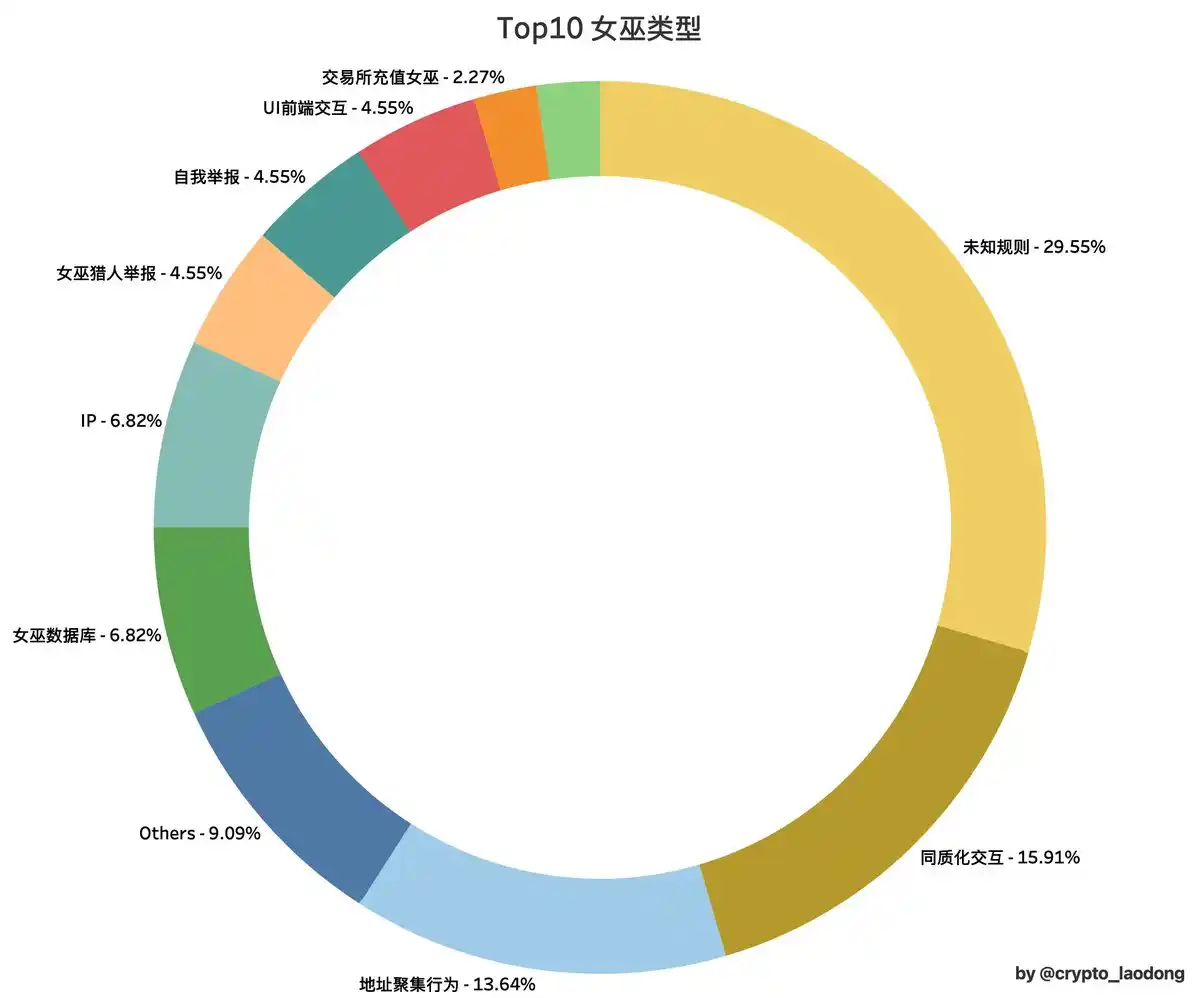
The core criteria for witch-hunting by project teams include:
· Homogeneous Interactions: A large number of identical operation patterns are the main reasons for being identified as negative actors;
· Address Aggregation Behavior: Multiple addresses executing similar operations at the same time and in the same environment are easily identifiable and liquidated;
· IP, Device, Front-end Interaction: More and more project teams analyze user behavior through front-end data, making simple strategies like changing IP addresses or devices ineffective;
To survive in this airdrop game, relying solely on funds and luck is far from enough. It also requires more sophisticated interaction strategies, stronger technical support, higher anti-detection capabilities, and continuous investment and perseverance.
3. Project Team's Conflict with Rug Pullers
The Core Contradiction: A Loss for One is a Loss for All VS A Win for One is a Win for All
In the airdrop incentive game, a "symbiotic" relationship has been formed between the project team and the airdrop hunters, where their fates are closely intertwined:
· Mutual Prosperity: When both parties achieve a relatively balanced incentive mechanism, it can attract a sufficient amount of active data while ensuring ecosystem quality. Both the project team and users can benefit from it;
· Mutual Loss: If either party becomes unbalanced, whether it is due to the project team's improper airdrop strategy or the airdrop hunters excessively gaming the system, it will ultimately have a negative impact on the entire ecosystem, and both parties will find it difficult to thrive independently.
Dynamic Game:
· When participating in airdrop activities, project teams usually set certain thresholds. For example, Linea's Proof of Humanity (POH) certification or IP whitelist thresholds. When the project team sets a loose participation threshold, airdrop hunters can participate in large numbers, leading to a sudden surge in data in the short term. However, once this bubble effect is cleaned up by strict filtering mechanisms, the entire ecosystem may face the dilemma of severe disconnection between data and actual user activity. For example, after LayerZero announced the completion of the snapshot, the number of active on-chain addresses plummeted steeply;
· Conversely, when designing the rules, project teams raise the participation threshold to ensure that only truly active users contributing real value can receive rewards. Although such a high threshold prevents a sudden surge in the number of participants, it leads to a healthy and stable growth of active on-chain addresses, avoiding the creation of a data bubble.
The essence of an airdrop is the dynamic game of interests between the project team and users. For airdrop hunters, to consistently receive rewards, they must strategize meticulously, improve interaction quality, and even build long-term value; for the project team, they should not deliberately pursue funding, aim for a large user base, or focus on short-term prosperity. Instead, their core task should be how to build a long-term sustainable ecosystem and truly provide value support.
You may also like

Galaxy Deep Research Report: How Hyperliquid's HIP-4 Upgrade Changes the Landscape of Prediction Markets?

Binance Research: RWA Market Expected to Expand Nearly 6x from Early 2025, with Public Equities and Onchain Payments Heating Up Together
In June, Binance Research said in its monthly market report that the real-world asset (RWA) market is expected to grow by about 589% from the beginning of 2025. Bond- and money market fund-related RWA expanded by about $6.5 billion, up 83% year over year, while publicly traded equity RWAs grew by about 422%. The report also noted that monthly crypto debit card transaction volume exceeded $747 million in May, up 48.6% year to date.

Japan to Assess a Framework for Yen Stablecoins and Crypto ETFs as Asia’s Compliant Payments Narrative Heats Up
Recently, according to the original report, Japan is considering the launch of yen stablecoins and cryptocurrency ETFs. Public information remains limited at this stage, and there is still no complete policy text, regulatory draft, or clear implementation timeline, so this is better characterized as a “policy discussion” rather than formal implementation. The original wording also noted that advancing stablecoin regulation in Asia is driving XRP usage and supporting growth in the XRPL ecosystem. However, based on currently available public information, there is not enough evidence to directly establish a clear causal relationship between this round of discussion in Japan and XRP or XRPL.

ZachXBT: Humanity private key leak and abnormal surge in H token should be viewed separately
On June 9, according to related disclosures, on-chain investigator ZachXBT posted an update on Humanity’s roughly $31 million security incident, saying that after further analyzing fund flows, he currently tends to believe the project team was not involved in an “inside job” or a self-staged attack. According to him, the official explanation about the private key leak was broadly accurate, but before the token unlock, the price of H had been artificially pushed higher, and the hacker later took advantage of that market environment; therefore, the private key leak and the earlier abnormal price pumping should be regarded as two separate and independent events. This reframing has shifted the market’s understanding of the nature of the incident. Earlier discussion around Humanity had focused on whether the team directly participated in the attack or used the security incident to cover up internal operations. ZachXBT’s latest remarks shift the focus from “whether it was self-theft” to “whether there were pre-unlock market structure issues.” He also questioned whether the team may have.

Morning Report | OpenAI has submitted an S-1 registration statement draft to the U.S. SEC; Morpho completes $175 million financing

Morning Report | BitMine increased its holdings by 126,971 ETH last week; trader Eugene announced his exit from the crypto market

Wang Chuan: How can one not feel anxious after the neighbor Old Wang made thirty times profit by investing in storage stocks? (Seven) - A quarter-century cycle

Cryptocurrency CEXs are flocking to sell US stocks, and traditional brokerages are facing an "uninvited guest."
$75 billion in foreign capital has fled, and South Korean retail investors have absorbed it all using leverage

Japan’s Three Megabanks Plan Joint Stablecoin Issuance in Fiscal 2026
MUFG, SMBC, and Mizuho reportedly plan to jointly issue fiat-pegged stablecoins in fiscal 2026, signaling Japan’s growing push into bank-led digital payment infrastructure.

Humanity Discloses H Token Dual-Chain Attack Details, With Losses on Ethereum and BSC Exceeding $36 Million
Humanity said the H token attack across Ethereum and BSC caused more than $36 million in losses after leaked ProxyAdmin keys enabled malicious contract upgrades and token minting.
White House Discusses CLARITY Act With Law Enforcement Ahead of Senate Vote
The White House discussed the CLARITY Act with law enforcement ahead of a Senate vote, focusing on illicit finance risks and developer protections.

Bitcoin Trading Guide 2026: Strategies for Experienced Traders

What Is XAUT and PAXG? Why Tokenized Gold Is Booming in 2026

Will the SpaceX IPO Hurt Bitcoin? Here's What Traders Are Watching

Foreign selling in the South Korean stock market accelerates, with cumulative net sales reportedly reaching $75 billion this year
On June 9, The Kobeissi Letter, citing Goldman Sachs data, reported that global investors are selling South Korean stocks at an unusually rapid pace. In the latest trading session, foreign investors sold about $801 million worth of Kospi constituent stocks again; total foreign outflows last week reached about $10 billion, and the market has been in net foreign selling on nearly every trading day over the past month. According to the data cited in the report, foreign investors have sold about $75 billion worth of South Korean stocks so far this year. Meanwhile, South Korean retail and institutional investors together recorded roughly $69 billion in net buying over the same period, suggesting that the market’s main buying support has come from domestic capital rather than returning overseas funds. The information currently disclosed still mainly comes from The Kobeissi Letter’s retelling and Goldman Sachs data summaries, while public details on the statistical period and the specific definition of “selling” remain relatively limited.

Fortune Warns of Strategy’s Financing Structure Risks as Bitcoin Premium Narrows
Fortune warned that Strategy’s Bitcoin treasury model faces growing financing risks as MSTR’s net asset premium narrows and preferred stock dividend pressure increases.

Ferrari Challenge Le Mans: Carl Moon to Dominate in WEEX Livery
Galaxy Deep Research Report: How Hyperliquid's HIP-4 Upgrade Changes the Landscape of Prediction Markets?
Binance Research: RWA Market Expected to Expand Nearly 6x from Early 2025, with Public Equities and Onchain Payments Heating Up Together
In June, Binance Research said in its monthly market report that the real-world asset (RWA) market is expected to grow by about 589% from the beginning of 2025. Bond- and money market fund-related RWA expanded by about $6.5 billion, up 83% year over year, while publicly traded equity RWAs grew by about 422%. The report also noted that monthly crypto debit card transaction volume exceeded $747 million in May, up 48.6% year to date.
Japan to Assess a Framework for Yen Stablecoins and Crypto ETFs as Asia’s Compliant Payments Narrative Heats Up
Recently, according to the original report, Japan is considering the launch of yen stablecoins and cryptocurrency ETFs. Public information remains limited at this stage, and there is still no complete policy text, regulatory draft, or clear implementation timeline, so this is better characterized as a “policy discussion” rather than formal implementation. The original wording also noted that advancing stablecoin regulation in Asia is driving XRP usage and supporting growth in the XRPL ecosystem. However, based on currently available public information, there is not enough evidence to directly establish a clear causal relationship between this round of discussion in Japan and XRP or XRPL.
ZachXBT: Humanity private key leak and abnormal surge in H token should be viewed separately
On June 9, according to related disclosures, on-chain investigator ZachXBT posted an update on Humanity’s roughly $31 million security incident, saying that after further analyzing fund flows, he currently tends to believe the project team was not involved in an “inside job” or a self-staged attack. According to him, the official explanation about the private key leak was broadly accurate, but before the token unlock, the price of H had been artificially pushed higher, and the hacker later took advantage of that market environment; therefore, the private key leak and the earlier abnormal price pumping should be regarded as two separate and independent events. This reframing has shifted the market’s understanding of the nature of the incident. Earlier discussion around Humanity had focused on whether the team directly participated in the attack or used the security incident to cover up internal operations. ZachXBT’s latest remarks shift the focus from “whether it was self-theft” to “whether there were pre-unlock market structure issues.” He also questioned whether the team may have.
Morning Report | OpenAI has submitted an S-1 registration statement draft to the U.S. SEC; Morpho completes $175 million financing
Morning Report | BitMine increased its holdings by 126,971 ETH last week; trader Eugene announced his exit from the crypto market


