
Deciphering Moonshot Listing Data: 50% Unavoidably Reverts to Zero, TRUMP Emerges as the Top Dog


Original Title: "Decoding Moonshot Listing Data: 50% Inevitably Zeroed, TRUMP Coin Emerges as Top Dog"
Original Author: ChandlerZ, Foresight News
Since its launch, Moonshot has quickly gained recognition in the market with its focus on the Meme coin ecosystem, and has even been praised by some industry insiders as the "Binance of Memes." Against the backdrop of a relatively low overall trading sentiment, the on-chain data of projects listed on Moonshot still provides important insights into price movements, market trends, and development progress, allowing us to better understand the Meme ecosystem.
In essence, Moonshot is a Meme trading platform built on the Solana blockchain, aiming to lower the barrier of entry for retail users into the crypto market through a streamlined registration and trading process. The platform supports multiple fiat on-ramps such as Apple Pay, credit cards, and PayPal, and facilitates fast and convenient asset withdrawals. During the Meme coin craze in the second half of 2024, Moonshot attracted users by quickly curating and listing popular tokens.
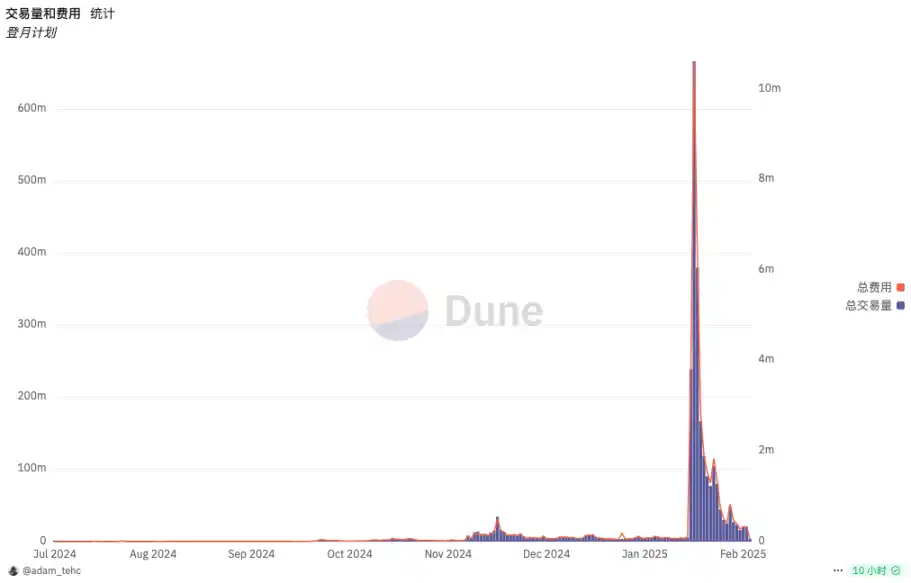
According to Dune Analytics, Moonshot's trading volume and transaction fees in 2024 showed a relatively stable development, with daily trading volumes around tens of millions of dollars and daily active traders ranging from 3,500 to 4,900. The turning point in this state came on January 18, 2025, when former U.S. President Trump launched his personal Meme coin TRUMP, which was subsequently listed on Moonshot. Trump's official tweet promoting the TRUMP token ignited a new wave of hype.
Based on official data, within 12 hours, Moonshot was recommended on TRUMP's official website as a purchase method, processing nearly $400 million in trading volume, breaking the fiat on-ramp record, and attracting over 200,000 new users.
With the decline of TRUMP and the overall market, Meme coins experienced widespread pullbacks and price fluctuations. What was Moonshot's wealth creation effect? Through an in-depth analysis of the performance of tokens listed on Moonshot in the past three months, we aim to explore its position as an emerging trading platform and the market conditions behind this effect.
March Listing: 116 Tokens, 68 Nearing Zero, One-Third Peaks Upon Listing
In this article, we have selected the tokens listed on the Moonshot platform between November 2024 and January 2025 as the research sample. The data is based on the listing time records provided by the "Moonshot Listings" account.
The overall data is as follows:
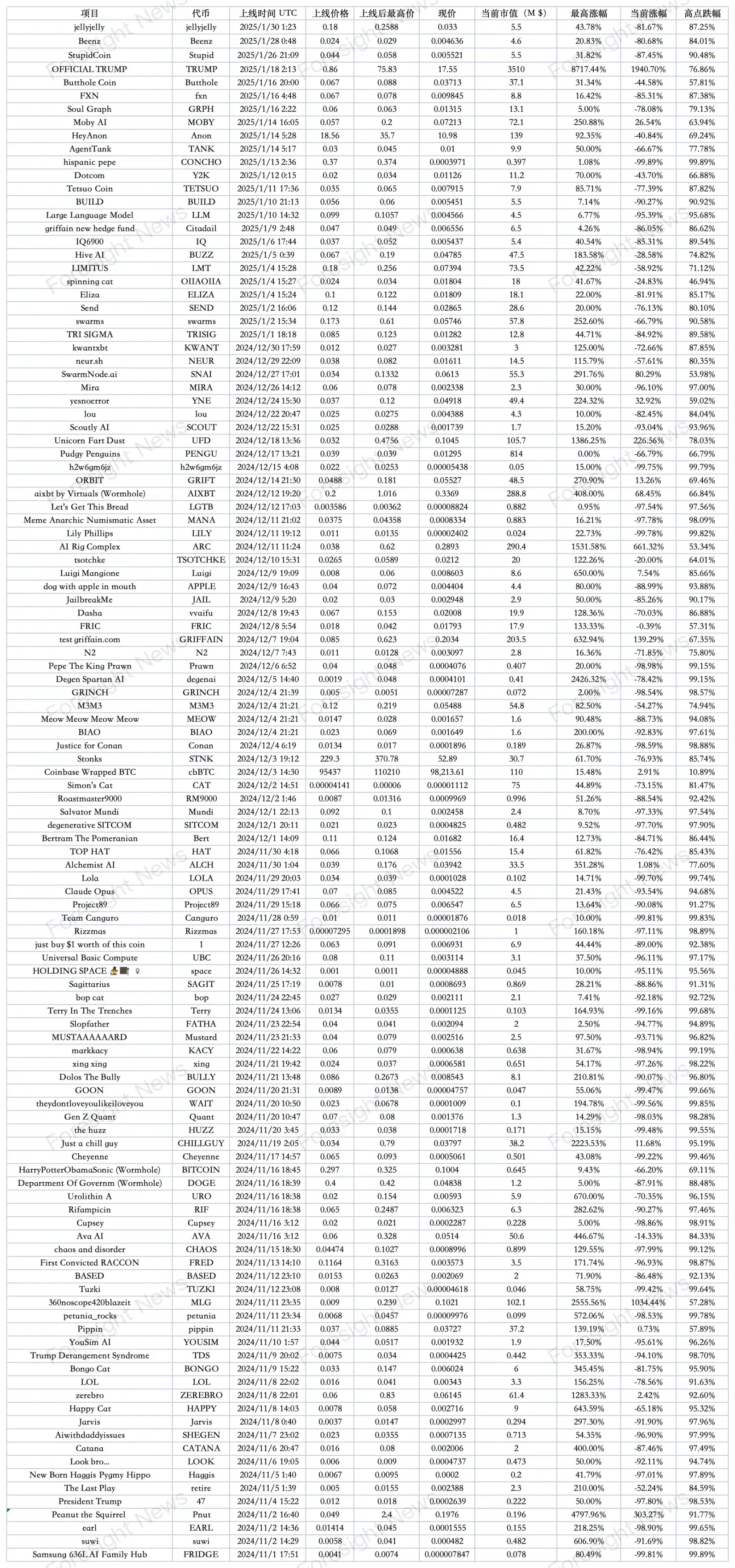
The records from "Moonshot Listings" show that during these three months, the number of tokens listed on Moonshot was 116, with 54 listed in November 2024, 38 in December, and a total of 24 listed in January 2025.
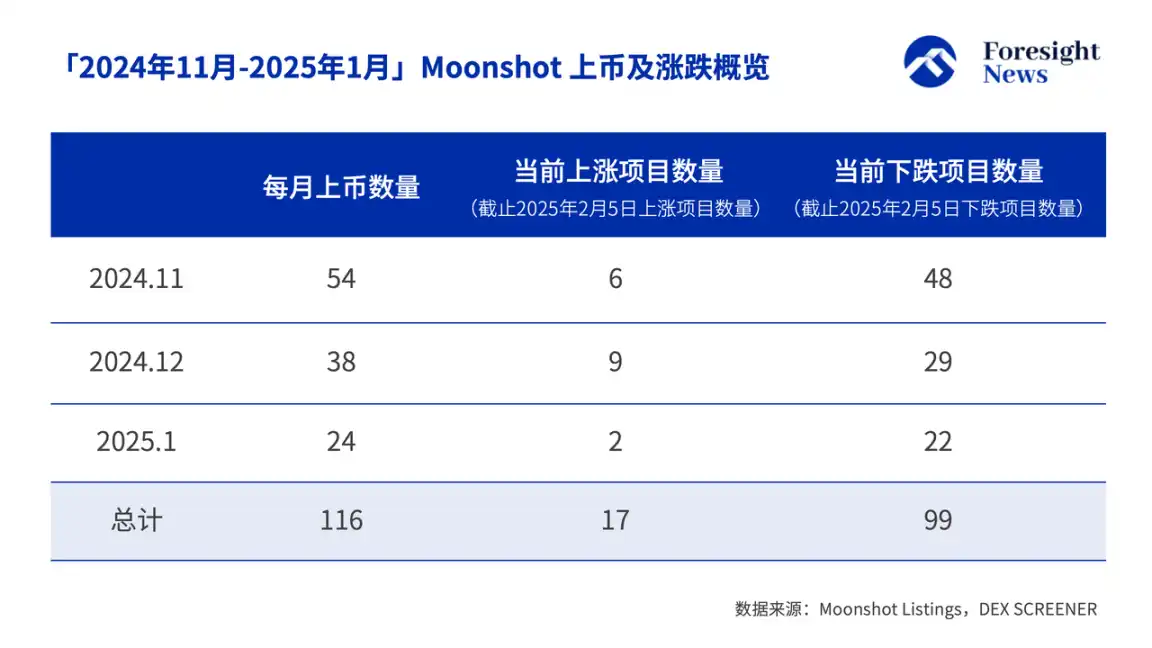
Further analysis reveals that out of the 116 listed tokens in the current market environment, only 17 are currently priced higher than their listing price, accounting for less than 15%. The vast majority of projects are currently in a downtrend, with over 85% of projects experiencing a price decline.
Due to the meme-like nature of many projects nearing zero, we also attempted to objectively calculate this data. If we define projects that have dropped by more than 90% from their peak price after listing as "nearing zero" projects, based on the statistical data, out of the 116 tokens we analyzed, 46 projects in November met this criterion, 17 in December, and 5 in January 2025, totaling 68 projects, accounting for over 58.6%. This number intuitively reflects that most tokens quickly lost market support after the initial enthusiasm.
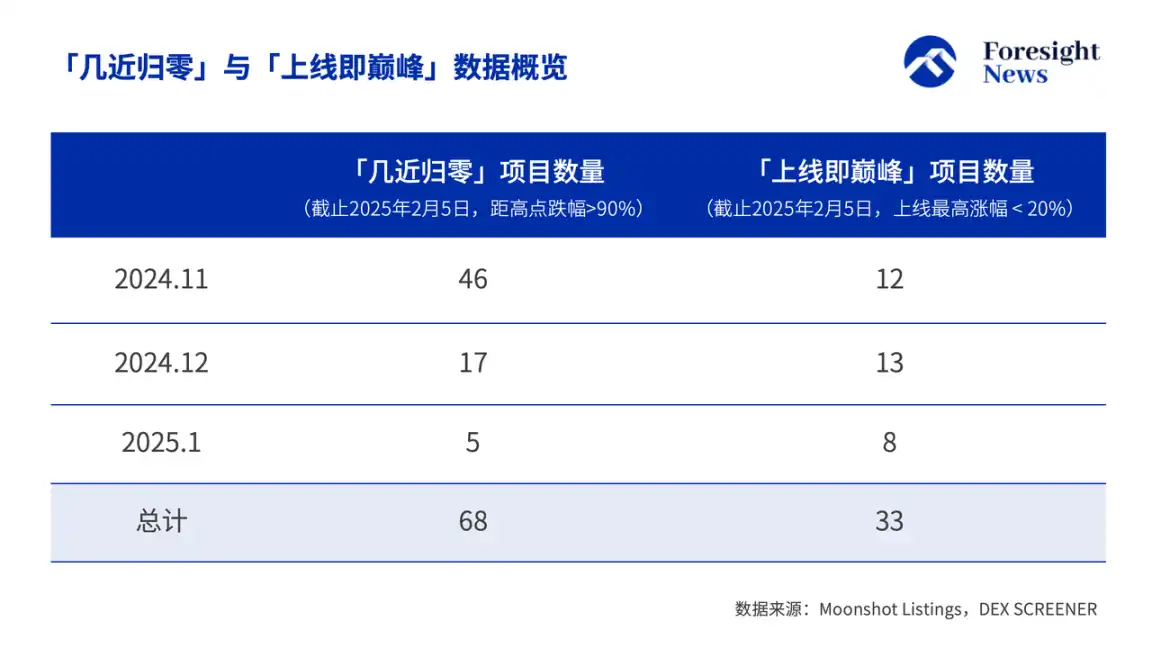
Additionally, we found that according to the criterion of projects whose highest price increase post-listing is less than 20%, classified as "peaking upon listing," the numbers in the three statistical periods were 12, 13, and 8 projects, totaling 33 projects. This means that nearly one-third of the projects had already approached their all-time highs when they first appeared on Moonshot, but due to a lack of sustained fundamental support or a weakening market confidence, they quickly lost their potential for further gains.
40% of Tokens Double After Listing, TRUMP Dominates Funding
Approximately 40% of tokens have at least doubled in price after listing, indicating that the market showed strong enthusiasm and support for some projects early on. From the data, the top ten projects in terms of current price increase and post-listing increase to some extent exhibit overlapping trends, with some tokens holding a leading position between their all-time high and current performance. Due to specific political factors, TRUMP undoubtedly holds absolute dominance.
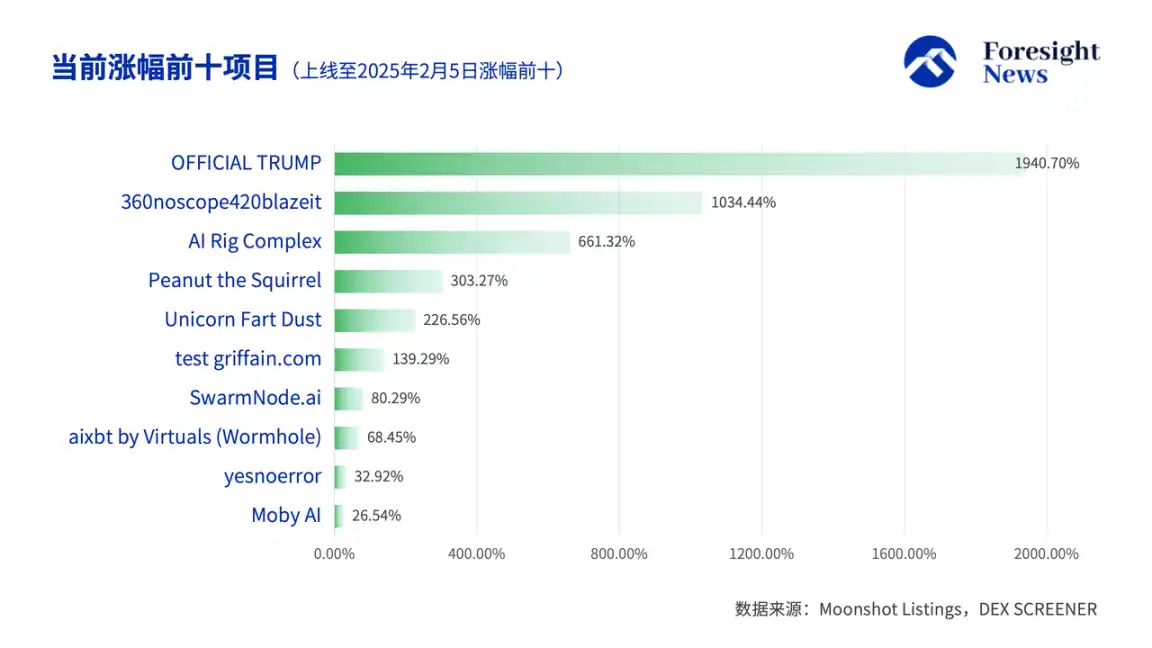
PNUT and 360noscope420blazeit (MLG) have achieved gains of 4797.96% and 2555.56%, respectively, while degenai, CHILLGUY, and several other projects have also surpassed the 20x gain threshold. These data indicate that, driven by extreme market sentiment and short-term speculation, some tokens have temporarily attracted extraordinary market attention and speculative capital, leading to significant price surges.
However, when compared to their all-time highs post-launch, the current price surges of the top ten projects appear relatively subdued. Currently, TRUMP has increased by 1940.70%, significantly lower than its previous peak; similarly, MLG and AI Rig Complex (ARC) have seen declines of 1034.44% and 661.32%, respectively, while the tenth-ranked Moby AI has only risen by 26.54%. This disparity reflects that although some projects have experienced explosive growth, with market sentiment becoming more rational and profit-taking widespread, the price surges of the vast majority of projects have significantly narrowed.
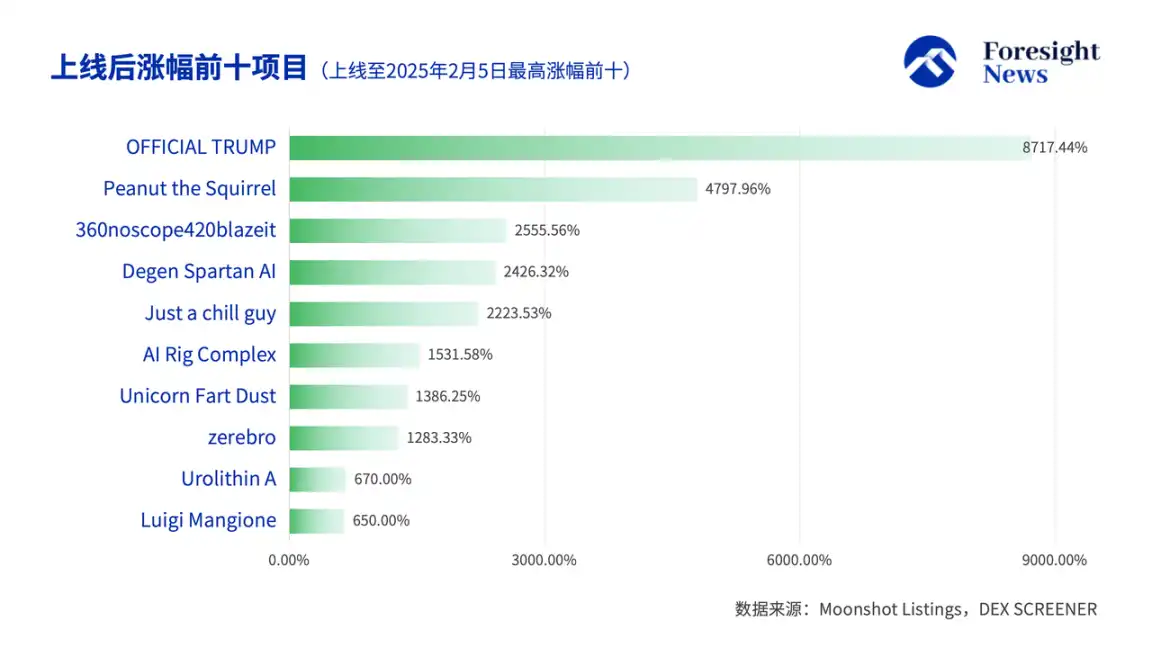
These two sets of data complement each other, painting a picture: in the short term, some projects have experienced explosive price surges due to market speculation, but as the market enthusiasm cools and profit-taking takes effect, very few projects can sustain continuous growth. This also reveals the speculative nature and intense price volatility in the current Meme coin market, while also exposing that after the initial frenzy, most projects are facing a harsh reality of value regression and risk reassessment.
“Peak-to-Trough” is Actually Resilient
Looking at the data on pullbacks from the peak, excluding the special case of Coinbase Wrapped BTC, those projects with pullbacks around 50% are actually among the less severely affected.
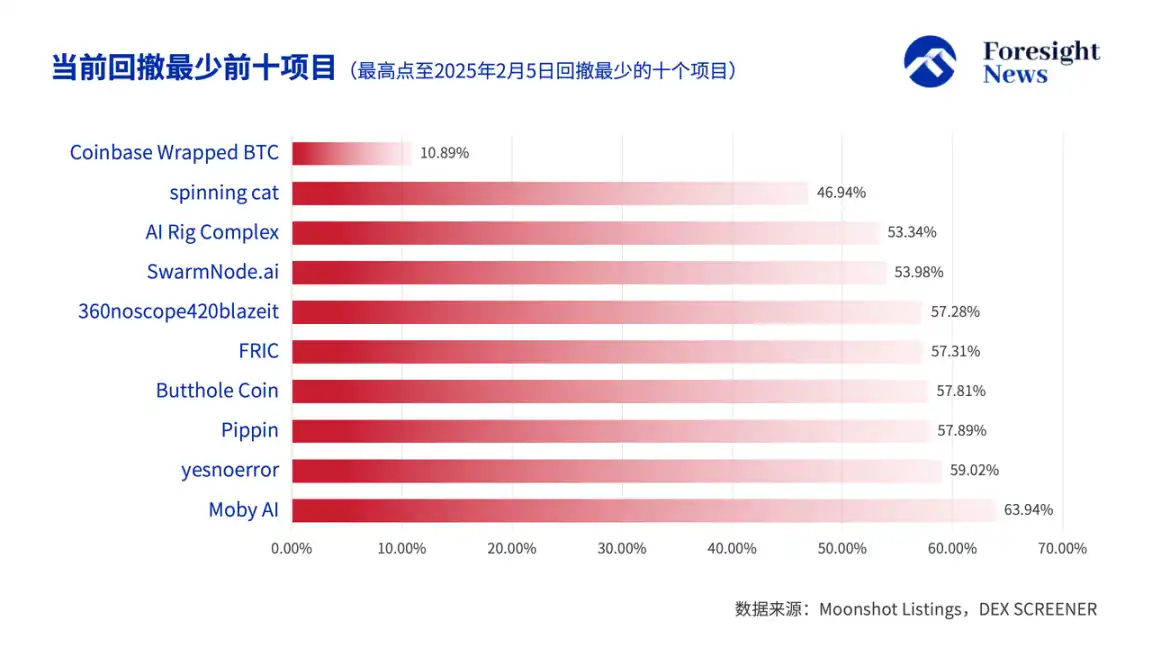
Take spinning cat (OIIAOIIA) as an example, with a pullback of about 46.94%, which can be seen as relatively mild in the context of a correction from the high. Subsequent projects like ARC, SNAI, MLG, FRIC, Butthole, and Pippin have peak-to-trough pullback percentages close to or exceeding 50%. This indicates that within the entire sample, only those few projects with pullbacks around 50% can still be considered to have fallen relatively “less,” while the majority of projects have experienced more significant price retracements.
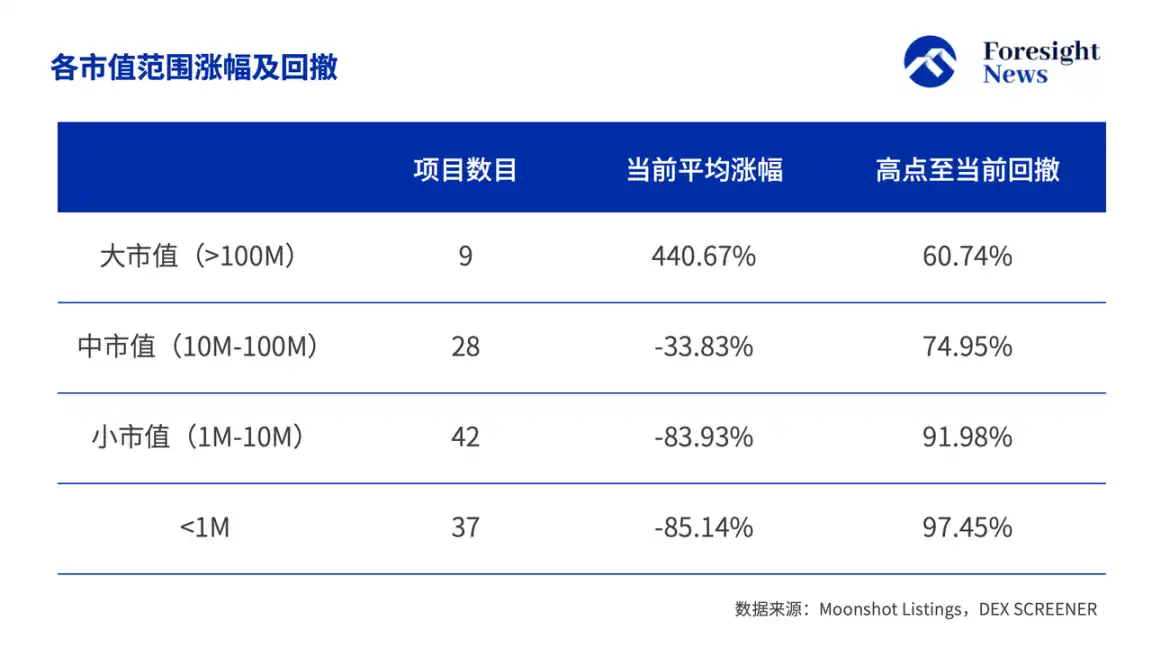
If we stratify by market capitalization, the current high market cap Meme coin group consists of only 9 projects, with an average price increase of 440.67% and an average peak-to-trough drawdown of 60.74%. In contrast, the mid-cap group (28 projects), small-cap group (42 projects), and projects with a market cap below 1 million (37 projects) present a completely different picture. Low-cap projects are more affected by speculative sentiment and market volatility, with most of them already in a "rug pull" state.
In summary, we can see that the wealth creation effect demonstrated by this platform in the Meme field is both dramatic and exposes its inherent high-risk nature. As an emerging trading platform focused on Meme coins, Moonshot's listing effect has indeed generated amazing short-term returns for individual projects (such as TRUMP) in certain extreme market conditions, attracting a large influx of speculative capital. However, looking at the overall data, out of 116 listed projects, over 85% of them have experienced significant declines, with low-cap and sub-million-dollar market cap tokens facing a fate of almost zeroing out. The listing effect has not been able to establish widespread and enduring value support in the current market environment.
Memes themselves, as assets primarily driven by entertainment and trends, exhibit extreme and rapid price fluctuations. The hype comes fast, fades fast, and the speed of going to zero is jaw-dropping. This extreme volatility and fragility are core features of the Meme asset market, where market sentiment can easily be driven to a peak by momentary hype. However, after the hype subsides, funds quickly flow out, and the price correction or even zeroing out speed far exceeds expectations.
It can only be said that while Moonshot platform's listing effect has brought substantial returns to "some" investors, it has also sounded the alarm for market participants. In this market characterized by quick gains, speculative enthusiasm is often short-lived. Risk management and rational investment are the only way to navigate this high-risk domain.
You may also like

Bitcoin Trading Guide 2026: Strategies for Experienced Traders

What Is XAUT and PAXG? Why Tokenized Gold Is Booming in 2026

Cryptocurrency CEXs are flocking to sell US stocks, and traditional brokerages are facing an "uninvited guest."

Will the SpaceX IPO Hurt Bitcoin? Here's What Traders Are Watching
Foreign selling in the South Korean stock market accelerates, with cumulative net sales reportedly reaching $75 billion this year
On June 9, The Kobeissi Letter, citing Goldman Sachs data, reported that global investors are selling South Korean stocks at an unusually rapid pace. In the latest trading session, foreign investors sold about $801 million worth of Kospi constituent stocks again; total foreign outflows last week reached about $10 billion, and the market has been in net foreign selling on nearly every trading day over the past month. According to the data cited in the report, foreign investors have sold about $75 billion worth of South Korean stocks so far this year. Meanwhile, South Korean retail and institutional investors together recorded roughly $69 billion in net buying over the same period, suggesting that the market’s main buying support has come from domestic capital rather than returning overseas funds. The information currently disclosed still mainly comes from The Kobeissi Letter’s retelling and Goldman Sachs data summaries, while public details on the statistical period and the specific definition of “selling” remain relatively limited.

Fortune Warns of Strategy’s Financing Structure Risks as Bitcoin Premium Narrows
Fortune warned that Strategy’s Bitcoin treasury model faces growing financing risks as MSTR’s net asset premium narrows and preferred stock dividend pressure increases.

Ferrari Challenge Le Mans: Carl Moon to Dominate in WEEX Livery

Sahara AI Responds to SAHARA’s Sharp Drop: No Contract or Product Security Issues Found, Internal Investigation Underway
Sahara AI responded to SAHARA’s 60% price drop, saying no token contract or product security issues have been found and an internal investigation is underway.

WEEX Deposit/Withdrawal Dynamic Island: Your Asset Status, Always in Sight

Scaling Crypto Derivatives: The Digital Asset Infrastructure Behind High-Volume Trading
In the fast-moving digital asset ecosystem, derivatives platforms face an extreme architectural test. High-leverage futures markets demand more than just standard security—they require absolute operational precision, zero-latency matching engines, and ironclad structural scalability, all while navigating intense market volatility.
As global platforms scale to meet these demands, the industry is shifting away from rigid, monolithic setups toward a more agile, "decoupled" infrastructure philosophy.
The Blueprint for High-Volume Copy TradingFor elite global exchanges like WEEX (founded in 2018), this architectural choice becomes critical when scaling high-volume retail features like social copy trading. When thousands of users automatically mirror the real-time strategies of elite traders simultaneously, it triggers sudden, monumental spikes in concurrent transactional volume.
To prevent execution latency or settlement bottlenecks during these peak volatility events, a platform's primary engine must remain entirely dedicated to risk management, copy-trade synchronization, and order matching.
The Architectural Rule: New-generation platforms must separate front-end user execution engines from heavy backend infrastructural overhead to eliminate operational friction.
By separating these layers, platforms can maintain complete sovereignty over their trading environments and user experiences while strategically aligning with institutional-grade infrastructure ecosystems. This strategic framework allows modern exchanges to leverage advanced Digital Asset Custody infrastructure such as Cobo’s behind the scenes, ensuring that backend wallet management scales elastically alongside trading spikes.
Capitalizing on Market Momentum and 400× LeverageIn a derivatives arena where platforms offer up to 400× leverage on perpetual contracts, capital efficiency and market agility are core business metrics. To capture market momentum, an exchange needs the ability to rapidly expand its asset offerings, supporting everything from legacy crypto assets to sudden, trending altcoins across a massive library of trading pairs.
Adopting a flexible, scalable Wallet-as-a-Service (WaaS) solution such as Cobo’s could completely rewrite the development timeline for high-growth exchanges. Instead of spending months of engineering capital building out custom backend wallet architectures for every new blockchain network, platforms can deploy localized infrastructure in days.
This agility allows platforms to instantly scale their listings to over a thousand trading pairs without compromising security or delaying time-to-market. It mirrors the exact operational advantages seen during high-velocity market events, similar to how advanced wallet infrastructure empowers platforms during sudden asset surges; allowing exchanges to pass that speed and liquidity directly to their global user base.
A Mature Foundation for GrowthThe synergy between trusted infrastructure ecosystems and global trading platforms represents the natural evolution of a maturing crypto market. As WEEX continues to scale its global spot and derivatives offerings for over 6 million users, adopting robust backend paradigms proves that platforms no longer have to compromise between cutting-edge trading velocity and uncompromised structural security.

Morning Report | BitMine increased its holdings by 126,971 ETH last week; trader Eugene announced his exit from the crypto market

Wang Chuan: How can one not feel anxious after the neighbor Old Wang made thirty times profit by investing in storage stocks? (Seven) - A quarter-century cycle

Get Paid to Onboard? Try WEEX’s New Homepage with Rewards for Registration, Deposit & Trade

WEEX Custom Layout: Build Your Perfect Trading Workspace in Seconds

See “Buy Walls” & “Sell Walls” Instantly: WEEX Launches the Depth Chart for Smarter Trades

What Is Quick Trade on WEEX? 2 Ways WEEX Ends Chart-Panel Jumping
Morning News | Five major virtual asset platforms in South Korea have experienced 57 incidents of hacking and system failures in six years; Grayscale submits registration application for Canton ETF
Should we escape the peak? The principle of the tail-end market in the stock market
Bitcoin Trading Guide 2026: Strategies for Experienced Traders
What Is XAUT and PAXG? Why Tokenized Gold Is Booming in 2026
Cryptocurrency CEXs are flocking to sell US stocks, and traditional brokerages are facing an "uninvited guest."
Will the SpaceX IPO Hurt Bitcoin? Here's What Traders Are Watching
Foreign selling in the South Korean stock market accelerates, with cumulative net sales reportedly reaching $75 billion this year
On June 9, The Kobeissi Letter, citing Goldman Sachs data, reported that global investors are selling South Korean stocks at an unusually rapid pace. In the latest trading session, foreign investors sold about $801 million worth of Kospi constituent stocks again; total foreign outflows last week reached about $10 billion, and the market has been in net foreign selling on nearly every trading day over the past month. According to the data cited in the report, foreign investors have sold about $75 billion worth of South Korean stocks so far this year. Meanwhile, South Korean retail and institutional investors together recorded roughly $69 billion in net buying over the same period, suggesting that the market’s main buying support has come from domestic capital rather than returning overseas funds. The information currently disclosed still mainly comes from The Kobeissi Letter’s retelling and Goldman Sachs data summaries, while public details on the statistical period and the specific definition of “selling” remain relatively limited.
Fortune Warns of Strategy’s Financing Structure Risks as Bitcoin Premium Narrows
Fortune warned that Strategy’s Bitcoin treasury model faces growing financing risks as MSTR’s net asset premium narrows and preferred stock dividend pressure increases.


