
28-Year-Old American Guy Issues a Coin for the Once $70 Billion Enron?

This may be the most interesting thing that happened in the crypto world after the US President launched the $TRUMP coin. To tell this story, we need to go back to the early 21st century and start with a historical investment scam that took place back then...
The Historical Investment Scam in the Early 21st Century
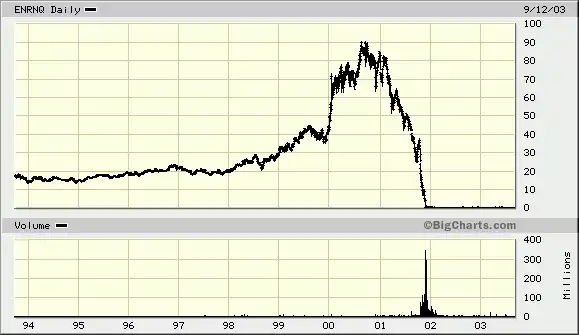
The image above is not from the cryptocurrency world's price movement but from the former US stock market, from the Enron Corporation.
It was a former giant in the US energy sector and one of the most infamous entities since the emergence of "financial fraud." As a former Wall Street darling stock, Enron's stock was once highly sought after by investors and analysts, with the stock price reaching a high of $90.75 in August 2000. However, as the financial scandal unfolded, the stock price plummeted rapidly. Eventually, the company filed for bankruptcy, the stock price dropped to $0.26, it was delisted from the New York Stock Exchange, and trading was suspended.
Thousands of employees lost their jobs due to Enron's bankruptcy, and countless investors were left penniless in this historical scam.
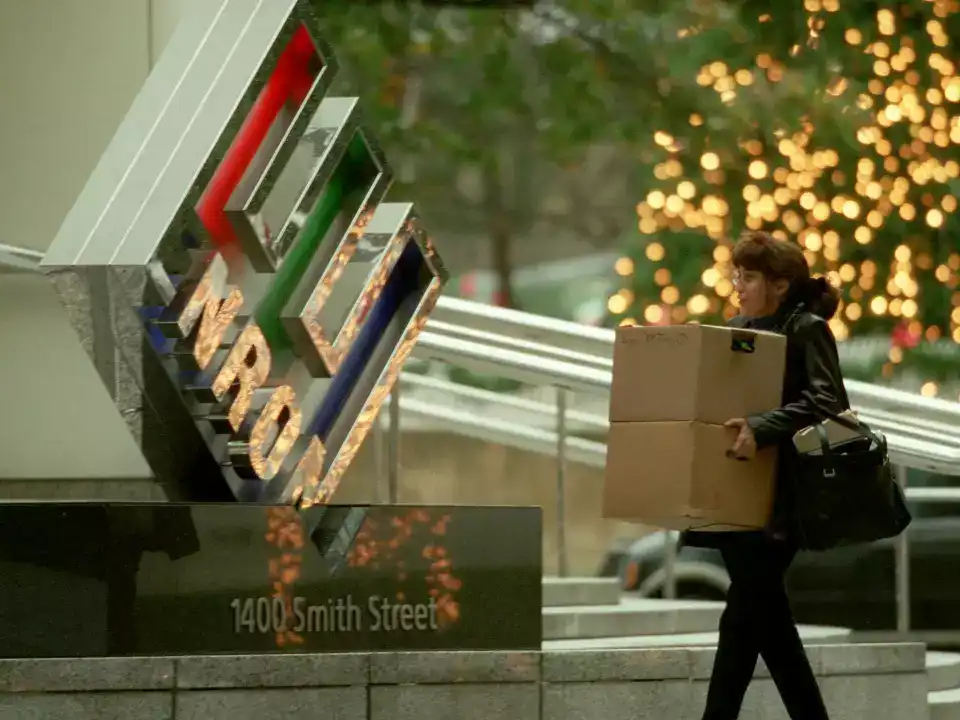
At 28, Holding the Enron CEO Role for $275
When this tragedy occurred, the protagonist of the story, Connor Gaydos, was only 5 years old, and the wheels of destiny began to turn. 23 years later, he became the CEO of Enron Corporation.

Connor Gaydos
In 2020, the trademark of Enron Corporation was acquired by a company named "The College Company," and Connor Gaydos is the co-founder of this company.
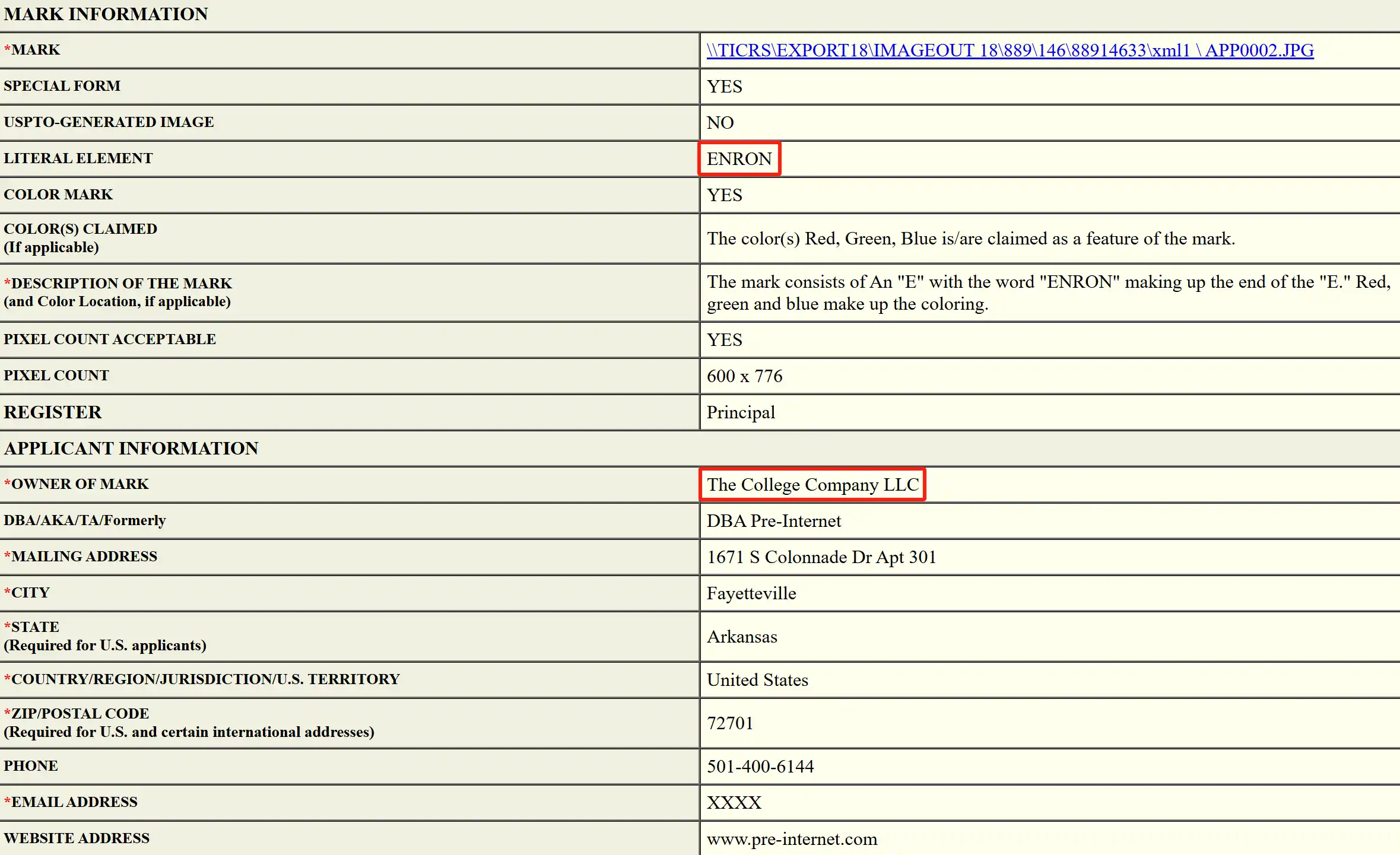
How much did it cost to acquire the Enron trademark? $275.

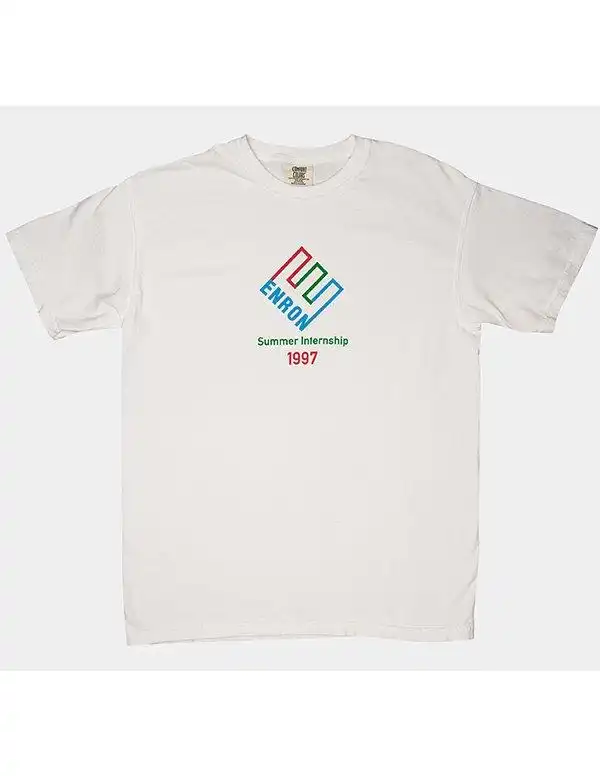
What was the purpose of acquiring this trademark? The answer at that time was—to sell clothing.
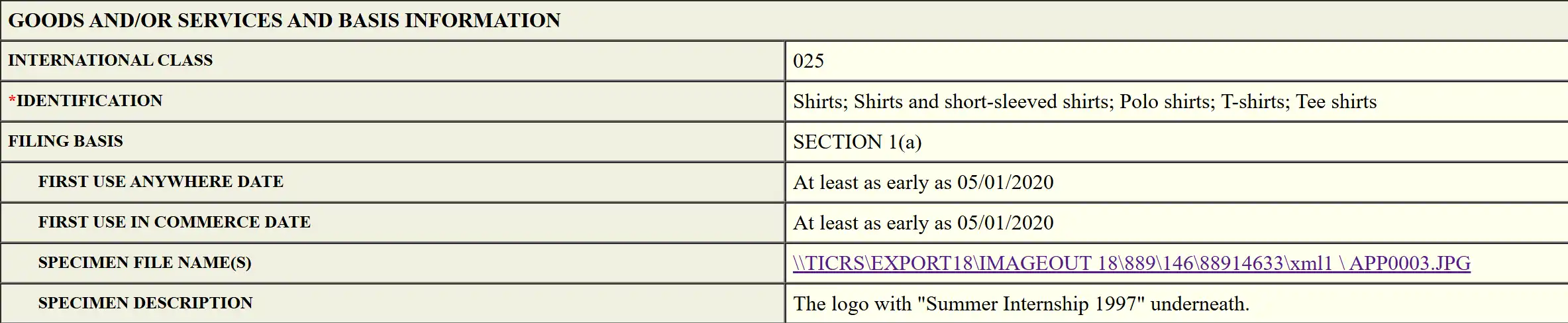
What does this piece of clothing look like? It features a large logo of the Enron corporation with the text below saying "1997 Summer Internship." I wonder how Enron's former employees, especially those who truly joined the company as interns in the summer of 1997 and ended up losing everything in the end, would feel when they see this garment...
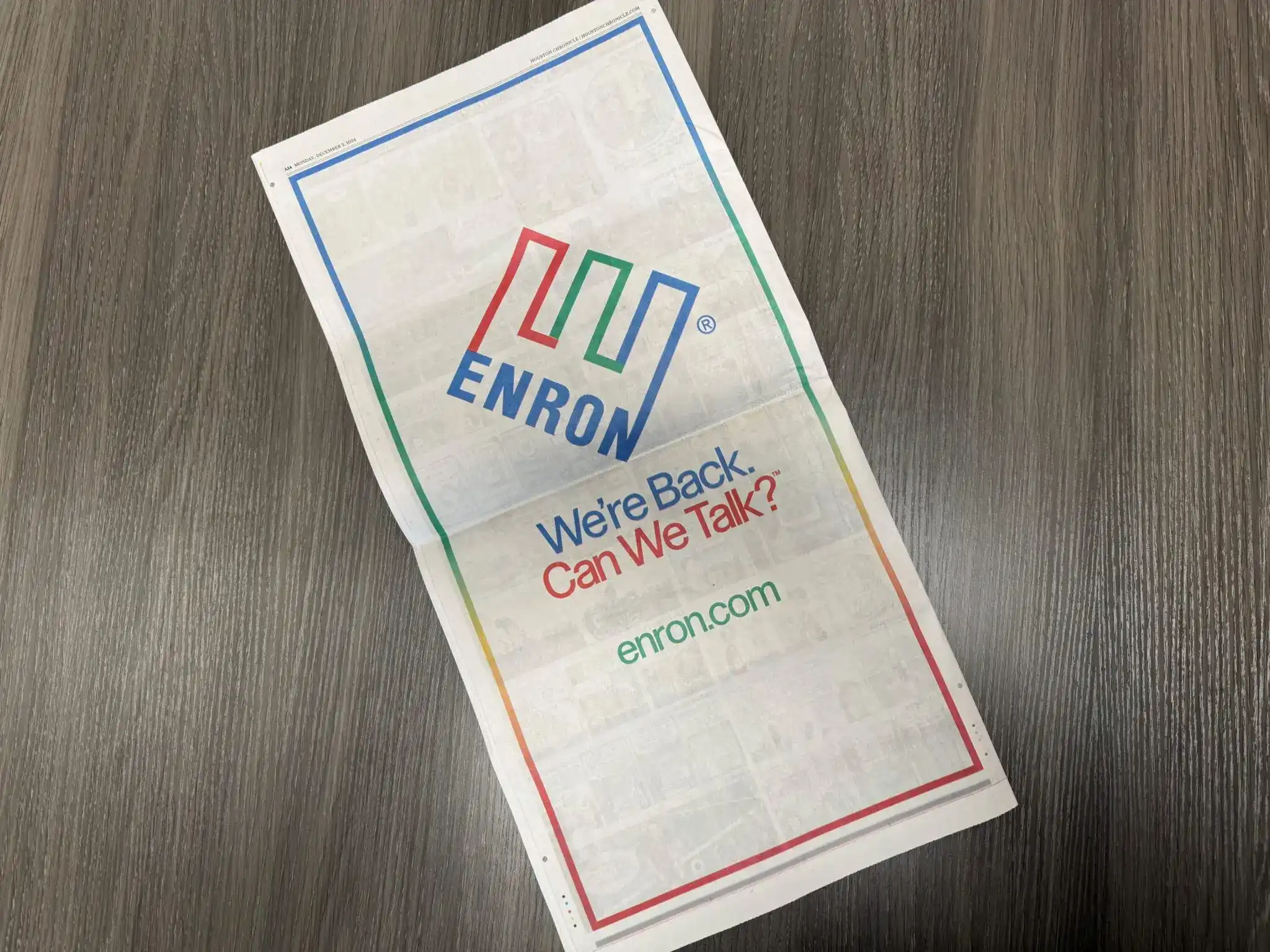
Fast forward to the year 2024. On December 2, 2024, which marks the 23rd anniversary of Enron's bankruptcy, a full-page advertisement from Enron appeared in the Houston Chronicle, causing a sensation across the United States—Enron is back?
Simultaneously, a new official website and social media presence emerged. The social media account even released a one-minute serious advertisement, giving the appearance of seriousness. However, it's unclear what Enron's comeback entails, but they keep emphasizing everywhere:
"We are making a comeback, can we talk?"
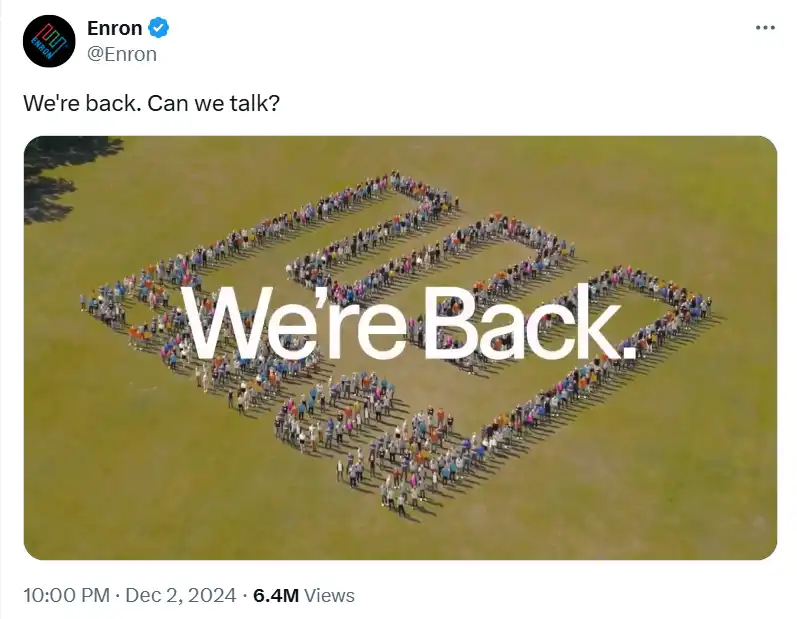
On this day, the official account announced the establishment of the new Enron Corporation, aimed at addressing the global energy crisis. In Houston, the city where the original Enron was headquartered, people also spotted large Enron billboards.

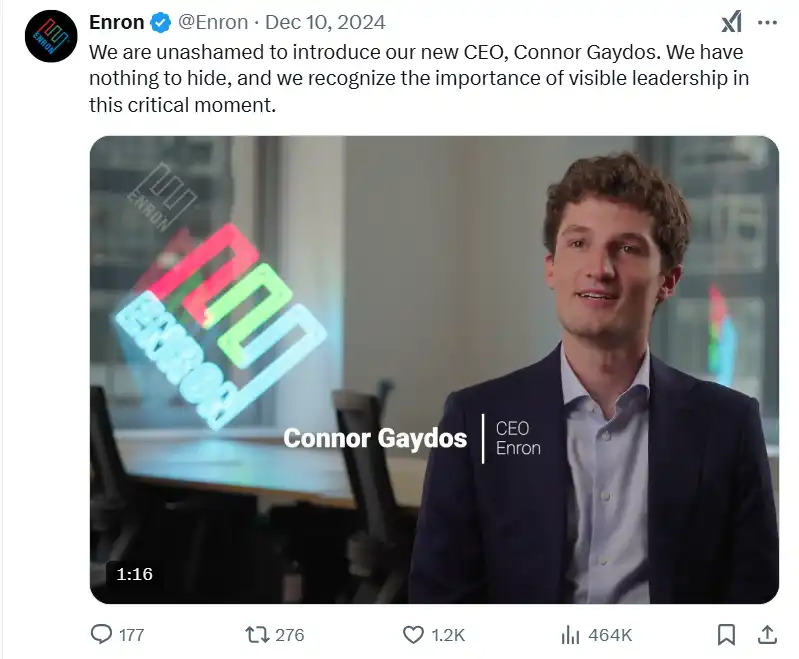
On December 10, 2024, the new Enron's official social media account formally announced Connor Gaydos as the CEO of the new Enron Corporation. The content of this post was quite intriguing, directly addressing Enron's past and stating, "We are completely transparent, with nothing to hide."
The Last Remaining Shell of a Former Energy Giant, Now a Tool of Performance Art
So, is Connor Gaydos really here to solve the global energy crisis? Of course not. Let's take a look at what this "resurrected" CEO of Enron has been up to.
Firstly, as the new company supposedly aiming to resolve the global energy crisis, the online store page on their website doesn't sell energy but instead offers clothes, hats, water bottles, and stickers. They have essentially turned energy stations into a large marketplace, transforming the bankrupt energy giant into a fashion brand akin to UNIQLO after 24 years.
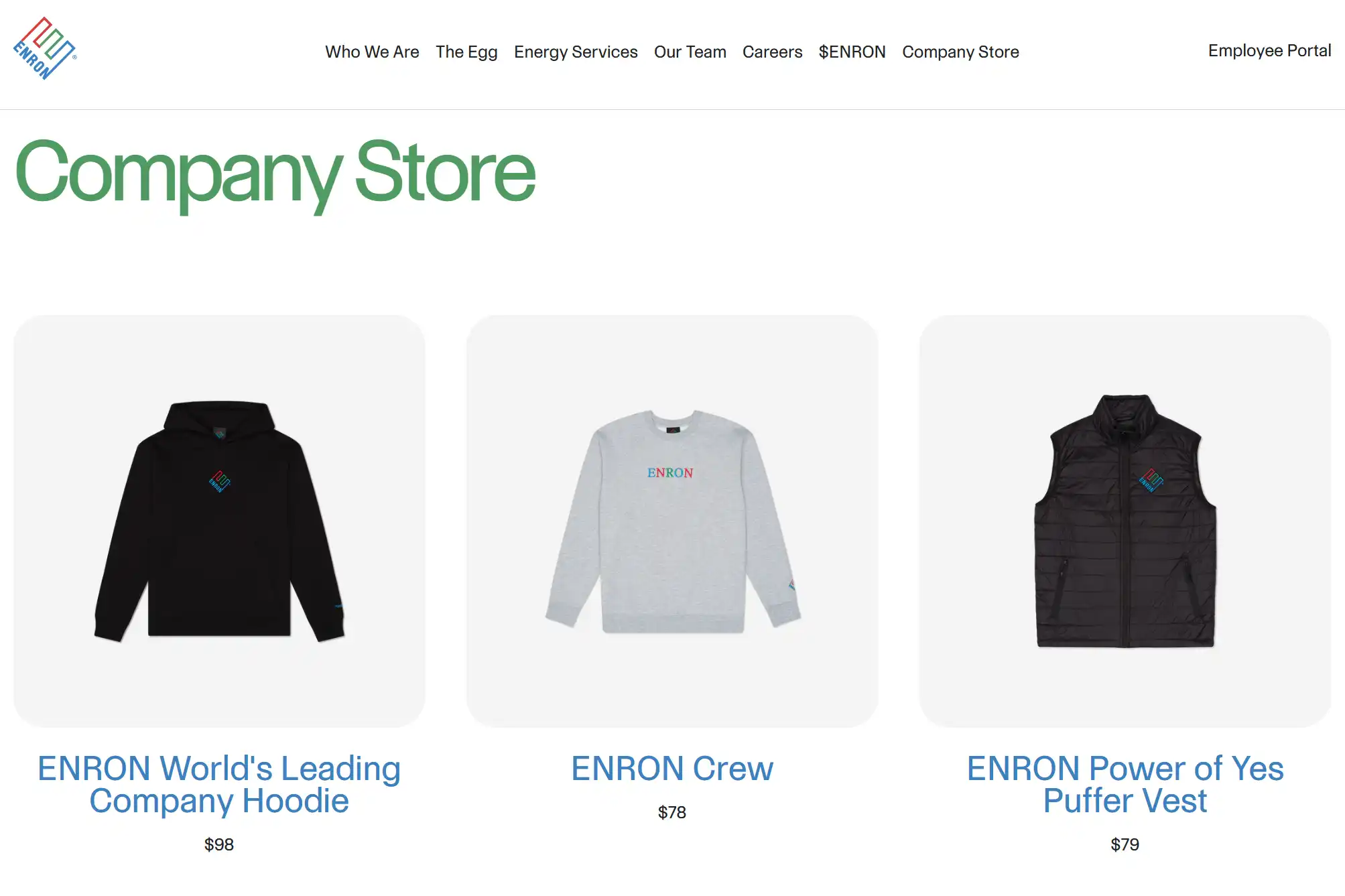
Get one and recharge your body
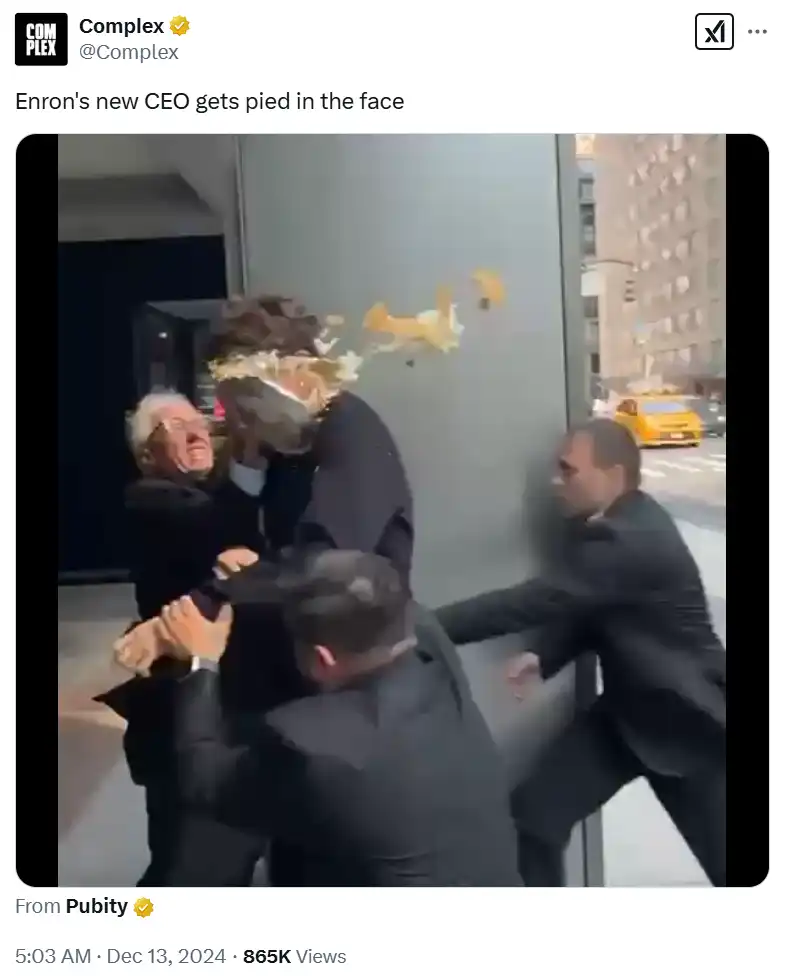
Next, on December 13, 2024, our newly appointed 28-year-old CEO stepped out of a black sedan, smiled and waved at the camera, only to be "pie-faced" by an old man at the corner with a giant pie straight to the face. The video was shot in a very funny way, with some unknown security actor who was much shorter than the CEO, ultimately protecting the CEO covered in pie crust like escorting a criminal...
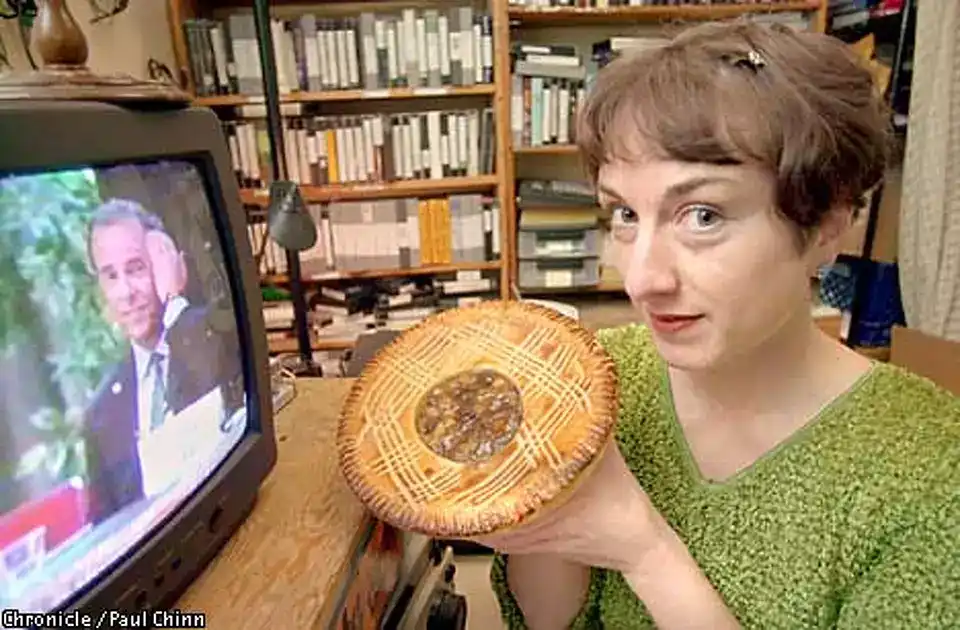
Interestingly, this was a cue to a similar event that occurred 24 years ago. On June 21, 2001, a lady named Francine Cavanagh greeted former Enron CEO Jeff Skilling with a pie to protest in San Francisco. She was detained but not arrested.
More importantly, this led to a "offline reconciliation meeting" three days later.
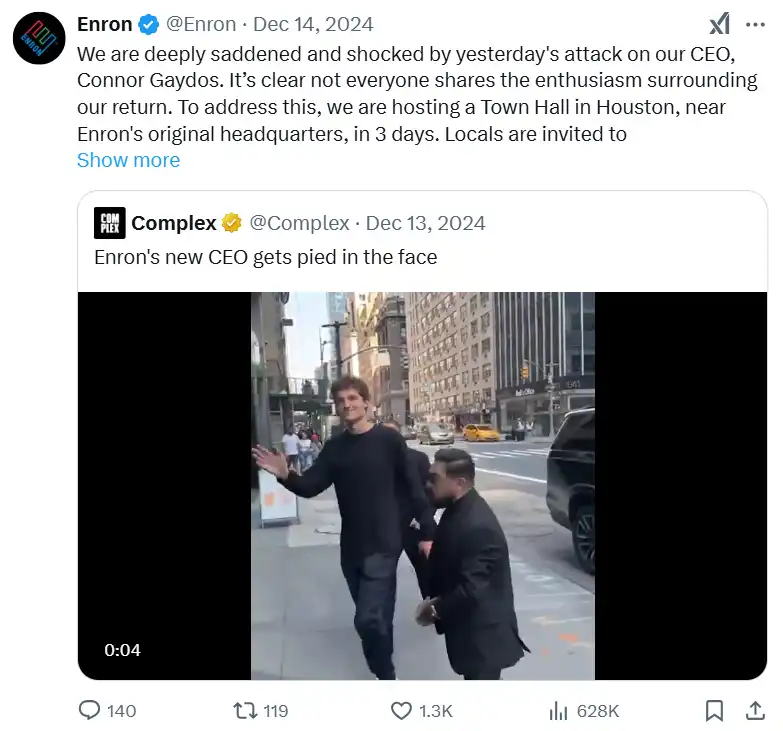
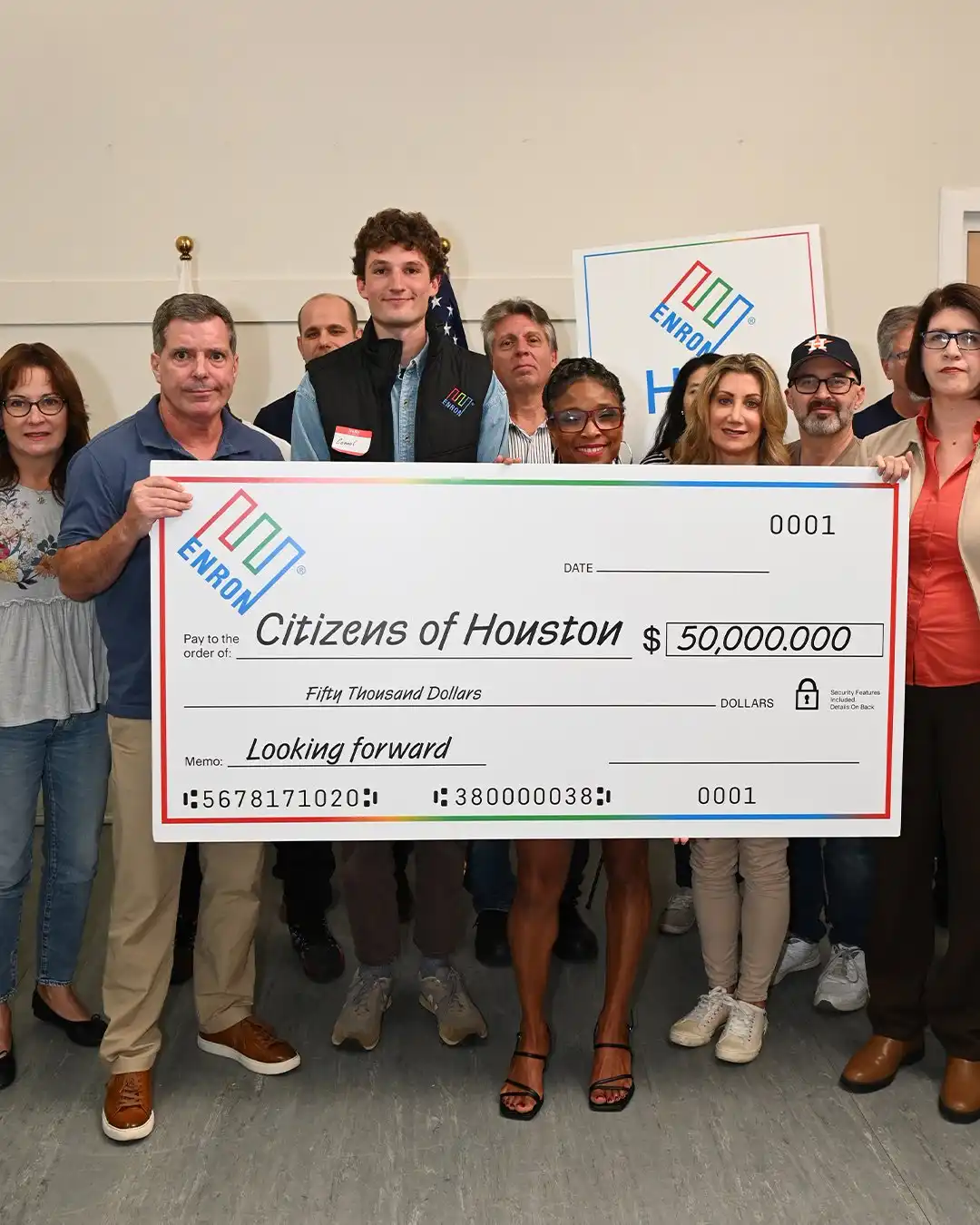
During this "offline reconciliation meeting," the new Enron CEO donated $50,000 to all Houston residents, urging everyone to look forward, creating a very harmonious atmosphere.
Following that was a heavyweight move; on January 7, the new Enron Company announced the launch of a revolutionary energy product, the Enron Nuclear Egg.
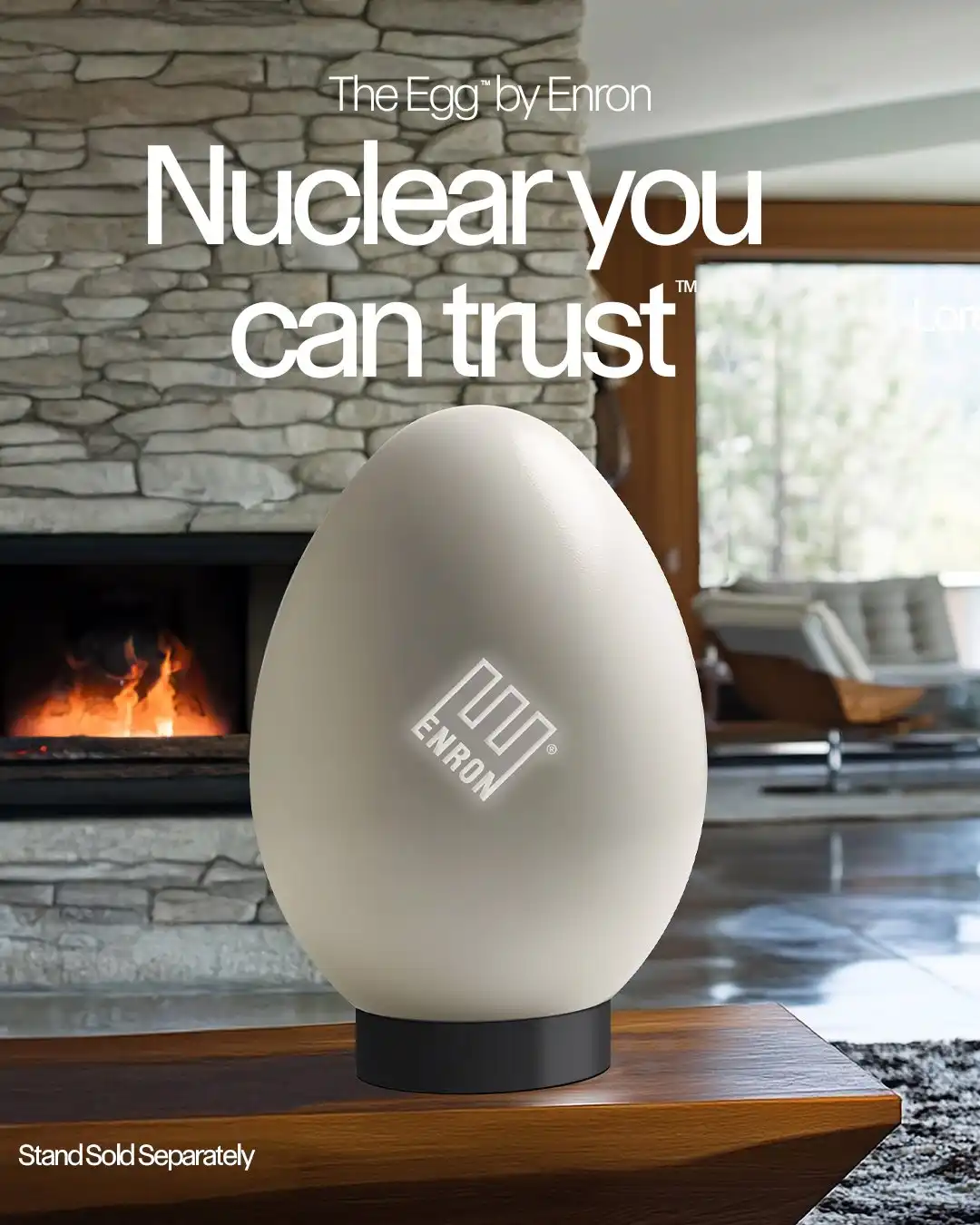
The Enron Nuclear Egg, the world's first residential micro nuclear reactor, can provide uninterrupted power to homes for up to 10 years. How was such a high-tech thing achieved?
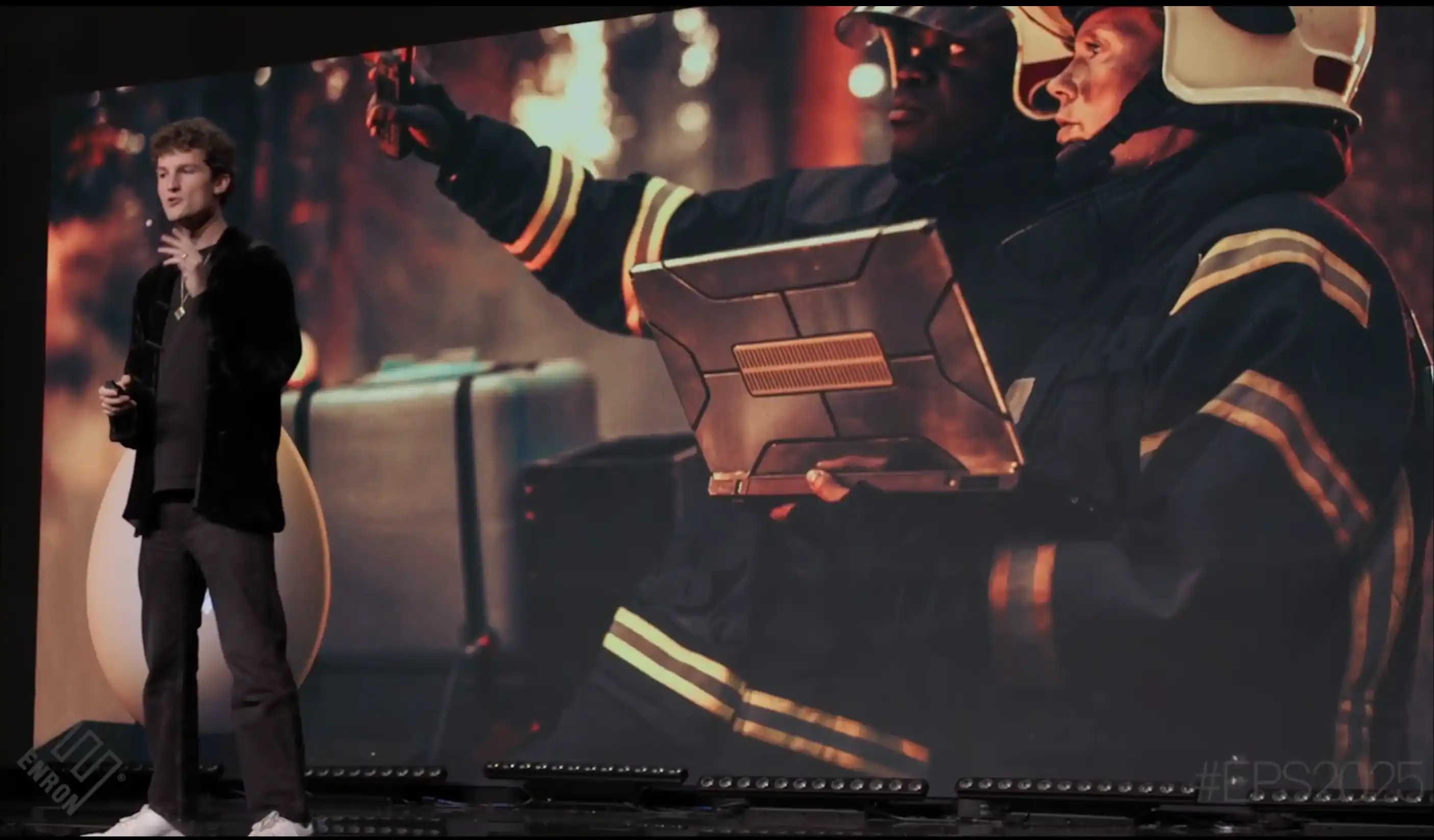
In a 5-minute-long Twitter press conference video, the CEO said it was all thanks to Enron's mineral department developing a material called "Enron Ore." The new Enron will also collaborate with FEMA (Federal Emergency Management Agency) under the Department of Homeland Security to provide them with the Enron Nuclear Egg, ensuring portable energy supply for emergency responses.
This event also featured the new Chief Technology Officer of New Enron, Daniel Wong. This guy claimed that our energy egg only used 20% enriched uranium, far below the level required to make nuclear weapons. After speaking, he felt a sense of fruitful joy.
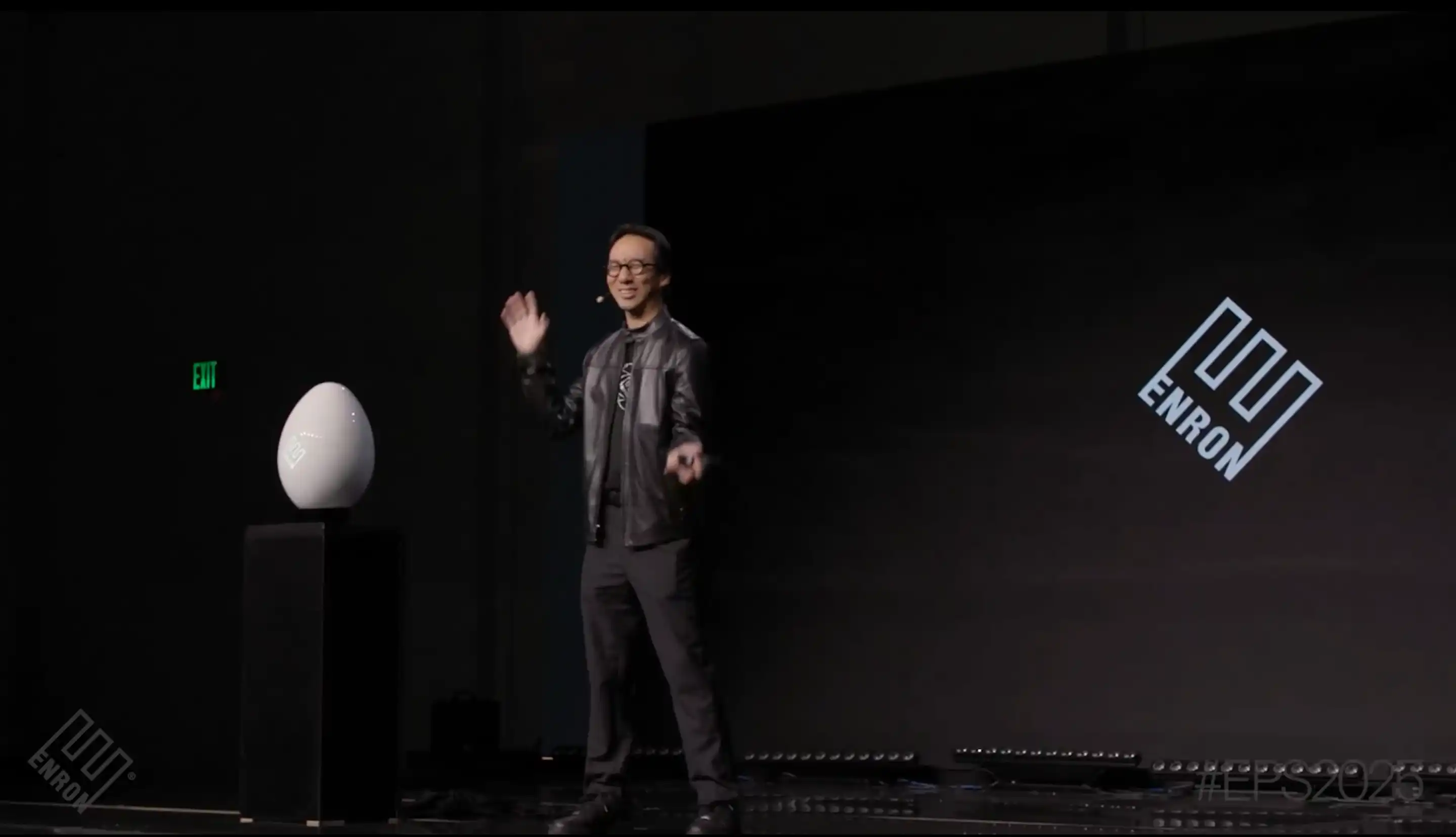
Indeed, it is far below the over 90% enriched uranium needed to manufacture nuclear weapons, but ChatGPT told me that nuclear power plant fuel typically uses only 3%-5% enriched uranium. Whether they've installed a nuclear power plant at home or are casually enjoying radiation at home, I am very confused...
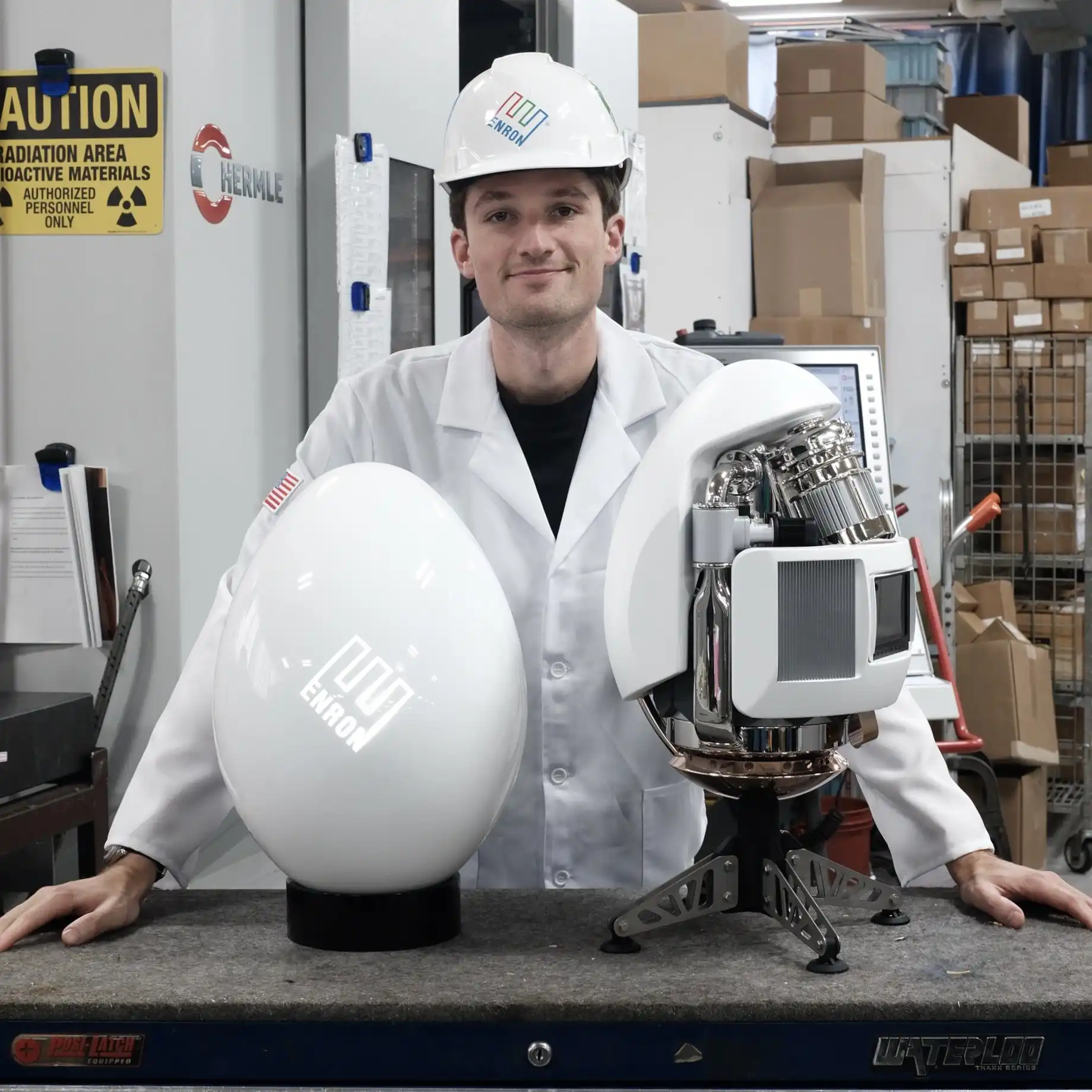
Everything was done in an orderly manner. In a few days, New Enron's official Twitter account released a photo of the CEO at the Enron Nuclear Egg Factory, along with a short video titled "CEO Takes You Inside the Enron Nuclear Lab."
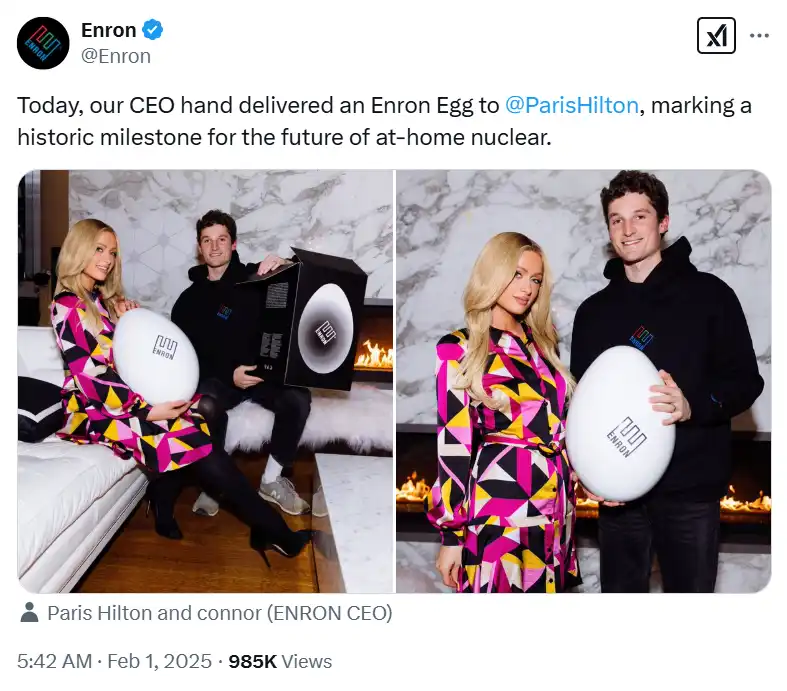
On January 25th, Paris Hilton tweeted at the CEO on Twitter, expressing her desire for a New Enron Energy Egg. On February 1st, they met, and successfully delivered the egg into Paris Hilton's hands. Thus, art was created.
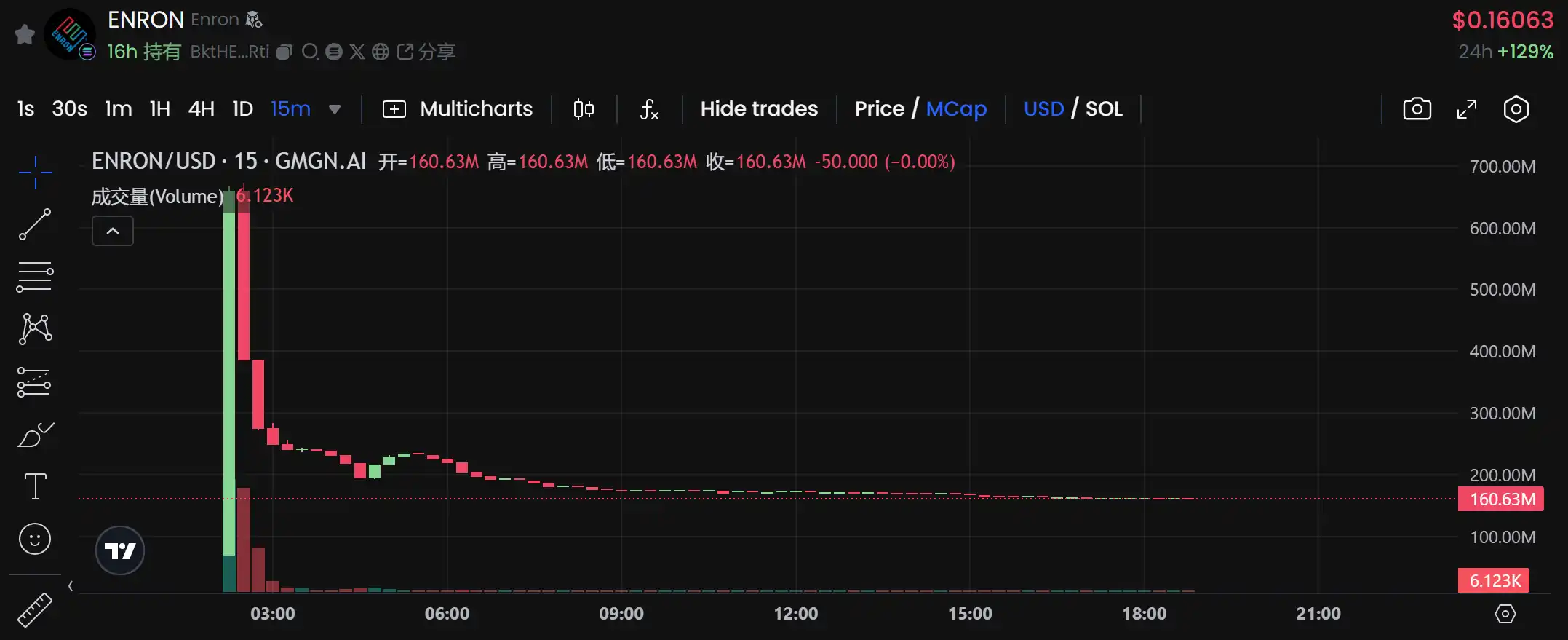
Finally, there was the $ENRON token launched on Solana last night. After this token was released, many in the crypto community questioned whether the egg created by New Enron was a scam akin to turning water into oil. However, this was all part of the "play" orchestrated by Connor Gaydos, the New Enron CEO, a large-scale meme performance breaking the fourth wall from reality to the virtual world...
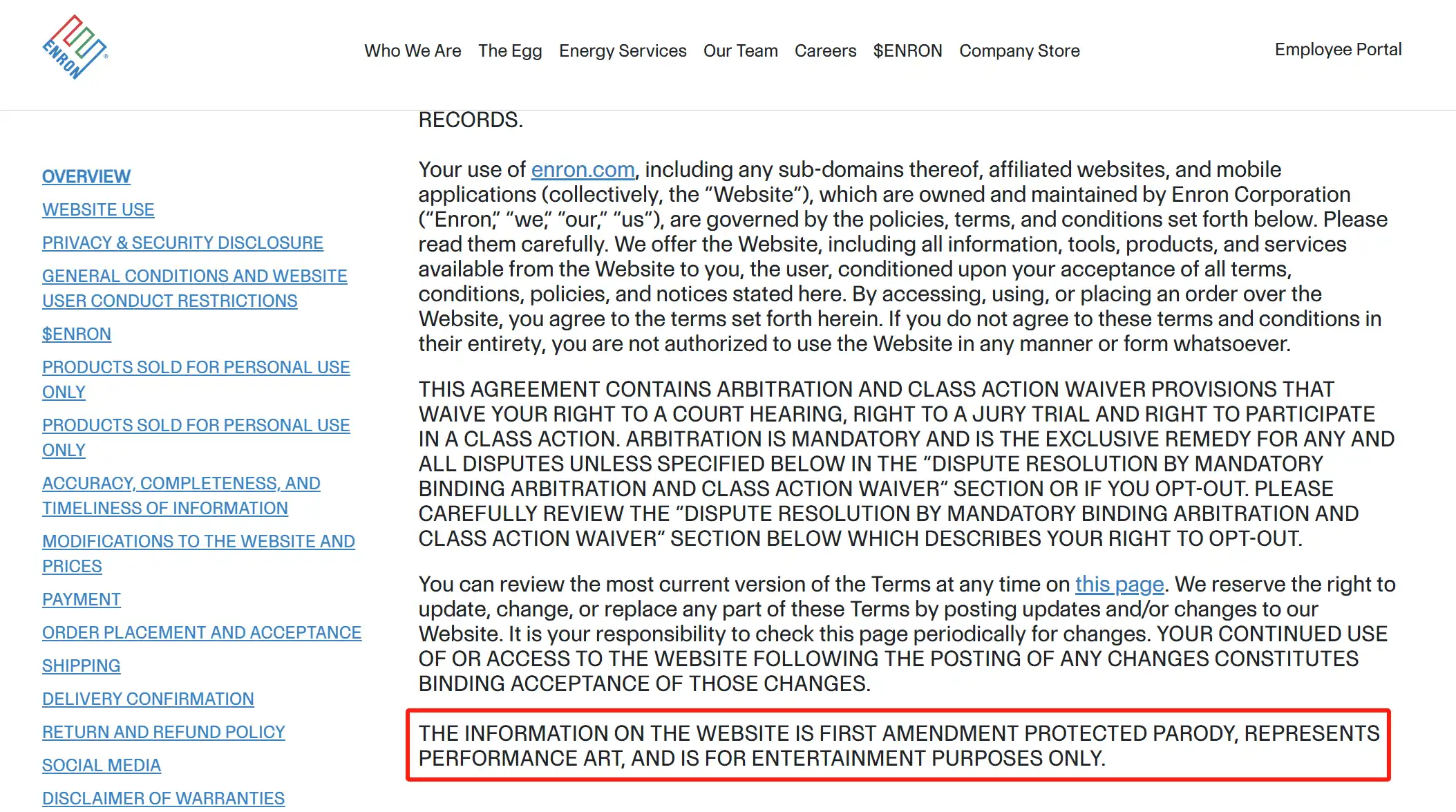
In the terms of use on the New Enron website, it is emphasized in capital letters that "the information on this website is satirical content protected by the First Amendment to the United States Constitution, constitutes performance art, and is for entertainment purposes only."
As mentioned earlier, Connor Gaydos, as a co-founder of 'The College Company,' also owns the trademark for 'BIRDS AREN'T REAL.'
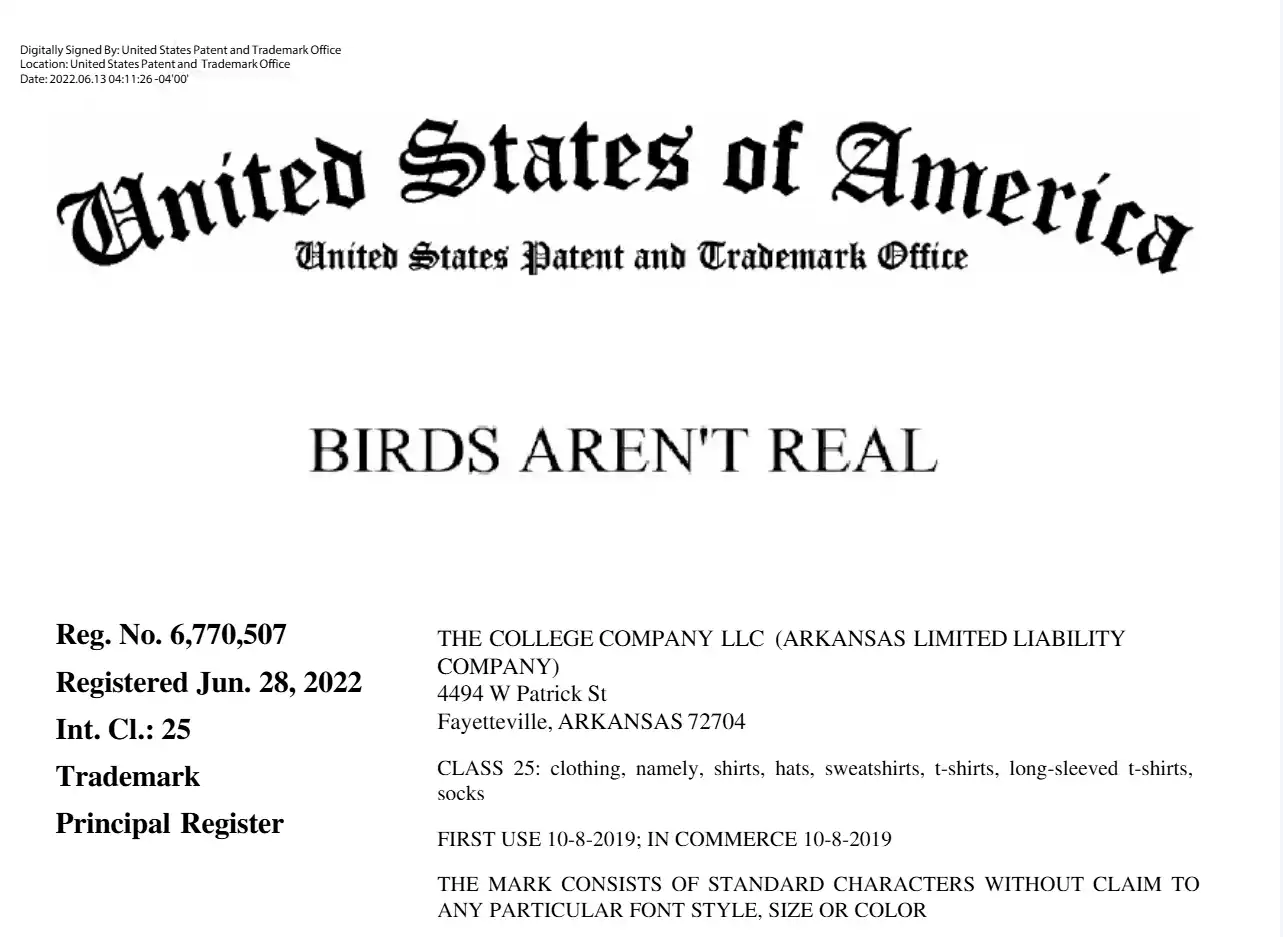
'BIRDS AREN'T REAL' is an ironic movement promoted by Connor Gaydos and Peter McIndoe, pretending to advocate the conspiracy theory that "all of America's birds have been killed by the government, and the birds we see are surveillance drones monitoring the public." This movement satirizes real-life conspiracy theories like "the moon landing was fake." Many fans participate, forming a community of a seemingly legitimate conspiracy theory to observe the spread of information and the public's reaction.
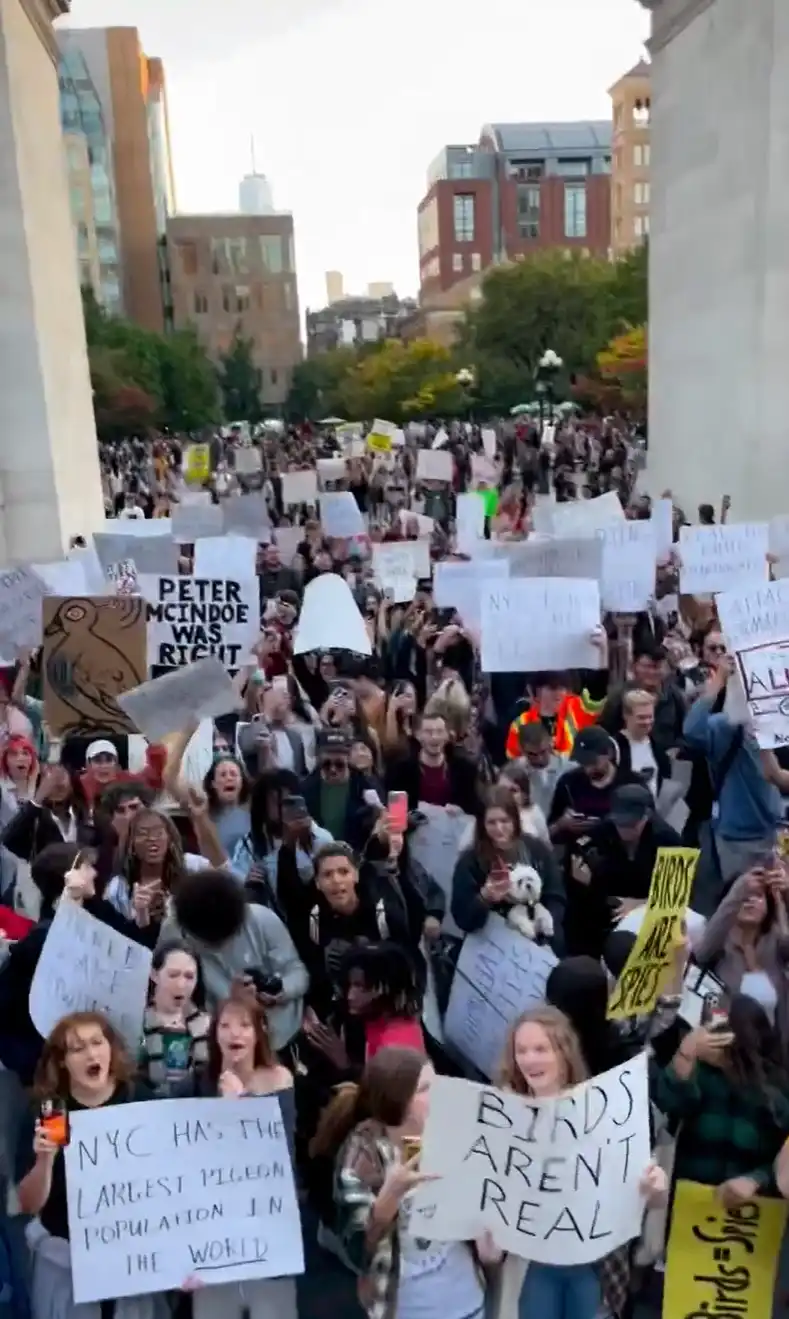
Surprise! The new CEO of New Enron, who not only took out a full-page newspaper ad, purchased a billboard, and recorded a press conference video, but did everything to establish a company in reality that could deceive people with its falsehoods. This is an ongoing performance art piece and social experiment.
Epilogue
After reading all the stories above, you may be left with one question at the end—
Is that it? All that effort just to launch a token?
If everyone went to such great lengths over four years to launch a token, it would be great. We could explore so many angles... It's a bit of a pity that everyone's focus is on "the meme project team making a fortune" or "New Enron is here to scam again," rather than taking a moment to appreciate the rare cross between Web2 and Web3 performance art itself.
To put so much thought into something, even if it's abstract, is admirable. This project reminds me of an example I mentioned when introducing Milady two years ago—
Recently, I encountered a map of "My House" in the old game "DOOM," where the author logged back into the game forum 17 years later and released a map honoring his deceased friend. Due to the intricate contents, it's almost impossible to tell whether it's based on real-life events or is a piece of "performance art"... But, it really immerses people.
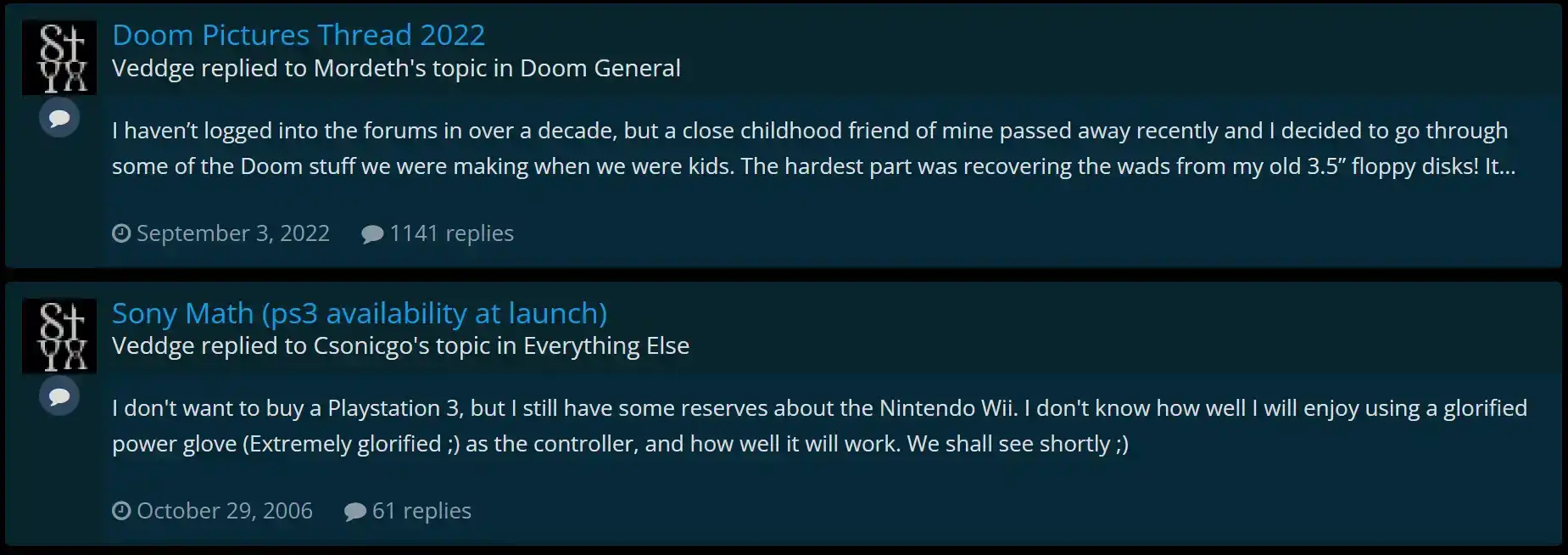
If what we wanted was an amazing meme, Enron achieved it. I'd like to call Connor Gaydos the innate abstract deity. Welcome to Web3, Gaydos.
You may also like

Cryptocurrency CEXs are flocking to sell US stocks, and traditional brokerages are facing an "uninvited guest."

Will the SpaceX IPO Hurt Bitcoin? Here's What Traders Are Watching
Foreign selling in the South Korean stock market accelerates, with cumulative net sales reportedly reaching $75 billion this year
On June 9, The Kobeissi Letter, citing Goldman Sachs data, reported that global investors are selling South Korean stocks at an unusually rapid pace. In the latest trading session, foreign investors sold about $801 million worth of Kospi constituent stocks again; total foreign outflows last week reached about $10 billion, and the market has been in net foreign selling on nearly every trading day over the past month. According to the data cited in the report, foreign investors have sold about $75 billion worth of South Korean stocks so far this year. Meanwhile, South Korean retail and institutional investors together recorded roughly $69 billion in net buying over the same period, suggesting that the market’s main buying support has come from domestic capital rather than returning overseas funds. The information currently disclosed still mainly comes from The Kobeissi Letter’s retelling and Goldman Sachs data summaries, while public details on the statistical period and the specific definition of “selling” remain relatively limited.

Fortune Warns of Strategy’s Financing Structure Risks as Bitcoin Premium Narrows
Fortune warned that Strategy’s Bitcoin treasury model faces growing financing risks as MSTR’s net asset premium narrows and preferred stock dividend pressure increases.

Ferrari Challenge Le Mans: Carl Moon to Dominate in WEEX Livery

Sahara AI Responds to SAHARA’s Sharp Drop: No Contract or Product Security Issues Found, Internal Investigation Underway
Sahara AI responded to SAHARA’s 60% price drop, saying no token contract or product security issues have been found and an internal investigation is underway.

WEEX Deposit/Withdrawal Dynamic Island: Your Asset Status, Always in Sight

Scaling Crypto Derivatives: The Digital Asset Infrastructure Behind High-Volume Trading
In the fast-moving digital asset ecosystem, derivatives platforms face an extreme architectural test. High-leverage futures markets demand more than just standard security—they require absolute operational precision, zero-latency matching engines, and ironclad structural scalability, all while navigating intense market volatility.
As global platforms scale to meet these demands, the industry is shifting away from rigid, monolithic setups toward a more agile, "decoupled" infrastructure philosophy.
The Blueprint for High-Volume Copy TradingFor elite global exchanges like WEEX (founded in 2018), this architectural choice becomes critical when scaling high-volume retail features like social copy trading. When thousands of users automatically mirror the real-time strategies of elite traders simultaneously, it triggers sudden, monumental spikes in concurrent transactional volume.
To prevent execution latency or settlement bottlenecks during these peak volatility events, a platform's primary engine must remain entirely dedicated to risk management, copy-trade synchronization, and order matching.
The Architectural Rule: New-generation platforms must separate front-end user execution engines from heavy backend infrastructural overhead to eliminate operational friction.
By separating these layers, platforms can maintain complete sovereignty over their trading environments and user experiences while strategically aligning with institutional-grade infrastructure ecosystems. This strategic framework allows modern exchanges to leverage advanced Digital Asset Custody infrastructure such as Cobo’s behind the scenes, ensuring that backend wallet management scales elastically alongside trading spikes.
Capitalizing on Market Momentum and 400× LeverageIn a derivatives arena where platforms offer up to 400× leverage on perpetual contracts, capital efficiency and market agility are core business metrics. To capture market momentum, an exchange needs the ability to rapidly expand its asset offerings, supporting everything from legacy crypto assets to sudden, trending altcoins across a massive library of trading pairs.
Adopting a flexible, scalable Wallet-as-a-Service (WaaS) solution such as Cobo’s could completely rewrite the development timeline for high-growth exchanges. Instead of spending months of engineering capital building out custom backend wallet architectures for every new blockchain network, platforms can deploy localized infrastructure in days.
This agility allows platforms to instantly scale their listings to over a thousand trading pairs without compromising security or delaying time-to-market. It mirrors the exact operational advantages seen during high-velocity market events, similar to how advanced wallet infrastructure empowers platforms during sudden asset surges; allowing exchanges to pass that speed and liquidity directly to their global user base.
A Mature Foundation for GrowthThe synergy between trusted infrastructure ecosystems and global trading platforms represents the natural evolution of a maturing crypto market. As WEEX continues to scale its global spot and derivatives offerings for over 6 million users, adopting robust backend paradigms proves that platforms no longer have to compromise between cutting-edge trading velocity and uncompromised structural security.

Morning Report | BitMine increased its holdings by 126,971 ETH last week; trader Eugene announced his exit from the crypto market

Wang Chuan: How can one not feel anxious after the neighbor Old Wang made thirty times profit by investing in storage stocks? (Seven) - A quarter-century cycle

Get Paid to Onboard? Try WEEX’s New Homepage with Rewards for Registration, Deposit & Trade

WEEX Custom Layout: Build Your Perfect Trading Workspace in Seconds

See “Buy Walls” & “Sell Walls” Instantly: WEEX Launches the Depth Chart for Smarter Trades

What Is Quick Trade on WEEX? 2 Ways WEEX Ends Chart-Panel Jumping
Morning News | Five major virtual asset platforms in South Korea have experienced 57 incidents of hacking and system failures in six years; Grayscale submits registration application for Canton ETF

Should we escape the peak? The principle of the tail-end market in the stock market

RootData: May 2026 Cryptocurrency Exchange Transparency Research Report

Founder of Baixing.com: My Experience with Claude Code in Fourteen Points
Cryptocurrency CEXs are flocking to sell US stocks, and traditional brokerages are facing an "uninvited guest."
Will the SpaceX IPO Hurt Bitcoin? Here's What Traders Are Watching
Foreign selling in the South Korean stock market accelerates, with cumulative net sales reportedly reaching $75 billion this year
On June 9, The Kobeissi Letter, citing Goldman Sachs data, reported that global investors are selling South Korean stocks at an unusually rapid pace. In the latest trading session, foreign investors sold about $801 million worth of Kospi constituent stocks again; total foreign outflows last week reached about $10 billion, and the market has been in net foreign selling on nearly every trading day over the past month. According to the data cited in the report, foreign investors have sold about $75 billion worth of South Korean stocks so far this year. Meanwhile, South Korean retail and institutional investors together recorded roughly $69 billion in net buying over the same period, suggesting that the market’s main buying support has come from domestic capital rather than returning overseas funds. The information currently disclosed still mainly comes from The Kobeissi Letter’s retelling and Goldman Sachs data summaries, while public details on the statistical period and the specific definition of “selling” remain relatively limited.
Fortune Warns of Strategy’s Financing Structure Risks as Bitcoin Premium Narrows
Fortune warned that Strategy’s Bitcoin treasury model faces growing financing risks as MSTR’s net asset premium narrows and preferred stock dividend pressure increases.
Ferrari Challenge Le Mans: Carl Moon to Dominate in WEEX Livery
Sahara AI Responds to SAHARA’s Sharp Drop: No Contract or Product Security Issues Found, Internal Investigation Underway
Sahara AI responded to SAHARA’s 60% price drop, saying no token contract or product security issues have been found and an internal investigation is underway.


